
Pirelli Diablo Rosso Corsa Tire Review
World Superbike tire tech trickles down
Creating a sport tire is a cruel compromise for engineers. Riders always want more grip, but few beyond racers are willing to tolerate replacing tires at 1000-mile intervals.
Modern tire design has provided a partial solution to this balance conundrum in the form of multi-compound construction. Slap on a durable compound at the tire’s center for extended longevity when droning around in a straight line. Then incorporate sticky rubber at the tire’s edges where traction really counts.
The latest tire to follow this design ethos is Pirelli’s Diablo Rosso Corsa (DRC), a replacement for the dual-compound Diablo Corsa III. The DRC shouldn’t be confused with the Diablo Rosso (non-Corsa), which is a lower-performance tire that trades some racetrack grip for better wet traction and durability.
|
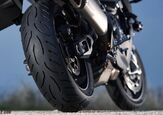
The front DRC consists of a single compound in which silica is a component (for quick warm-up and wet traction) not used in the rear tire. Pirelli says the DRC’s profile is more like its WSB tire than the non-Corsa Diablo Rosso. The shoulders of both tires are “nude,” as in no tread, for maximum grip and stability.
The rubber employed in the shoulder area of the rear DRC is borrowed from the SC2 compound used in World Superbike competition where Pirelli is the sole tire supplier. The edges feature “high-dispersion carbon black,” while the more durable center of the rear tire has new resins and plasticizers for durability and optimum balance between wet and dry grip, using what Pirelli describes as “high-resistance differentiated carbon black.”
|
A Tasty Buffet
The “Corsa” in the new Diablo Rosso’s name is Italian for racing, so Pirelli brought us out to the rarely sampled Assen TT Circuit in Holland. We’d ride the historic 2.8-mile track on the new DRCs the day following the World Superbike races, which were some of the most exciting ever seen.
If that wasn’t enough motivation for a good time, the cornucopia of sportbikes laid out on pit lane as a sampler plate surely was. Given the morning’s cool and dampish conditions, I reached first for the BMW S1000RR’s keys, hoping its traction control and ABS would bail me out while I learned which way to wobble around this fast and flowing racetrack.
Pirelli showed a lot of confidence in its new tires by letting a bunch of caffeine- and adrenaline-fueled journalists out on the track without the benefit of tire warmers or track-specific tire pressures. Also worthy of note is that just one bike hit the ground (a gentle lowside in the third corner of a warm-up lap – nice to finally pass you, Steve-O!) during a full day of non-stop riding.
It only took a couple of corners to ascertain the Diablo Rosso Corsa steers quicker than the Metzeler Sportec M5 we recently tested, allowing the Beemer to feel more agile. And it took just one blast down the front straight and scrubbing speed into Turn 1 to be thankful for anti-lock brakes, which could be felt pulsing over wet patches.
Next to feel the wrath of my WSB-level throttle hand (Ha!) was a Yamaha R1, a bike that didn’t make the cut into our 2010 Literbike Shootout because of its relatively low power-to-weight ratio.
Out on the Assen TT circuit equipped with Pirelli’s DRC, the R1 provided cooperative turn-in response, and mid-corner feedback is direct, feeling stable and precise through the 2.5km of 0-degree steel cord in each tire. Acceleration grip is plentiful, as the R1’s front end rose off the ground several times while on the gas still leaned over. It only took a couple of laps before I was decking the R1’s pegs in multiple corners, so the tire’s SC2 compound obviously has potent edge grip.
Pirelli’s marketing crew suggested to us that the Diablo Rosso Corsas deliver to the ground 10 hp more than other tires in this segment, offering as evidence the amount of distance gained through corners. It seemed a bit hyperbolic to me, but there’s no doubt the DRC’s can scamper around a racetrack.
|
| World Superbike Rubber | ||||||||||
|
As the spec tire in World Superbike competition, Pirelli reaps a lot of R&D feedback from some of the fastest racers in the world. It’s also a massive endeavor, as some 5000 tires are brought to each race. Here’s a few more quick hits of info from Pirelli’s racing arm.
|
After lunch, we were again sent out on unwarmed, unscrubbed tires, but this time I had Pirelli reduce pressures to a more track-appropriate 30 psi front, 32 rear. The bike of choice this time around was Honda’s CBR1000RR equipped with C-ABS.
The lower tire pressures helped the rubber quickly come up to temperature, as I was dragging knee before the first lap was complete. Not long after, my ears were greeted by the satisfying sound of footpegs skimming the track surface.
Again, the DRCs feel neutral with no surprises, allowing the rider to look for opportunities to shave lap times instead of wondering how the bike’s going to behave in the next corner. At this point I became convinced the DRCs are better than the Corsa 3s, which was Pirelli’s primary mission.
With my literbike hunger sated, I decided to ride a Kawasaki ZX-6R to test the 180mm DRC, one of four sizes available for rear wheels ($249 to $346 MSRP). A 120/70-17 is the only front DRC offered ($205 MSRP).
The 180/55/17 proved flickable, neutral and confidence inspiring on the Ninja. It also demonstrated that I don’t have enough talent to continuously ride a literbike to its limits, as I felt like I went at least as quickly as I did on the more powerful machines.
The tracks of this train of thought led me to this final one: For a rider of my speed, it’s difficult to make a case for a full-race rubber if only riding trackdays and canyons.
So if you’re not regularly grinding footpegs, you don’t need anything more grippy than the Diablo Rosso Corsa. Be honest with yourself: How fast are you, really?
|
Realted Reading
EICMA 2009: Pirelli Diablo Rosso Corsa
Pirelli Angel ST Tire Review
Pirelli Night Dragon Tire Review
Night Dragon Tire Tour of North America
Pirelli's Red Devil
Metzeler Sportec M5 Review
Metzeler Roadtec Z6 Interact Tire Review
Michelin Power One Tire Review
Michelin Pilot Power 2CT Tire Review
Michelin Pilot Power 2CT
Dunlop Roadsmart Tire Review