


2026 KTM 1390 Super Adventure R Review – First Ride

If you’re willing, it’ll take you there

This past week, I had the chance to indulge in excess atop the new KTM 1390 Super Adventure R, Team Orange’s long-legged beast which now boasts more power, a stiffer chassis, revised bodywork, and double the miles to service intervals. All welcome attributes, while maintaining its long-haul legs and off-road prowess. Why? Because more is more according to KTM (and every editor that has stroked a keyboard for this very website). In the U.S.A., we like big horsepower and torque numbers and salivate as they increase. We love flash and panache. And we love a good deal. I speak, of course, of the national “we.” And if that’s you, you might be intrigued by KTM's big burly 1390 Super Adventure R.
2026 KTM 1390 Super Adventure R
KTM strengthens its grasp on the pointy end of the off-road open-class ADV segment, bringing more performance and tech, while simultaneously becoming a bargain in the class — even after paying extra for software.
Highs
- Plenty of usable power on tap via your right wrist
- Composed, nimble chassis
- Advanced rider aids
Sighs
- Electronic gremlins lurking in the background
- Sticky starter buttons
- Polarizing facial features
VIDEO: 2026 KTM 1390 Super Adventure R Review
I’m going through changes…
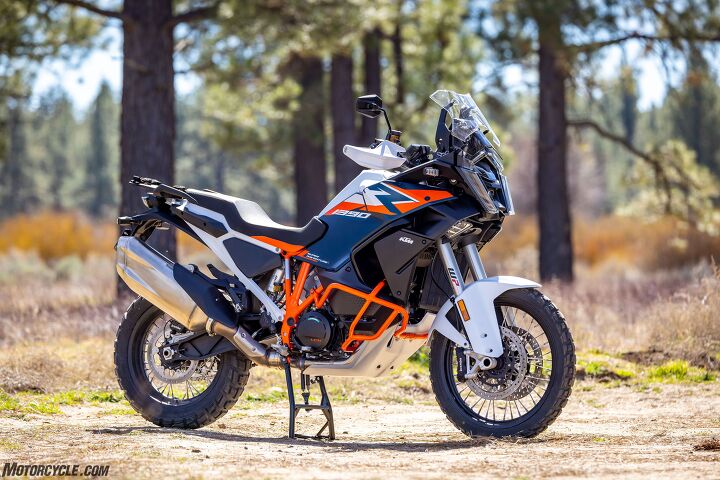
There’s quite a bit to cover regarding what’s new with the KTM 1390 Super Adventure R as a whole, but let’s start with that big ol’ 4.3-inch-piston-pounding 1,350cc V-Twin engine nestled under a low-slung 6.1-gallon fuel tank. KTM bored the LC8 V-Twin out by an extra 2mm achieving displacement with a 110mm bore and 71mm stroke. But they didn’t just hog the mill out and send it down the production line. The SA-R is now breathing through larger 60mm throttle bodies which are also nearly a half inch shorter in addition to the larger diameter intake, increasing air speed for sportier engine character. Moving into the cylinder head, a particularly nice update is a new valve seat alloy that reduces thermal conductivity (reducing heat) allowing KTM to double the valve service intervals from 18,641 miles to 37,282.

The Austrians have also brought “Camshift” technology — introduced on the 2024 Super Duke R EVO — to the SA-R, providing optimized torque at low rpm with higher peak performance in the top end of the rev range, in addition to better fuel economy and lower emissions. The change in intake cam profile (which happens within milliseconds) is done by an electronic actuator around 5,500 to 6,500 rpm depending on gear and rpm build up. When the switch is made, the second profile offers more cam lift and opening duration to increase air and fuel intake at higher rpm. Rounding out the updates, KTM claims a 1.5 hp increase from new connecting rods, a redesigned water pump, and reduced internal pressure alone. Peak horses hit a claimed 173 at 9,500 rpm and 107 lb-ft of torque at 8,000 rpm. After our good friends at Rottweiler Performance were willing to give the 1390 Super Adventure R a spin on the dyno, we measured 151.8 hp at 9,200 rpm and 96.6 lb-ft. at 8,000 rpm. The increase in horsepower was enough to impress Chris Parker, KTM aftermarket manufacturer and owner of Rottweiler Performance, into stating after the first run, “I would trade in my 2022 1290 for that,” pointing to the graph.

Expanding out from the SA-R’s beating heart, it is cloaked in KTM’s three-piece low-slung fuel tank design that holds 6.1 gallons of petrol low on the bike which lends to a massive improvement in handling by keeping the center of gravity as low as possible. It also uses an electronically activated closure that works with a key fob proximity sensor.

The frame has undergone significant changes with engineered flex character becoming stiffer in every regard: 13% longitudinally, 23% laterally, and 73% torsionally. This was achieved through wall thickness and tube diameter of the frame. WP XPLOR suspension components once again make an appearance on the SA-R with the fork and shock offering up 9.4 inches of travel. The fork’s compression, rebound, and preload can all be adjusted by hand without tools, while the shock’s high- and low-speed compression and rebound require a socket and screwdriver. Thankfully, a well-placed hole is drilled through the swingarm, making rebound adjustments easy. Shock preload is adjustable via a knob by hand.

Brembo components are used throughout the braking system with dual 320mm rotors up front and a 267mm disc in the back. A new master cylinder also makes an appearance for the front brake while a Brembo clutch master cylinder replaces the previously used Magura unit. A tubeless 21/18-inch wheel combo is shod in Dunlop Trailmax Raid rubber — a 40/60 offering giving a hint of the Super Adventure R’s intentions.
And then we have the electronics. Strap in.
Via a vertical 8-inch TFT display, riders can choose to use the touchscreen to navigate menus or the new handlebar switch clusters. The display features an anti-glare coating and is extremely vivid with a 1280x720 resolution and 256,000 colors, KTM tells us. The menu is also customizable in terms of how much room certain info takes up. Perhaps one of the most interesting features to use with the adaptable screen real estate is the built-in navigation powered by Mapbox (also used by the VW Group).

The map navigation built into the display now houses 32gb of internal storage to download regions and use offline nav for the downloaded regions. Digging into the system, it appears the whole of the U.S. could be downloaded for 16.3gb of a usable storage capacity of 18.3gb. You do need to connect to wifi in order to download maps or to use the live traffic feature within the system, which requires a constant wifi connection to your phone. The feature worked flawlessly during our limited time with the unit. The 1390 Super Adventure R also uses an eSIM for over-the-air software updates.
Moving back to the switchgears, the left side features a customizable paddle button that can be set to a handful of different functions, while the cruise control – of which the adaptive variant can be had as an option – paddle can be used to switch TC when the bike is in the optional Rally mode. The switchgears are also backlit.

IMU-assisted ride modes are available in the following configurations:
- Street: Full power, standard throttle, normal MTC and ABS, allowing for some front wheel lift
- Sport: Full power, direct throttle, slight rear wheel spin, ABS intervenes later, more front wheel lift
- Rain: Reduced power (100hp), smooth throttle, maximum TC, Street ABS, no front wheel lift
- Off-Road: Reduced power (100hp), smooth throttle, reduced TC for more rear wheel slip, rear ABS off while front is reduced and corner sensitivity is disengaged, front wheel lift allowed
- Custom: Each mode can be set by the rider for TC, ABS, EBC and is saved
- Rally (optional): Full power, selectable throttle (four options), on-the-fly adjustable TC (0-9), rear ABS disabled while being reduced on the front and corner sensitivity is disengaged, wheel lift allowed, cruise control is deactivated

As we have said for some time now with KTM, the $960 Tech Pack is going to be worth popping for the extra features. This unlocks the Rally Pack, Quickshifter+ (up/down), Motor Slip Regulation (MSR), Hill Hold Control (HHC), and five levels of Engine Brake Control (EBC). This really gives you full access to features that take the bike to the next level. We’re not fans of a pay to play system, but this is the reality. And despite the risk of “KTM apologist” comments, at $22,609 ($21,649 MSRP + $960 Tech Pack), the KTM is the cheapest of the top end of the open-class segment.
Styling? You either love it or hate it, and while I’m of the former, there are a few updates worth mentioning that go beyond aesthetics. The bodywork and fans have been redesigned to push heat away from the rider more effectively. Obviously, we have a new headlight design with cornering lights integrated higher in the upper fairing. The windscreen is also lower, while offering up 2.75 inches of adjustment. A larger phone storage compartment is found on the front of the fuel tank while a tool storage compartment is tucked away under the seat.

Ergonomically, the handlebar is 1.18 inches wider with a rubber bar mount to reduce vibration. New beefier handguards are also equipped. Moving down to the footpegs, they’re lower by a little more than a quarter inch while being 0.4 inches wider from the bike. For more adjustment, a PowerParts option is available. The new seat is said to reduce “boot hooking” and sits at 34.6 inches.
Well, I’d say it’s about time to talk about the ride!
Pivoting plans and turns
KTM invited us south of the border to beautiful Baja California to ride this new behemoth… and then a cartel leader was killed and, according to the media, all hell broke loose. While reports from locals in the country were not nearly as dramatic, KTM North America chose to explore our local Southern California desert instead of risking losing any soft-handed moto-journos in Mexico. So, we convened at the shiny new KTM headquarters in Murrietta, CA before making our way into the San Jacinto Mountains and eventually to the desert floor near Joshua Tree.

KTM’s open-class adventure bikes have always been a balance of strong, powerful engines and willing chassis, allowing those brave enough to push the limits to explore the maximum potential that these 500+ pound bikes are capable of, which is truly impressive when it comes to upping the ante off-road. It’s a proposition those willing to bargain for will be rewarded by a machine that handles far better than it should, with mechanical and electronic engineering that goes a long way to make the experience work for hardcore off-road enthusiasts, or folks looking to tour every kind of terrain on their way across the globe.
It’s easy to expect a 1,350cc V-Twin to steal the spotlight, and it is a star, don’t get me wrong, but it’s one piece in a concoction that delivers a stellar experience. KTM’s V-Twins in the last decade have been very smooth. With an 1190 Adventure R in my garage, I remember riding a similar sized Italian V-Twin during my first international press launch with MO. I sat around the lunch table waiting for the seasoned journos to call the bike out for its lurchy power delivery. Those comments never came. So, I broached the subject, and I was met with excuses citing “Italian charm,” or “Desmo character,” none of which I was buying, because the machine in my garage was infinitely smoother. That lineage carries on to the LC8 motor powering the SA-R. It can be as rowdy as you want it to be, but at the same time, the buff V-Twin can sit in the background as you cruise down the road waiting to knock out a few twisties with vigor.

When the going gets loose though, the chassis takes the limelight. Between the tank and stiffness of the frame, the Super Adventure R remains composed and focused more than any open-class off-road machine that I’ve tested. Thanks to the fuel tank and chassis design, the SA-R feels as lithe on its feet as a middleweight. Inputs to the wide bar or even weighting the pegs in tight trails immediately elicits a reaction. So much so that I had to get used to how quickly the machine would respond to inputs. The wide bar and updated footpegs give you four solid points of contact as you nudge your knee into the tank to smooth things out. The WP suspension, as should come as no surprise, is very well adept at handling the rigors of off-road riding despite the heft of the machine. Sure, you get some dive on-road, but it’s controlled and the experience off-road is well worth a bit of finesse to keep things controlled on the tarmac. The confidence in which the SA-R can plow through rocky terrain is very much indebted to the suspension at both ends.
This was the first time I had a chance to sample the Dunlop Trailmax Raid tires, and I was stoked to see them fitted to our bikes, since EU models come equipped with Bridgestone Battlax AT41 tires. I later learned that U.S. bikes come stock with the Dunlops instead. I can admit that early in the ride I was taking my time getting used to them on road given the power on tap, but after getting into some two track trails, letting the bike get loose, and feeling how the chassis behaved, I was ready to give ’em the full tarmac test as we blazed down mountain roads to the desert floor. Everything was predictable off-road from braking front and rear, to traction when the front started to push. With the tires and the big bike geometry, gathering things back into line was never a problem. I felt comfortable on-road or off-road on the Dunlop rubber.

The braking system off-road surprised me by how much trust I could give it, which reminded me of the proliferation of ABS in general. With Euro5+ regs, the front ABS can no longer be disabled, so it’s always on, but it’s reigned in Off-Road ABS and corner sensitivity is shut off. These systems have gotten so good over the past decade that I am very happy to have it as-is. Feel at the lever is precise and you don’t get the pulsing that you once would. It’s just solid brake feel. On the road, it's the same thing, you get the same lever feel and can dial in the brake pressure smoothly, which was important to me on these new (to me) tires as we ripped down the mountain.

Anyone who buys a machine like this and doesn’t take advantage of the electronics is doing themselves a disservice. Whether it be switching ride modes for situations, TC for off-road scenarios, or simply using hill hold on an incline, this is the spaceship that can literally take you anywhere that you’re willing — and you can tailor it in a way that it will help you get there, or it will help you shred your tires like a maniac on your way. New tech like Dynamic Slip even has your back in situations where you, for example, come into some deep sand off of a hard packed road. There’s no need to bang down the TC with your paddle shifter. “When in doubt, throttle out,” applies here, because as you “ask” for more power, despite being in a high TC level, the system will drop it down in the background and give you that extra spin that you’re requesting from the throttle. And it works quite well. Would I want it for hooning around in the desert? No, I want to know exactly what I’m doing when burning up someone else's tires. If I were on an actual ADV tour, I’d definitely take advantage of the tech.

I do have to point out that, during our press ride on what I’m told were pre-production machines, we did have some issues here and there. There were a few electronic gremlins that seemed to crop up, like the paddle buttons not working or the screen showing a “Body Control Unit Error” now and then. And it wasn’t isolated to one bike, this was happening with a few of the machines. We also noticed the starter button sticking in the starter position which would allow you to start like normal, but would cause some weird issues if you were to stall and then pull the clutch back in, like, it restarting automatically. I’ve noticed the unit that I was able to spend some more time with has the same issues, and I now make sure to push the paddle starter/kill switch combo back into position after starting it. If I were spending $22k on the bike, I wouldn’t be happy. I do have to say, the mechanics on our ride worked diligently into the night recording feedback and diagnosing the bikes to send their findings back to Austria to ensure these issues are handled for customers. And I hope for everyone’s sake, they are.

The KTM 1390 Super Adventure R continues to push boundaries at the pointy end of the off-road spectrum, but it’s well-suited enough to be absolutely at home as a long-haul tourer splitting days between dirt and pavement. It handles better than it ever has, while delivering more performance in a more sophisticated chassis. I think back to what Chris from Rottweiler Performance said as a 1290 SA-R owner after our first dyno pull, “Yep, I’d buy that.” If you have the scratch and you’re interested in this machine, the orange juice just might be worth the squeeze.
Scorecard
Engine | 19/20 | Suspension | 14/15 | Transmission | 9/10 |
Brakes | 9/10 | Instruments | 4/5 | Ergonomics | 9/10 |
Appearance | 9/10 | Desirability | 9/10 | Value | 9/10 |
Editors Score: 91.5% | |||||
In Gear

- Helmet: HJC i80
- Jacket: Tourmaster ADV Lite
- Pants: Tourmaster ADV Lite
- Gloves: Racer Mickey
- Boots: Sidi Atojo SRS
2026 KTM 1390 Super Adventure R Specifications | |
|---|---|
MSRP | Starting at $21,649 |
Engine Type | Liquid-cooled, four-stroke, 75° V-Twin, DOHC with 4 valves per cylinder and camshift variable valve timing |
Displacement | 1350cc |
Bore x Stroke | 71.0 mm x 110.0 mm |
Compression Ratio | 13:1 |
Transmission | 6 speed, claw shift |
Clutch | Multi-disc wet clutch / hydraulically activated |
Final Drive Ratio | 17:42 |
Fuel System | Electronic fuel injection |
Ignition / Engine Management | Keihin EMS with Ride-by-Wire and cruise control, double ignition |
Frame | Chrome-moly tubular lattice frame, powder-coated |
Front Suspension | WP XPLOR 5548 with adjustable compression, rebound, and preload, 8.7 inches of travel |
Rear Suspension | WP XPLOR 5746 with adjustable compression (high and low speed), rebound, and preload, 8.8 inches of travel |
Front Brake | 2 x Brembo four piston, radially mounted caliper, 320mm discs |
Rear Brake | Brembo twin-piston floating calliper, 267 mm brake disc |
ABS | Cornering ABS and off-road mode |
Front Wheel | Wire spoke, 2.5x21" |
Rear Wheel | Wire spoke, 4.25x18" |
Front Tire | Dunlop Trailmax Raid 90/90 ZR 21 54T Tubeless |
Rear Tire | Dunlop Trailmax Raid 150/70 ZR 18 70T Tubeless |
Rake / Trail | 25.2° / 4.4 inches |
Wheelbase | 62.1 inches |
Ground Clearance | 9.5 inches |
Seat Height | 34.7 inches |
Fuel Capacity | 6.1 gallons |
Weight | 547 pounds (claimed) |
2026 KTM 1390 Super Adventure R Review Gallery

We are committed to finding, researching, and recommending the best products. We earn commissions from purchases you make using the retail links in our product reviews. Learn more about how this works.
Become a Motorcycle.com insider. Get the latest motorcycle news first by subscribing to our newsletter here.
Ryan’s time in the motorcycle industry has revolved around sales and marketing prior to landing a gig at Motorcycle.com. An avid motorcyclist, interested in all shapes, sizes, and colors of motorized two-wheeled vehicles, Ryan brings a young, passionate enthusiasm to the digital pages of MO.
More by Ryan Adams








Comments
Join the conversation
If the tech pack is so essential, and I don't doubt that it is, then it should be included. If 22,600 dollars is a fair price, it should just be the price! They need to stop playing games and commit to the price that the whole motorcycle actually costs, it's not that big of a deal... But trying to slip extra expenses into the price for things that are already on the bike is just gross. Great bike, bad deal.
Shopping this class and hearing the electrical gremlins ruins the idea of even looking at this bike. I need something I can take across country and even up to Alaska and back. All the power and cool farkles mean squat if I cant trust that it will behave right and be reliable.