Has this happened to you? I know it's happened to me. I have this recurring nightmare: I'm riding the fastest, most powerful, best-handling sportbike I've ever owned up a gnarly, twisted mountain road. I'm braking late and getting on the gas early. I'm wearing leathers and my kneepucks are lightly tapping the ground in the corners. My wrists ache and my knees are straining, but it's worth it because I'm going fast as heck. I'm on a vehicle that is purpose-built to do one thing and one thing only -- go as fast as possible on pavement.
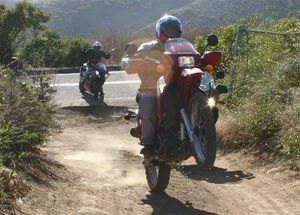
I'm not looking in my mirrors, because there's nothing in them but blurry elbows, but if I did, I would see a crusty old guy wearing moto-cross boots and an even crustier old Bell helmet with goggles, astride a monstrosity of a motorcycle, a dirty, banged-up dual sport, rolling on skinny tires and making all of 32 bhp. He's gaining on me, and then, with almost no warning aside from a whirring sound not unlike a Huey helicopter, he is past me, pushing the bike into the next bend as he disappears from view. The guy looks like he's barely awake, much less breaking a sweat.
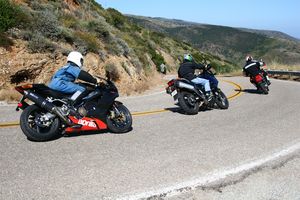
In April, contributor Fred Rau wrote an insightful essay putting into words what few motorcycle publications like to discuss: a skilled rider on a slow bike can go much faster, in the real world, than a less-skilled rider on better machinery. But what kind of bike suits which riders, on which roads, and why?
There's only one way to figure it out: get a few totally unrelated motorcycles, break out the MO charge card and ride around some of the sweetest roads in the LA area to find out what happens when an old dual sport, an exotic Italian, and a goofy-looking I-Don't Know-What-the-Hell-That-Is walk into a bar.
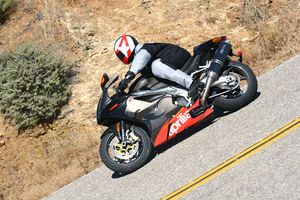
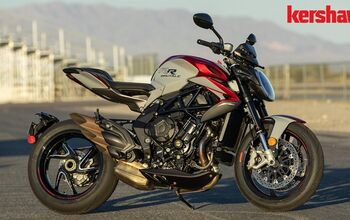
First up on our reality show is the hot Italian supermodel, the 2004 RSV 1000 R. First introduced in 2003, the Mille R is a focused and hardcore sportbike. The ergonomics are compact, with low clip-ons and extremely high footpegs. The seat is hard and flat, with a vestigial passenger seat.
This thoroughly modern Mille is equipped with all the best hardware you'd expect on a $14,000 Italian race replica. Up front is a pair of four-piston, radial-mounted calipers bolted to a 43mm inverted Showa fork. On the other end of the beautifully welded aluminum frame is a "banana" style swingarm that looks like it could have been lifted off of Aprilia's Moto GP bike. Like everything Aprilia builds, the RSV 1000 R has slick and flawless build quality, reminiscent of ordering a cheeseburger at a high-end restaurant: it's the same basic recipe as a diner's, but the preparation, presentation, and execution are so good that the lowly cheeseburger is elevated to a memorable affair.
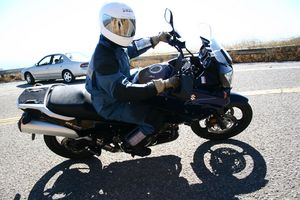
Our next contestant is also visiting us for our upcoming Adventure Tour shootout, and is another motorcycle that wouldn't have existed 10 years ago, at least not in this country. Introduced in 2002, our own John Burns reviewed the Suzuki V Strom for us and told us all about what makes Lil' Suzy Wee Strom tick. To spare you Burnsie's stream-of-consciousness musings, I can recap the highlights.
The V-Strom uses a pair of old-tech, two-piston, sliding-pin calipers bolted to a pair of 43 mm cartridge forks with plenty of travel. It's all led on its merry way by a 19-inch front wheel riding on a 110/80-19 Bridgestone Trailwing. This connects to the back 150/70-17 rear Trailwing via an aluminum frame and swingarm suspiciously reminiscent of the SV 1000.
The motor is a 996cc 90-degree "L" twin derived from the TL 1000 S, but with smaller valves and different fuel injection... the good ol' "tuned for torque" routine. It's still good for 91 HP and 60 foot-pounds of torque (2002 model): good enough to get you going as fast as you could want.
All bolted together, we come up with a vehicle that looks bigger and heavier than it is: the V-Storm has a *claimed* dry weight of just 458 pounds, and even though the little windscreen is way out in front of the rider, the V-Strom still doesn't seem overly ponderous or big once you're in the saddle.
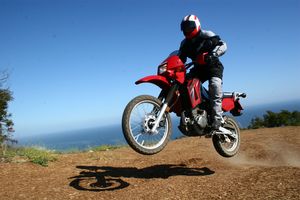
What makes it so good? If first impressions are lasting, the KLR is in trouble. Build quality and styling are more Mainland China than the swoopy V-Strom's Euro-looks, with clunky plastic, silver-painted steel and a very industrial-looking powerplant suspended under the Reagan-era bodywork. There's a tiny front brake with a single-piston caliper bolted to a 38mm air-adjustable fork.
Air-adjustable? Yes, my boy, back in the old days we used to have little valve caps on top of our forks to adjust preload. It sort of works, too. Just don't hook up the air line at the gas station to them to see what will happen, unless you want to hear your fork seals go "pow". Don't ask me how I know this.
The rear Unitrak shock is adjustable (with a ramped collar, thanks) for both preload and even rebound damping. It holds up a steel swingarm and 130/80-17 rear tire on a spoked wheel, matching the front 90/90-21-shod wheel. But the advantage to all this low tech is a light 337 pound *claimed* dry weight.
The motor is a buzzy, thumpy history lesson in liquid-cooled four-stroke singles. There's no fancy fuel injection or automatic fast idle here: a 40mm carburetor does all the work of feeding the four-valve, dual overhead cam 651cc single. At least there's electric start as a concession to modernity. A small windscreen, spacious saddle and large luggage rack are included for your comfort and convenience
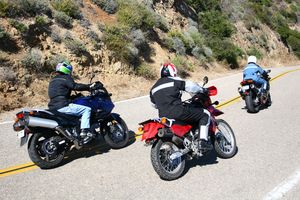
So I've described three dissimilar motorcycles we have here in the MO garage: so what? We chose these three bikes because they represent two totally opposite approaches to having fun while riding fast on a twisty road.
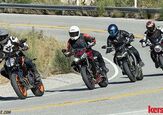
The first approach is what I will term the "holistic" one. "Holistic Sportbiking" is an almost ceremonial affair, with image and appearance being paramount. On our ride up the Angeles Crest highway, we saw a couple of acolytes of the Holistic Church of the Sportbike. They were both riding the preferred vessel, the GSX-R, with rear fenders ceremonially chopped, and dressed in baggy, spotless one-piece leathers and pristine, unscuffed knee sliders.
Holistic sportbiking is an activity performed infrequently and often in large groups. Only the most high-tech, class-leading motorcycles are acceptable. Great amounts of thought, time, energy and money are placed into improving power, brakes, suspension and appearance. In practice, these motorcycles rarely see the racetrack, but instead are ridden on carefully selected two-lane roads somewhere near the speed limit. Much time is spent at rest stops comparing tires, suspension and other esoterica.
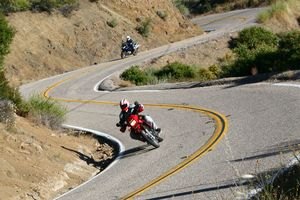
Practical sportbiking involves long, 250 mile or longer Sundays spent on a variety of roads. Any line on the map is acceptable, as long as it's not an interstate. When the pavement disappears or is impossibly broken these practical riders don't even flinch.
Therefore, a practical bike must have a comfortable seating position, decent wind protection, good fuel range and suspension with sufficient travel to handle a wide variety of pavement. In the last five years, a number of bikes have appeared to satisfy these requirements, with the famous BMW GS series spearheading.
The V Strom and the KLR represent two different ways to get this combination of features. The V Strom has a lot more heft than the stone-axe KLR, but compensates with a burlier engine and much more sophisticated suspension. The KLR offers its light weight and flexible, un-intimidating engine to get from point A to B the fastest.
We all know the Mille makes the most power and would doubtless be fastest on the racetrack. But for the kind of riding most of our readers here in the Land of the Free (that is, free except for riding as fast as you want), which bike gets you from here to there with the least effort, regardless of the type of road? Is the old cliché about dual-sports and an upright seating position accurate, or is it hype from broken old men justifying their purchase of dowdy equipment?
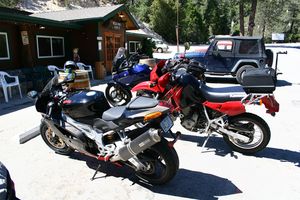
We spent two days riding these three bikes. On the first day we rode among the canyons of the Santa Monica Mountains. Here, the roads are characteristically tight and twisty, with limited sight lines, large elevation changes, and bumpy pavement. On the second day we rode in the Angeles National Forest, with roads that are also bumpy, but with greater sightlines and gentler, higher speed curves.
How many times have you read something like, "this (insert hard-core sportbike here) would be a great bike to have if you lived at the base of a twisty canyon road" in a sportbike review? We read as many magazines as anybody, so we put the theory to the test. We had perfect weather, great road conditions, light mid-week traffic, and a wonderful, Italian V-Twin sportbike to ride.
We switched bikes frequently during the days, so we could be sure we experienced each bike in all kinds of road surfaces and corner types. After a long traffic jam on the Pacific Coast Highway, we turned up one of the canyon roads towards Mulholland drive.
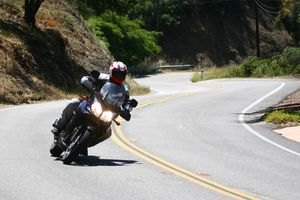
It was worth the wait. With wide, high bars, low footpegs and a very soft seat, the V-Strom greets you like a 90 HP easy chair. "The V-Strom combines the Aprilia's grunt with the KLR's ergonomics and wraps it all together in a smooth and refined package that's well suited to long days of terrorizing your favorite back road", says Publisher "Dirty" Alexander.

Motorcycle.com presents an unrivaled combination of bike reviews and news written by industry experts
More by Motorcycle.com Staff

Comments
Join the conversation