


You want a big cruiser but you don't need a large 1500 cc behemoth that weighs close to half-a-ton fully loaded. You want something you can cruise down the boulevard on but you want to be able to handle a corner or two. You want classic styling but you insist on reliability as well. If these are your guidelines, then Honda and Yamaha might have what you're looking for in the guise of the Honda Shadow American Classic Edition and Yamaha V-Star 1100. The ACE and V-Star have a few things in common: Both sport requisite V-twin powerplants (75° for the V-Star and 45° for the ACE) and both possess typical Japanese refinement. Aside from these similarities, the two rides are very different machines.
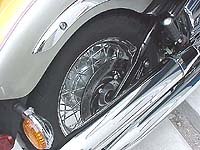
While both machines are shaft driven, the ACE uses the shaft housing as the swingarm. Although this arrangement is effective, it's a bit lacking style-wise. However, the whitewall tires and the classic fenders
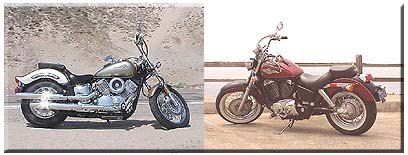
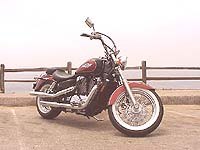
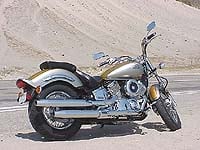
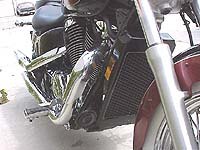
The exhaust pipes on both machines were covered in chromed sheet metal. While the majority of this bright work looked oh-so-fine, there were certain areas that seemed to a certain extent tacky, notably at the cylinders heads.
After mounting each bike we proceeded to look for the ignition switches. The V-Star placed the switch on the right side, right behind the steering column. The V-Star ignition switch also has an integrated fork lock for added security. The ACE has the switch behind the rider's left leg, camouflaged in a chrome cover. The fork lock for the ACE is located separately underneath the triple clamps.
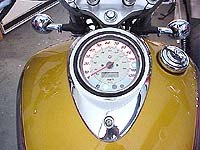
We then noticed the tank-mounted speedo on the V-Star. As one editor stated, "it's gorgeous".
The traditional and utilitarian ACE speedo, mounted on the handlebars, suffered a bit by comparison and looked as if it were an afterthought, something forgotten by a haphazard engineer. Both rides also had lengths of clutch and other cabling emanating from the grips. However on the ACE it looked more like insect antennae. The V-Star at least clipped the groups of cable together, making a somewhat neater package.
The ACE is water-cooled. Those wonderful cylinder fins are primarily ornamental, although they probably do reduce engine temperature since the radiator fan would engage only momentarily after the bike was stationary after a brisk ride. The V-Star on the other hand is completely air-cooled. Both bikes started right away. The V-Star responded immediately to throttle input, but the ACE bogged down when throttle was initially applied, however after a few minutes of relaxed riding the ACE had the necessary warm-up time to smoothly respond to throttle changes.
"Merging onto the freeway we realized that these twins share one more attribute: These bikes got some giddy-up."
They're not sport bikes, definitely, but they did have enough acceleration for all our merging and, more importantly, passing requirements. And very well they should.
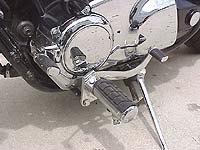
Accelerating and shifting were easy. The ACE implements a heel-toe shift lever, while the V-Star uses a standard shifter. Both used five-speed transmissions that performed without flaw. At speed we noticed the ACE produced considerable amounts of buzzing in the footpegs and seat area. This became extremely uncomfortable after a few minutes down the road but only occurred at highway speeds and is probably due to its single-pinned crank. The V-Star, on the other hand, felt much smoother. Thankfully not much of anything could be felt through the bars of either machines because they both have rubber mounted handlebars.
As we began to hit traffic, we realized a very important thing: Three brake disks are better than two! The V-Star has two 298mm disks up front each bound by a two-piston caliper and a 282mm disk in the back with a single piston caliper. These babies really do help the V-Star slow down all 580 lbs of metal at speed.
The ACE on the other hand, with its single 316mm disk in the front with a two-piston caliper and 276mm disk in the back also bound by a single piston caliper, felt vague and needed more input.

Motorcycle.com presents an unrivaled combination of bike reviews and news written by industry experts
More by Motorcycle.com Staff




Comments
Join the conversation