Choose Your Weapon: Best of the Best, 2006 - Motorcycle.com

What's the best sandwich?
Even that question is hard to answer and could probably spark endless discussion. Best sandwich for whom? What if you're vegetarian? What if you keep kosher? On a low-carb diet? Grilled or cold? Where do we begin?
Let's roll! It's Best of the Best time!So think how hard it is to answer the question of "what's the best sportbike?" Not only is it hard to answer, but you are guaranteed to make somebody unhappy with your response.
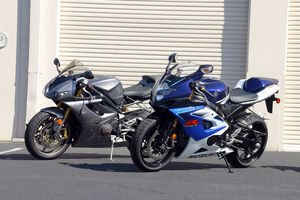
Since our first "Best of the Best" comparison in 1998, we've compared plenty of bikes, always looking for the one with the most appeal to our test riders, regardless of category or displacement. Last year's test simply pitted the best open-classer against the best middleweight sportbike out there, and we were as surprised as anyone at the results; we thought the 2005 Yamaha R6 had the best blend of power, handling and control, besting the mighty and feared Suzuki GSXR-1000.
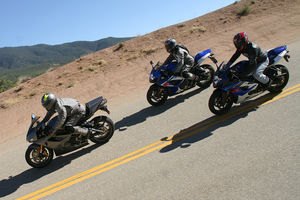
So which will come out on top? Is it the fancy new three-cylinder middleweight? Or is it the power-to-weight-ratio king? Or will the best blend of the two prove to be the one bike to have when you can't have more than one?
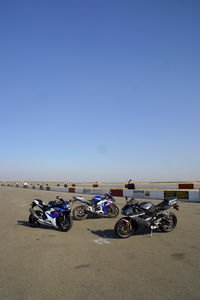
What to do? Call Ole! Ole, again, with great generosity, agreed to come on the street ride and track day with us. However, we still needed a fast guy to get impressions from. A phone call to Lee Parks, motojournalist, inventor, author, instructor and dog owner got him out of his High Desert hiding hole. Of course, we know we'll have our two grizzled veteran editors Gabe Ets-Hokin and Pete Brissette to fill in the middle. Photographer and Executive Editor Alfonse Palaima would shepherd the whole crew along.
Meet our Testers
Lee "It's Not My Fault I'm Better" Parks
190 Pounds, 5'9", 37 years old, Favorite Barbecued Meat: Baby back ribs with Memphis-style dry rub
A self-proclaimed motorcycling icon, Lee is a legend in his own mind. The glove-making, book-writing, riding-school-teaching miscreant actually managed to win a WERA National Endurance Championship in between stints in the witness relocation program. A big fan of lightweight, small-displacement race bikes, he has raced 125s, 250s, 400s and 650 twins, as well as 750s and open bikes both domestically and abroad. He claims to not be a control freak but the title of his best-selling book suggests otherwise.
Ole "Can I Ride My Bike Now?" Holter
How could anybody toss a perfectly good Iron Butterfly album out the window of their car? Savages! 195 lbs, 6'3", 42 yrs, Favorite Barbequed Meat: Roasted Subaru Boxer Engine
Ole (say "Ol-ee") has been broken in to the rigors of MO editorial testing and has years of motorcycle riding and engineering experience to draw on. Plus, he owns the bike we needed for the test. Ole is a good, solid rider who is either very well-medicated or just very well-adjusted, which adds balance to our little crew.
Suzuki GSXR 1000: Even Elvis Couldn't Top the Charts Forever
It's good to be king. There's one nice thing about testing the GSXR-1000; if you say it's the most amazing bike you've ever ridden, not many people will tell you you're wrong. We here voted it best open-class sportbike of 2005 and 2006, and numerous magazines worldwide have followed our lead. Why is pretty much a no-brainer: 161.61 HP at the back wheel in a package that weighs in at a claimed 365 pounds dry and also manages to be relatively civil and easy to ride.
The Suzuki GSX-R 1000 is the result of a total redesign for the 2005 model year.
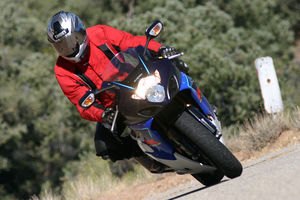
The frame needed to be the same dimensions as the 600 and 750 models that inevitably follow a GSX-R 1000's redesign, so the cast and extruded twin-beam unit is extremely compact. It uses a heavily-braced swingarm and a linkage rear suspension to hold the rear 190/50-17 Bridgestone tire just 55.3 inches from the front wheel, which is suspended from the massive steering head by a pair of fully-adjustable upside down forks.
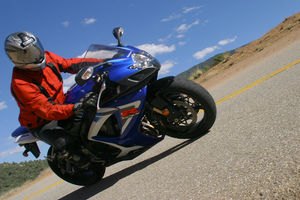
Top-of-the-line components and build quality complete this 365 pounds (claimed) dry weight package. Radial-mount four-piston calipers clamp 310mm front brake discs, powered by a radially-actuated master cylinder. A bleed screw on top is a nice touch that will be appreciated by those who do their own maintenance. The sleek bodywork includes a sexy solo seat cover, all for the paltry asking price of $10,999.
This text is from our 2006 Open Supersports Comparison Test.
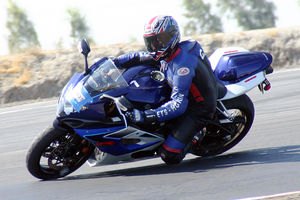
Hopping on the 1000 reveals a pretty comfortable bike. The clip ons are the highest of any of these machines, and the seat is low enough for short-legged Pete and Gabe to comfortably paddle around at stops. Ole even took it a step further, calling the 1000 the "sport tourer of the bunch...a much more comfortable ride." Seat comfort is good enough that nobody complained about it for the 100-mile stints we rode, and the windscreen gives pretty good protection at triple-digit velocities.
Controls and instruments are sportbike standard. The instrument panel is well-placed and easy-to-read. The huge digital speed readout is especially appreciated, as is the prominent analog tachometer. We'd like to see adjustable clutch levers standard on every bike, but what can you do?
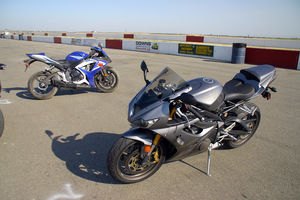
Things just happen quickly on a liter sportbike. Because of all that power, things like four-piston, radial-mount calipers and Brooklyn Bridge-sized frame spars become necessities, not fashion frippery. The GSXR-1000 will shoot you out of a turn and down the straightaway much faster than the fastest middleweight, and do it with a minimal level of engine vibration or drama. However, we just hope you know what you are doing. Things happen very fast on public roads when you're seeing all those numbers on that LCD readout. Ask yourself; do you need this much power for street riding? Why?
The suspension, brakes and chassis are all up to task for street excursions, however, unless you are at a Grand Theft Auto level of law-breaking. As delivered we had no complaints about suspension settings for our street ride,
For the track, Lee said the ergonomics were "perfect", with "good leverage from the bars" and an "all-business" cockpit. Gabe liked the seating position too: "this would be a great place to spend a day at the races", if he could actually make the pace for a day of racing a 750.
The motor is yet another example of techno-wizardry from Suzuki. It fires up with a refined-yet-serious exhaust and intake note and is instantly ready to ride away. The gearbox is "typical Suzuki, shifting like the action of a well-built watch", according to Ole, no doubt aided by the seamless clutch. The gearing is shorter than the 1000's, and the 750 would be a perfect around-town ride if the riding position was more suited to low-speed riding.
Whipping through traffic like the world's fastest 600, the 750 shows off its powerful, yet controllable nature. Steering is razor-sharp, and the brakes are "half-a-finger sensitive", even at high speeds, according to Gabe; the saner velocities produced by the slightly softer (than the 1000) motor and loss of a few pounds makes the 750 feel easier to handle at high speeds whether you're braking, steering or on the gas.
The GSXR-750 is an amazing sportbike, an example of Japanese refinement and attention to detail at its best. The motor is great; Pete noted it had "just enough power to make it very fun and fast, yet not as crazy as the 1000", and Gabe thought it was "so fun to wind the motor out"; the twin balance shafts make it relatively smooth as silk at almost any engine speed. Handling is textbook perfect; like with the SV650, when Suzuki wants a bike to handle, they do it right, with neutral steering that is still fast and responsive.
With such perfection and balance, the Blue Blaster should be a shoe-in to win this, right? Well, apparently not. Although Gabe voted it his favorite, the others did not follow suit, and not just because Gabe refuses to shave his back (he says it gets too itchy). It just lacks the character that the 675 has, and although a racer or hard-core track enthusiast really needs to get one of these, it won't ignite the passion in street guys the way the 675 might. And passion is what brings the checkbooks out, right? We're not corporate purchasing agents, looking for the equipment that best fulfills the contract terms, we're a bunch of nuts who prefer a method of entertainment and transportation that stirs our souls. Not to say the GSXR-750 won't do that if your heart isn't racing when the Gixxer's tach needle swings past 12 grand, then to quote Sinatra, "Jack, you're dead" but it feels a touch sanitized.
Ole remarked it was "damn near perfect" when he wasn't "paying attention to how quickly this thing gets up to speed." Brakes are one-finger sensitive with excellent power at sub-ton velocities. Mile after mile, it's clear this bike is very capable of going much faster than you are. This is intimidating, even to riders of Lee's caliber, who have ridden almost everything and performed every two-wheeled motorcycling activity known to mankind.On the racetrack, riding the GSXR-1000 back-to-back with the smaller, slower bikes revealed problems related to the embarrassment of riches that is 162 rear-wheel horsepower. Even if we had been using trackday or racing-compound rubber, we still would have used the GSXR's fun-stick with a judicious measure of respect. Like last year, that means getting on the gas later and braking sooner at the corner entrances. Sure, you can leave slower bikes in the dust on the longer straights, and it's immensely satisfying, but there's a lot more pressure to stay ahead of the "slower" bikes, as well. It's fun, but not exactly relaxing.
Suspension and braking become issues as well. The massive torque from that motor caused the back end to squat more than the other bikes, prompting editor Ets-Hokin to wonder if the 1000 lacked rebound damping. And where the almost-identical brakes on the other two bikes were more than adequate for racetrack work, the GSXR-1000's stoppers needed more effort
Like last year, the GSXR-1000 came in last place because our testers just couldn't use the incredible advantages that the massive power output provides. It's "like naked freak-dancing with a porcupine", according to editor Ets-Hokin,
Can you really get too much of a good thing?and both Ole and Pete ascribed psychological conditions to the engine's character. Whether you think 160 horsepower in a 400-pound vehicle is "psychotic" or "schizophrenic", being shot out of a corner like a human cannonball is fun for a while, but we don't think it will either translate into a faster overall laptime for most trackday riders, or to becoming a smoother, faster rider on the street.If the test were just evaluating motorcycles on what kind of rush a rider feels riding them, the GSXR-1000 would be a clear winner. But it's a test of what makes the best sportbike of 2006, and to be that, it has to do more than go around corners, stop and accelerate like an ICBM. It also has to have enough user-friendliness so that a wide spectrum of riders -- like our testers -- feel comfortable enjoying those performance advantages.
Compared to these other two bikes, the One K is too much of a handful to invest our tester's money in. We'd rather get something we can dominate, rather than the other way around.
More by MO Staff

Comments
Join the conversation