Choose Your Weapon: Best of the Best, 2006

2006 Suzuki GSXR-1000 v. 2006 GSXR-750 v. 2006 Triumph 675 Daytona

story by MO Staff, Photograph by Fonzie, Created Sep. 26, 2006
BACK TO THE ARTICLE PRINT
What's the best sandwich?

Even that question is hard to answer and could probably spark endless discussion. Best sandwich for whom? What if you're vegetarian? What if you keep kosher? On a low-carb diet? Grilled or cold? Where do we begin?

Let's roll! It's Best of the Best time!

So think how hard it is to answer the question of "what's the best sportbike?" Not only is it hard to answer, but you are guaranteed to make somebody unhappy with your response. Unfortunately for us, this is the place you look for this kind of information, so we have to take a stab at answering it.
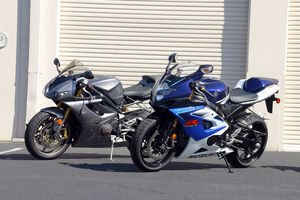
Since our first "Best of the Best" comparison in 1998, we've compared plenty of bikes, always looking for the one with the most appeal to our test riders, regardless of category or displacement. Last year's test simply pitted the best open-classer against the best middleweight sportbike out there, and we were as surprised as anyone at the results; we thought the 2005 Yamaha R6 had the best blend of power, handling and control, besting the mighty and feared Suzuki GSXR-1000.  
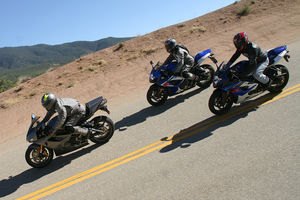
This year, we decided to extend MO's tradition of throwing in a wild card test bike to the Best of the Best. The Suzuki GSXR-1000, winner of our 2006 Open Superbike Shootout brought along a friend, the all-new for 2006 GSXR-750 to see if that coveted MO BOTB trophy could be parked in Suzuki's garage for once. Too bad they're not going to bat against the competent-yet-focused 2006 Yamaha YZF-R6 this year. Instead, they have to lock horns with the small-yet-mighty, competent-yet-soulful, exotic-yet-value-priced Triumph 675 Daytona, an acclaimed bike that didn't just win our Middleweight comparison this year, it's also garnered plenty of acclaim from lesser media outlets as well.

So which will come out on top? Is it the fancy new three-cylinder middleweight? Or is it the power-to-weight-ratio king? Or will the best blend of the two prove to be the one bike to have when you can't have more than one?
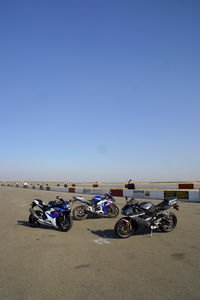
For this year's Best of the Best story, we decided to basically repeat last year's story, but with the addition of an extra rider to match the extra bike. One rider was easy to choose. Ole Holter might be known to you as the guy who generously donated the use of his shiny new 675 for the Middleweight test earlier this year. We wouldn't have invited him, but on the Friday before the test the nice young lady from Triumph rang us up with bad news; the 675 we were supposed to use for the test had been damaged by somebody. Who was it? We can guess, but won't name names.

What to do? Call Ole! Ole, again, with great generosity, agreed to come on the street ride and track day with us. However, we still needed a fast guy to get impressions from. A phone call to Lee Parks, motojournalist, inventor, author, instructor and dog owner got him out of his High Desert hiding hole. Of course, we know we'll have our two grizzled veteran editors Gabe Ets-Hokin and Pete Brissette to fill in the middle. Photographer and Executive Editor Alfonse Palaima would shepherd the whole crew along.


Meet our Testers

Lee "It's Not My Fault I'm Better" Parks
190 Pounds, 5'9", 37 years old, Favorite Barbecued Meat: Baby back ribs with Memphis-style dry rub

A self-proclaimed motorcycling icon, Lee is a legend in his own mind. The glove-making, book-writing, riding-school-teaching miscreant actually managed to win a WERA National Endurance Championship in between stints in the witness relocation program. A big fan of lightweight, small-displacement race bikes, he has raced 125s, 250s, 400s and 650 twins, as well as 750s and open bikes both domestically and abroad. He claims to not be a control freak but the title of his best-selling book suggests otherwise.

Ole "Can I Ride My Bike Now?" Holter
How could anybody toss a perfectly good Iron Butterfly album out the window of their car? Savages! 195 lbs, 6'3", 42 yrs, Favorite Barbequed Meat: Roasted Subaru Boxer Engine

Ole (say "Ol-ee") has been broken in to the rigors of MO editorial testing and has years of motorcycle riding and engineering experience to draw on. Plus, he owns the bike we needed for the test. Ole is a good, solid rider who is either very well-medicated or just very well-adjusted, which adds balance to our little crew.


Suzuki GSXR 1000: Even Elvis Couldn't Top the Charts Forever

It's good to be king. There's one nice thing about testing the GSXR-1000; if you say it's the most amazing bike you've ever ridden, not many people will tell you you're wrong. We here voted it best open-class sportbike of 2005 and 2006, and numerous magazines worldwide have followed our lead. Why is pretty much a no-brainer: 161.61 HP at the back wheel in a package that weighs in at a claimed 365 pounds dry and also manages to be relatively civil and easy to ride.


GSXR1000 tech talk

The Suzuki GSX-R 1000 is the result of a total redesign for the 2005 model year.
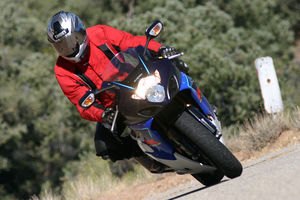
We hope this is the 1000 in this photo... Suzuki's engineers had a goal of making the lightest, fastest, best handling bike they possibly could, while still retaining the rider-friendliness and ease-of-maintenance that a good streetbike requires.

The frame needed to be the same dimensions as the 600 and 750 models that inevitably follow a GSX-R 1000's redesign, so the cast and extruded twin-beam unit is extremely compact. It uses a heavily-braced swingarm and a linkage rear suspension to hold the rear 190/50-17 Bridgestone tire just 55.3 inches from the front wheel, which is suspended from the massive steering head by a pair of fully-adjustable upside down forks.
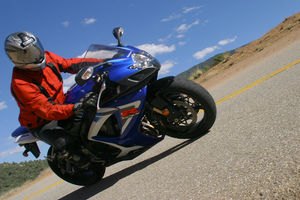
A superbike is all about motor, and the Suzuki doesn't disappoint. It uses a liquid-cooled, inline-four powerplant with four valves per cylinder opened and shut by dual overhead camshafts. Bore and stroke figures are heavily oversquare at 73.4 by 59 mm, compressing fuel and air from the eight 52 mm fuel injectors (two per throttle body) to a 12.5:1 ratio. There's no changes evident from the outside, but something happened inside that motor this year; our dyno run revealed a bike making 161 hp and 81 foot-pounds of torque, compared to last year's bike, which made a mere 158 hp and 78 foot-pounds. How did we stand it?

Top-of-the-line components and build quality complete this 365 pounds (claimed) dry weight package. Radial-mount four-piston calipers clamp 310mm front brake discs, powered by a radially-actuated master cylinder. A bleed screw on top is a nice touch that will be appreciated by those who do their own maintenance. The sleek bodywork includes a sexy solo seat cover, all for the paltry asking price of $10,999.

This text is from our 2006 Open Supersports Comparison Test.
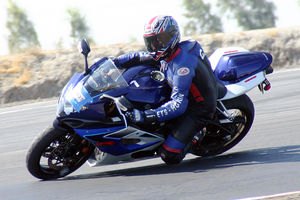
It still looks current, although some of our testers thought it was starting to look dated, especially "compared to the 750 and the Triumph", according to Ole. Pete also thought it was "getting a little old but it still looks as fast as it is", with its swoopy styling, integrated turnsignals, Jetsons-style exhaust can and partially-exposed motor. Gone are the days of being able to accuse the Japanese factories of cookie-cutter styling, for better or worse.

Hopping on the 1000 reveals a pretty comfortable bike. The clip ons are the highest of any of these machines, and the seat is low enough for short-legged Pete and Gabe to comfortably paddle around at stops. Ole even took it a step further, calling the 1000 the "sport tourer of the bunch...a much more comfortable ride." Seat comfort is good enough that nobody complained about it for the 100-mile stints we rode, and the windscreen gives pretty good protection at triple-digit velocities.

Controls and instruments are sportbike standard. The instrument panel is well-placed and easy-to-read. The huge digital speed readout is especially appreciated, as is the prominent analog tachometer. We'd like to see adjustable clutch levers standard on every bike, but what can you do?
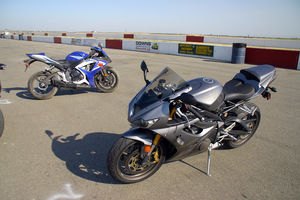
Like a lot of four-cylinder machines, the GSXR-1000 really comes with two motors. The first one is handy on the street, with all of Suzuki's tuning tricks

Two fast horses cooling down after a day at the races...
conspiring to create a torquey, tractable and fun powerband below 8,000 rpm. The tall, 99 mph-in-first-gear gearing makes starting from a stop slightly tricky, but once rolling, it's a one or two-gear affair at around-town speeds. Over 8,000 rpm and the motor delivers a pure literbike experience that is at once intoxicating and terrifying.

Things just happen quickly on a liter sportbike. Because of all that power, things like four-piston, radial-mount calipers and Brooklyn Bridge-sized frame spars become necessities, not fashion frippery. The GSXR-1000 will shoot you out of a turn and down the straightaway much faster than the fastest middleweight, and do it with a minimal level of engine vibration or drama. However, we just hope you know what you are doing. Things happen very fast on public roads when you're seeing all those numbers on that LCD readout. Ask yourself; do you need this much power for street riding? Why?

The suspension, brakes and chassis are all up to task for street excursions, however, unless you are at a Grand Theft Auto level of law-breaking. As delivered we had no complaints about suspension settings for our street ride,

Ole went so fast on the 750 the mirrors actually blew backwards.For the track, Lee said the ergonomics were "perfect", with "good leverage from the bars" and an "all-business" cockpit. Gabe liked the seating position too: "this would be a great place to spend a day at the races", if he could actually make the pace for a day of racing a 750.

The motor is yet another example of techno-wizardry from Suzuki. It fires up with a refined-yet-serious exhaust and intake note and is instantly ready to ride away. The gearbox is "typical Suzuki, shifting like the action of a well-built watch", according to Ole, no doubt aided by the seamless clutch. The gearing is shorter than the 1000's, and the 750 would be a perfect around-town ride if the riding position was more suited to low-speed riding.

Whipping through traffic like the world's fastest 600, the 750 shows off its powerful, yet controllable nature. Steering is razor-sharp, and the brakes are "half-a-finger sensitive", even at high speeds, according to Gabe; the saner velocities produced by the slightly softer (than the 1000) motor and loss of a few pounds makes the 750 feel easier to handle at high speeds whether you're braking, steering or on the gas.

The GSXR-750 is an amazing sportbike, an example of Japanese refinement and attention to detail at its best. The motor is great; Pete noted it had "just enough power to make it very fun and fast, yet not as crazy as the 1000", and Gabe thought it was "so fun to wind the motor out"; the twin balance shafts make it relatively smooth as silk at almost any engine speed. Handling is textbook  perfect; like with the SV650, when Suzuki wants a bike to handle, they do it right, with neutral steering that is still fast and responsive.

With such perfection and balance, the Blue Blaster should be a shoe-in to win this, right? Well, apparently not. Although Gabe voted it his favorite, the others did not follow suit, and not just because Gabe refuses to shave his back (he says it gets too itchy). It just lacks the character that the 675 has, and although a racer or hard-core track enthusiast really needs to get one of these, it won't ignite the passion in street guys the way the 675 might. And passion is what brings the checkbooks out, right? We're not corporate purchasing agents, looking for the equipment that best fulfills the contract terms, we're a bunch of nuts who prefer a method of entertainment and transportation that stirs our souls. Not to say the GSXR-750 won't do that if your heart isn't racing when the Gixxer's tach needle swings past 12 grand, then to quote Sinatra, "Jack, you're dead"  but it feels a touch sanitized.

Ole remarked it was "damn near perfect" when he wasn't "paying attention to how quickly this thing gets up to speed." Brakes are one-finger sensitive with excellent power at sub-ton velocities. Mile after mile, it's clear this bike is very capable of going much faster than you are. This is intimidating, even to riders of Lee's caliber, who have ridden almost everything and performed every two-wheeled motorcycling activity known to mankind.

On the racetrack, riding the GSXR-1000 back-to-back with the smaller, slower bikes revealed problems related to the embarrassment of riches that is 162 rear-wheel horsepower. Even if we had been using trackday or racing-compound rubber, we still would have used the GSXR's fun-stick with a judicious measure of respect. Like last year, that means getting on the gas later and braking  sooner at the corner entrances. Sure, you can leave slower bikes in the dust on the longer straights, and it's immensely satisfying, but there's a lot more pressure to stay ahead of the "slower" bikes, as well. It's fun, but not exactly relaxing.

Suspension and braking become issues as well. The massive torque from that motor caused the back end to squat more than the other bikes, prompting editor Ets-Hokin to wonder if the 1000 lacked rebound damping. And where the almost-identical brakes on the other two bikes were more than adequate for racetrack work, the GSXR-1000's stoppers needed more effort

Like last year, the GSXR-1000 came in last place because our testers just couldn't use the incredible advantages that the massive power output provides. It's "like naked freak-dancing with a porcupine", according to editor Ets-Hokin,

Can you really get too much of a good thing?and both Ole and Pete ascribed psychological conditions to the engine's character. Whether you think 160 horsepower in a 400-pound vehicle is "psychotic" or "schizophrenic", being shot out of a corner like a human cannonball is fun for a while, but we don't think it will either translate into a faster overall laptime for most trackday riders, or to becoming a smoother, faster rider on the street.

If the test were just evaluating motorcycles on what kind of rush a rider feels riding them, the GSXR-1000 would be a clear winner. But it's a test of what makes the best sportbike of 2006, and to be that, it has to do more than go around corners, stop and accelerate like an ICBM. It also has to have enough user-friendliness so that a wide spectrum of riders -- like our testers -- feel comfortable enjoying those performance advantages.

Compared to these other two bikes, the One K is too much of a handful to invest our tester's money in. We'd rather get something we can dominate, rather than the other way around.

PAGE 2Suzuki GSXR-750: Goldilocks' Pick

Where have all the 750s gone? After seeing the acclaim our testers gave the GSXR-750 in their notes, we were once again nostalgic for the days when this was a genuine class with more than one participant. After all, some of the most legendary sportbikes of the '80s and '90s are in this displacement category, like the Yamaha FZ-750 (and track-focused OW-01), the original Honda VFR750 as well as the RC-30, the Yamaha YZF-750 -- known for being the sweetest-handling big sportbike around -- and of course the O-G 1986 Suzuki GSXR-750, a bike that rewrote all the rules and made thousands of first-time bike owners aware of the term "highside".

This new GSXR-750 is truly worthy of putting on the big shoes of its forbearers. Introduced as an all-new model for 2006, the GSXR-750 is tiny, compact, and possessing of high style. Based on the diminutive 600 chassis, the 750 looks small parked next to the 1000, which isn't exactly a Boss Hoss either. Swoopy bodywork is counterbalanced with points and creases, making for a fresher look overall than the two year-old 1000. Pete complained that the "engine is a little more exposed than on the 1000, and the look suffers a little bit for it", and Lee didn't "care for the front end treatment", although he did find the seat to be "very sexy."

Pete liked the tiny snout of an exhaust poking out from under the fairing, and Gabe found the whole package to be "very satisfying, visually...Suzuki has found a distinctive voice in their sportbike designs." Ole was critical of the color scheme. Although he liked the blue color, he doesn't "like any sportbike with 'Denver Omelet' graphics." However, he went on to say that "compared to the 1000, it's more exciting and fun, even if I thought the same thing about the 1000 when it came out."

GSXR750 tech talk

The all-new GSXR-750 is the latest of a long series of GSXR-750 sportbikes. They are known for being light, fast, and uncompromising. Suzuki has often used common components for different-sized GSXRs, so let's see how different this bike is from the 1000.

Suzuki's engineers started from scratch for the 2006. At the heart is the liquid-cooled, four-valve, four-cylinder 749cc motor. The dual overhead cam cylinder head is designed to pack big, narrow-angle titanium valves into a tiny space, compressing mixture to a 12.5:1 ratio. 70mm short-skirt pistons work in 48.7mm bores, compressing mixture sent in from the twin-barrel 50mm throttle bodies (made with air forced through the ram-air system) and multi-hole fuel injectors. We weren't able to dyno our test unit, (since it mysteriously shed a handlebar and footpeg during testing, ahem) but we could reasonably expect around 130 HP at the rear wheel. There are two balancer shafts to smooth out all that power going through the forged steel crank. A back torque-limiting clutch helps with racetrack downshifts and a compact, under-engine exhaust Â- complete with Suzuki's SET exhaust tuning system Â- completes a pretty innovative engine design.

So easy to ride, even an idiot can...oh, sorry Gabe.The chassis sports lots of technology as well. As the chassis is based on the GSXR-600 Â- also new for 2006 Â- it emphasizes compact dimensions and light weight. The frame uses aluminum alloy castings everywhere for a strong, light structure. The braced alloy swingarm has a 25mm pivot and is 38mm longer than the 2005 version for better rear-wheel traction. The linkage uses forged pieces too, and the rear shock is fully adjustable, as are the 41mm inverted front forks. There are new radial-mount calipers and 310mm floating rotors on the front brakes, actuated by a radial master cylinder. The wheelbase is a compact 55.1 inches.


On board, we found a bike that is pretty focused, but not punishing to the rider. Lee said there's "lots of room to move around", and we noticed a tighter fit than the 1000, but with more room and better comfort from the slightly-higher clip-ons than the Triumph. The adjustable pegs aren't too high or far back, and the seat is soft and low enough that there were few complaints about it. It's no sport-tourer, but it's not the least comfortable bike here.

Controls and instruments are very serviceable. All controls and switches are easily reachable, although Pete said "it would be nice if the clutch lever were adjustable." However, he did say that the "speedometer and tachometer show all their information clearly and quickly", reflecting the observations of the rest of our testers. The gear indicator is a nice touch as well.

Ole and the SV650 It's no sport-tourer, but it's not the least comfortable bike here.

It's finished with new bodywork altered for a compact riding position and maximum aerodynamic efficiency. The tank is shorter, the seat is lower and the rider footpegs are adjustable. There's a new gear position indicator that all our testers found handy, as well.

All these improvements are delivered in a red, blue or yellow package for $9,999, just $300 more than the 2005 GSXR-750.

We get a lot of postings on our message boards informing us that an average rider will go just as fast at the racetrack on a well-prepped SV650 or similar machine than he would on the latest, hottest superbike. We decided to investigate a bit further by having Lee Parks bring his souped-up SV650 to the track to see how well Ole got around on it. We'll let him tell you in his own words what that was like.-Editor

You are such dirty-minded people! There is nothing going on here beside the perfectly normal, brotherly bond between men. Nothing else!Lee's SV is a very well put-together bike. It is stock except for the suspension, wheels, rearsets and handlebars. He added Heli-Bars to make it more streetable, and he took the front and rear suspension from his 2001 WERA National Endurance Racing Championship-winning SV650. Basically it has a Penske rear shock and highly-modified SV650 front forks with Honda CBR600F3 cartridges, Race Tech Gold Valves and springs, and YZF600 fork caps (set up for Lee, who weighs about the same amount as I do). To top it off it had cool-looking forged aluminum Carrozeria wheels (3.5 x 17 and 5.5 x 17).

Because of the fact that I also own a well-set up Honda Hawk, I've always been looking forward to the possibility of riding a well-set up SV650. Lee's bike lived up to my every expectation (and more). I first got to ride it on the stretch of Hwy 33 between Reyes Peak and Lockwood Valley (not an overly fast section of road, but very technical and full of interesting surface changes, with occasional bits of "gravel spray" thrown in to make it interesting). After getting off the Gixxer it at first felt very weird being on the SV650 until I reminded myself that it was just like my little Hawk, but with more power and much better suspension (and Michelin Pilot D.O.T. race tires).

Knowing how well it handled, and that the tire grip would be way beyond the limits which I chose to set, I pushed the SV down the mountain at a pace much greater than I would have if I'd been on my 675. Just like the Hawk, the SV650 makes it unbelievably easy to ride fast. The low center of gravity and high/wide bars make transitions from corner to corner as easy as just thinking about giving a little push on the bars. Although I knew that I probably could have gone slightly faster on my 675, I still had a total blast on the SV650.

On the second day of the test, I got to run quite a few laps on both my 675 and the SV650. As I'd already been riding my 675 for 5000 miles, I was pretty comfortable running her around Buttonwillow. After a couple of warm-up laps on the SV650, I quickly became totally at ease pushing it much harder than I did on my 675 (she's not prepped for the track yet, and I didn't want to take any risk with having to replace my stock bodywork).

I've already reported on how awesome the 675 is on the track. With the Triumph having nearly twice the power of the SV650, I was quite surprised to see that running laps at the same consistent (and safe) pace on both bikes my lap time on the SV650 (3:02) was only four seconds slower than a comparable lap on my 675 (2:58). Just like when I was riding the SV650 in the twisties (on the street), it was again a total hoot to ride on the track. Even at a safe pace (don't crash Lee's bike Ole!), I came away from every SV650 track session laughing at how easy it was to come to my turn points, slap the SV over onto my line, and power through the corners without a shimmy, squirm, wobble, or any untoward movements from anywhere on the bike.

The SV is an absolute joy to ride, but I'm not trading in my 675 for one. If I was in the market for a bike which I'd use only for the tightest and most technical roads or tracks, the SV650 would easily be my first choice. In most of the terrain where I ride my 675, its significantly higher power, nearly equivalent handling, and Triumph Triple sound and feel still makes it the bike for me.

If you ever have a chance to take an SV650 on a blast through some good twisty roads or to do a few laps on a nice technical track, take it! You'll have a great time. And isn't that why we ride?


Triumph 675: Good Things Come in Threes

The giant-killer.stance highlighted by its graceful design and simpleTriumph's giant-killer crouches waiting for you with a stinkbug, ass-in-the-air, almost stark, monochromatic color scheme. Ole described his baby as having an "excellent blend of classic styling and cutting-edge design", and Pete said the styling was "slightly quirky, but works well." We would say the styling is almost bland, but it works because it lends the bike a light, modern appearance that will probably age well.

The 675 is definitely not the most comfortable bike we've tested, although we've sat on worse. The first thing we noted about the 675 was a high seat, followed by very compact dimensions; although low, the clip ons fall readily to hand, since the bike is so small. Gabe complained about the footpegs being too small; 'Not made for commuting', Ole?"my feet keep falling off of them". Pete said the "bar position was a little too aggressive for extended street rides", and even Ole got the stars out of his eyes long enough to admit that "this bike was not made for commuting." It's no tourer, but it is built to put you in a good position to control the bike.

We also liked all the cool read-outs in the bike's instrument display. The rider can toggle through four different screens to display fuel economy (like you care!), lap times, or other information. There's a gear indicator and a cool array of programmable blue LED shift lights that tell you when to row through the gear box in case you can't hear the triple's siren song. We thought the small speedometer was hard to read, especially when the clutch cable obscured the view.

The motor fires up quickly and easily, with that incredible exhaust note providing a soundtrack. The clutch works with a mild squeeze and the transmission is good, if lacking the "buttery smooth" action of the other bikes, according to Ole. "It's typical Triumph 'rifle bolt' action; solid and consistent, although sometimes it's harder to engage first gear than the Suzukis." Gabe thought the transmission had a little more "throw" than Japanese gearboxes, making for a "looser" feel.

Lee practicing his 'moto-yoga'.Once in gear the motor wakes up, letting you know why this is such a popular bike. Once over a little flatness in the mid-range, the motor starts to make killer power at 9,000 rpm, which builds to a fever pitch and stays over 100 HP until about 13,000 rpm. That's not to say it's slow at normal-people speeds; it still makes plenty of torquey, responsive power where an R6-mounted person would be slipping the clutch. However, for maximum enjoyment, seven to ten grand is the G-spot on this bike, as it feels soft too much below that and vibration damps the fun at high rpm. "Hesitation at the lower rpm range, but otherwise [the engine] is perfect", says Lee, summing it all up. This is a great sportbike motor.

It's matched by a chassis that lets the rider have fun while still giving him excellent control and feel. Gabe described the suspension as "spot on", and Ole declared it "beyond what mortal riders are capable of". For street use we didn't find it overly harsh or jouncy enough to make our middle-aged man-boobies jiggle  on uneven or bumpy pavement. The chassis is very nice as well, allowing a snappy, quick turn-in while still tracking wonderfully through high-speed sweepers. It's a great balance of nimble for the tight stuff and ride-on-rails stability during high-speed maneuvering.

On the racetrack, the 675 is rewarding to ride for just about any skill level. Ole is of course in love with the bike, but Lee also raved about the solid handling. Gabe said the 675 was like "the world's fastest SV650", which speaks volumes about the bike's confidence-building handling and poise. Pete claimed he could "get the front to protest with a little head shake" from time to time, but the 675 always calmed right down, thanks to the steering damper tucked in under the steering head.

So can you guess if we liked it? Here's what our guys had to say:

"I had the most fun [on the 675]", said Pete.

"Such a wonderful sound" says Gabe.

"The best sound, feel and torque" opines Ole.

"Finally, a bike that's uniquely a Triumph", chimes in Lee.

Once every five or so years a sportbike comes along that really inspires passion in consumers, even if it's not the fastest or most radical-handling. The Honda VF750F of 1983 was such a bike, as was the Yamaha YZF 750. Ducati's 916 is still such an icon that many Ducati fans turn their noses up at the faster, better-handling and more reliable 999-series.

The 675 is such a bike. It's styled right and makes very competitive power for the middleweight class. The handling is good enough to please an expert without intimidating less-skilled riders. And it does it all using unique elements like the sexy aluminum frame and sexier three-cylinder motor.

With this bike Triumph shows it can build a bike that not only competes with Japanese and other European factories on their own terms, but also retain a character that is unlike any other marque.

With this bike Triumph shows it can build a bike that not only competes with Japanese and other European factories on their own terms, but also retain a character that is unlike any other marque. It's not the most comfortable bike Â- in fact it's the least comfortable sportbike we've parked editorial tushies on since the Aprilia RSV1000 -- but we think a few inexpensive modifications should fix that right up.

675 Tech Talk

The bike we've been wishing Triumph would make for a long time, the 675 uses a lot of cutting-edge technology to create a bike that will beat the giant Japanese factories at their own game. The heart is an incredibly compact, liquid-cooled 12-valve three-cylinder motor. The pistons are jumbo-sized, with a 74 mm bore and 52.3 mm stroke. The compression ratio is a sporty 12.65:1 and fueling duties are handled by a multipoint sequential electronic fuel injection system managed by an inductive digital ignition and an electronic engine management system. Triumph claims 123 hp at the crank, numbers right in line with our reading of 108 hp at the back wheel on the MO Dynojet Dyno.

The 675 is definitely not the most comfortable bike we've tested...

The chassis is also innovative, with the extruded aluminum frame spars arching over the motor to give it a slender, compact feel. The wheelbase is a stubby 54.8 inches and the chassis geometry is fashionably aggressive with 23.5 degrees of rake and 86.8 mm of trail. Suspension is handled by a pair of gold-anodized 41 mm inverted forks, adjustable for preload, rebound and compression damping. The rear shock works through a linkage and is also three-way adjustable. It also has a ride-height adjuster, if you can scrounge the right sized washers and don't mind taking the shock out to adjust it. Brakes are radial-mount four-piston calipers and 308 mm free-floating discs.

The bike is topped off with swoopy, modern-looking bodywork and an all-steel tank, a welcome thing if you've got a tankbag. The instrument panel is loaded with features, but there is no anti-theft system built into the ignition. With a price of just $8,999, the Triumph is priced right in line with its Asian competitors.

This text is from our 2006 Open Middleweights Comparison Test.

These bars are carved from a solid chunk of billet aluminum.aerodynamics as opposed to handling. Triumph's latest middleweight is the most impressive new sportbike we've seen in many years save its narrow, poorly angled handlebars that were optimized for significantly reduced. We only wish we could have tried them at the track as we'd bet they would have been worth a full second a lap. On the street the change meant an additional 30-40 minutes of comfort before our backs and wrists began to get sore. That could be the difference between deciding to take the bike somewhere or opting for the much lamer but more comfortable four-wheeled option.

It's always nice to find a product that can make life better for both the street and the track rider. While we would have liked to have seen the bars use clamps with replaceable tubes in case of a crash, Heli President Harry Eddy says that that design produces too much of a compromise in strength or bulk in this particular application. With product liability lawsuits being what they are in this country, we can understand his hesitation. In any case, the solid design also looks extremely trick and the improvement in steering/comfort more than justifies the asking price.

Now it's time to look over our notes and tally the votes. Does that character and ease-of-use overcome the 675's huge power disadvantage? Or will our riders listen to reason and vote the more traditional sporting machines number one?


PAGE 3Once You're on Top, There's Nowhere to Go But Down: the Conclusion.

If you haven't ridden a 675, you might be confused by our tester's conclusions. "So the most powerful, best-handling 1000cc bike ever lost, and I can understand that because you all ride like little Catholic schoolgirls, but then you should love the 750 for providing the best balance of horsepower and flickable low weight, right?

Well, no, actually. All the above is true, irrefutably so (although Lee looks terrible in a pleated skirt). The GSXR-1000 is an incredible motorcycle, one "So we're thinking about doing a long-term comparison test between the 675, my wife's car, and a BART train..."that will be even better for 2007 (if the USA market gets it) with on-the-fly-adjustable fuel injection maps to address the brutal power delivery, but as-delivered it's just too hard to ride hard, if that makes sense. A sport motorcycle should be friendly and make the rider feel good about herself, like she's using what it has to offer to help her learn and grow as a rider. The GSXR-1000 is designed for very seasoned experts to use every iota of skill they have to go faster than anybody else, and for most of us, that isn't what motorcycling is about.

The GSXR-750 is an incredibly balanced design that is also clearly intended to go as fast as possible on the racetrack. Therefore, the powerband is weighted towards the top, and the seating position is very focused and track-oriented. Were a rider just looking for a racetrack weapon, we could feel very good about recommending this model. But most of you Â- we'd say almost all of you Â- aren't looking to bring home trophies and contingency money next season, so this probably wouldn't be the bike for you. Similarly, it's not the bike for us either; even motojournalists spend the majority of their riding time off the track.

Reading over the last paragraph, we could say the same thing about the Daytona 675, and that would make us hypocrites, as all of us but Gabe voted the 675 first over the GSXRs. Again, you just have to ride this bike. It's the most amazing blend of torquey, free-revving power, razor-sharp handling and soulful exhaust note we've ridden in a long time. The bike inspires passion like the Ducati 916 did when it first arrived, and that's saying something.

When was the last time you sang along with your bike's exhaust note or were truly amazed by its handling? Triumph has a knack for occasionally designing a bike that feels so right you think they designed it just for you. The 675 is one of those machines, and that's why it has been voted the bike we'd most likely buy with our own money, and why it's the winner of this test.

"For Our Money" Table
How the testers would spend their own money.
We scored the bikes 4 points for 1st, 2 for 2nd, and 1 for 3rd.

Ole "at least it wasn't my bike" Holter

Lee "You're doing it wrong" Parks

Pete "Will Suzuki take a post-dated check?" Brissette

Gabe "Oy it's hot" Ets-Hokin

Totals

2006 Triumph 675

1st

1st

1st

2nd

14

2006 Suzuki GSXR-750

2nd

2nd

3rd

1st

9

2006 Suzuki GSXR 1000

3rd

3rd

2nd

3rd

5

The only problem is Triumph is a small company and might have trouble meeting demand for this product. Triumph's 2006 Daytona 675 is the best sportbike of 2006. The only problem is Triumph is a small company and might have trouble meeting demand for this product. Let's hope they come close, but if you think you might want one, put your deposit down sooner rather than later. It really is that good.

Now who ordered the corned beef on rye?

What I'd Buy

"What's the best sportbike" is a question fraught with confusing dualism. "Sport" can mean a lot of things when it comes to sportbikes, from plodding along at the speed limit on a mildly-twisty road to AMA-level competition on a real racetrack. Obviously what is good for one activity might not be the best for another, so it's a tough question to answer in either an objective or subjective sense.

That's why The Great One's commandment that MO editors only grade bikes by deciding which one they would actually buy with their own money is actually pretty clever. It makes us choose a bike not by what has the best laptimes or most horsepower, but what works the best for real-world needs, which for some reason seems important to many of our readers.

However, it doesn't really make it any easier for us. In fact, it's harder. What's the fastest bike? The 1000. What's the lightest? The 675. Which one would I choose if I had to purchase one of these three?

Ummmm...

Even my romantic, Euro-bike-loving heart can't deny the basic functional goodness and value of this amazingly evolved machine. Were it between the 675 and the 1000 this would be an easy choice. The 675 is much easier to ride fast and has so much character and panache I was practically weeping with ecstasy every time I got on the gas hard. That exhaust note, especially with the "off-road" silencer, is intense and beautiful. At $8,999, the Daytona is a steal.

The 1000 is an amazing piece of engineering, but like we found out last year, it doesn't really translate into a faster, more fun or more satisfying motorcycling experience. I've also found that the more power I have, the slower I go on the track, so why spend the extra money on something I don't need? I don't care how light or easy-steering these liter machines become (and they will keep getting better, oh you bet'cha), 160 horses have a heft and mass all their own that no engineering tricks can hide. I may be slow and timid compared to some riders, but I haven't high-sided in a long time, and I don't want to get any frequent flier mileage in that manner anytime soon.

So here we have the 750 to muddy the waters. 750cc? That's so 1994! But there's a reason it was once the most popular class; it really is an excellent compromise between the middleweight and open classes. This 750 really does feel like the world's most powerful 600. It's responsive, precise and stable, and has plenty of top-end boost for the straightaways. It also has a heartier mid-range than a 600 without sacrificing any throttle response.

It's simply a neutral, solid platform to help you grow and develop as a sporting or track rider, offering the perfect compromise of power, handling and weight. It's also more comfortable than the 675 and will doubtless be better-supported by both contingency money and the aftermarket. Anybody who needs more than this bike -- street or track -- is insane, and a modern middleweight isn't any less intimidating. Plus, at $9,999 the 750 isn't really that much more money than the priciest 600 while offering 20 more ponies. I think that makes it a better value Â- not to mention a better motorcycle Â- than the 675, much as I love Triumphs and enjoy seeing them do well.

Even my romantic, Euro-bike-loving heart can't deny the basic functional goodness and value of this amazingly evolved machine. Good job, Suzuki!

-Gabe Ets-Hokin, Senior Editor

For once in this little, seemingly meaningless addendum that we do in each comparison, I'll get straight to the point. The Triumph is the clear winner for  me. Not because it's perfect, but because it allows me to justify the emotional aspect of motorcycling with practicality.

If I were blowing my hard-earned dough on one of the three, price as it always is, would be a huge factor. It's a full two grand less than that crazy-fast, ultra high-performance 1000 and the great mid-range of the 675 allows me to have as much or maybe even more fun than I do on the big Suzuki. With its slightly taller saddle height and aggressively positioned clip-ons, the Daytona took a little longer to get comfortable on, but once I acclimated I felt more confident more quickly on this bike than on the other two.

Here again, I'll be unusually brief and say in few words that the exhaust note on the Triumph is so freakin' incredible that purchasing the bike just to hear it would almost be worth the cost.

As for the 1000, what else can be said that already hasn't. The volume in which these bikes are sold and their racing history say more than any one person could. The brakes, handling and engine are all stellar. But the more time I spend on this bike I start to realize that the razor's edge performance that it offers makes it less practical somehow. Before many of you start cackling that I might be "afraid of the power", let me just say that I'm not. But what I am, or like to think I am, is sensible. And the ferocity with which the 1000 utilizes its ponies requires the rider to keep a constant vigil against an over zealous use of their throttle hand. Hack the twistgrip open with too much vigor too soon and it'll spin up the rear tire in a heartbeat. When I ride, I like to be able to enjoy the ride as a whole and not spend too much of my concentration on any one operation of the bike.

Before many of you start cackling that I might be "afraid of the power", let me just say that I'm not.

The GSX-R 750, like the 1000 is a highly refined tool. It too can be found just about anywhere on the streets and it deserves a lot of respect. In my opinion Suzuki owes much of its success as a motorcycle company to this bike. Unfortunately the engine was just a little too flaccid at anything below 8,500 rpm (roughly speaking) for my tastes. But the biggest draw back for me about the 750 is the cost. There's just no way I could justify buying the 750 over the 1000 if it were a battle between the two. With only $1,000 difference I'd have to learn to live with all that power of the bigger Gixxer, no matter how impractical.

Thankfully the 675 is in the mix and it has all the power, mid-range, handling and excellent braking that most people will ever need. Let's not forget that great symphony that the triple makes. And it all comes in with lowest price tag. See, emotion justified by practicality.

-Pete Brissette, Managing Editor

At first I thought that picking which bike I'd buy from the Best of the Best would have been a quite daunting task. At second thought (based on all my preconceived notions about each of the three Best Bikes) I thought it would have been quite an easy decision.

"In a gadda-di-vida, baby, don't you know that I luh-uh-uhv you..."I'd already pretty much decided that the Gixxer Thou' was a "Pure Poser Machine" for hanging out at Saturday night cruises, polishing, and cruising up and down the Sunset Strip at one am with my floss-wearing wife hanging on for dear life. I'd also decided that the Gixxer 750 was every man's perfect sportbike Â- totally focused, race rep ergonomics, as light as any of the best sportbikes in the world, and unfortunately having that typical ultra revvy four cylinder power band Â- screaming ballistic power which is only available at the stratospheric end of the rev range. Everything I already knew about the Triumph Daytona 675 made this test a done deal Â- I had already decided that the little Triple was the Best of the Best. In reality though, once I got to see, smell, feel, touch, and ride all three bikes side-by-side, my decision became much more difficult.

The Gixxer Thou is an amazing machine, and much more than I expected. It is incredibly well balanced, not at all "heavy feeling"; light, flickable, and incredibly composed at all times. It handles and drives like one of the Best of the Best sportbikes which it truly is. It is also by far the most comfortable bike in this group. After getting off of the Triumph and onto the Gixxer Thou, it felt like moving from an overly cramped and painful torture device to a bike with ST1100 like comfort levels. On the other hand, this bike is mental! It has so much power that since I'm not a competing Superbike racer (on the track), I ended up spending far too much time and focus continuously trying to compensate for the fact that I had over-accelerated my comfort levels. Not that I couldn't get used to a bike with this much power, I'd really just prefer a bike that has enough power, handling, and feel to be perfect for every day that I'm on the track or out in the twisties. Even without having ridden most all of the middleweight sportbikes offered for 2006, I would have easily chosen any of them before I'd have considered buying a Gixxer Thou.

After everything which I had read, heard, and seen of the Gixxer 750, I had quite high expectations for how it would do in this comparison. I was also quite certain that it was going to come down to a "99.95 vs 99% perfection" type of decision between the G7 and the T675. When I got onto the G7, it was immediately evident to me that it fit perfectly right between the under-torqued, screaming revvy Gixxer Six and the mental, torque-laden and overpowering Gixxer Thou. Similar to the T675, it had a wonderful-feeling fistful of torque which started to come on at 6,000 rpm.

The comfort level of the G7 is also set "dead center" between the torture chamber of the 675 and the "sport touring" Gixxer Thou. As far as handling goes, the G7 is in a virtual tie with the T675 (maybe it's even better). It is difficult for a mere mortal such as my self to describe how truly perfect this bike handles and rides. I was in absolute comfort and "twisty bliss" as I followed Lee, Gabe, and Pete up Hwy 33. The Gixxer 750 has a wonderfully perfect balance of handling and power that would make any sportbike junkie easily have a love-at-first-ride experience. Although once I got back onto the Gixxer Thou, it instantly hit me that the Gixxer 750 really felt like just another under-torqued, over revvy inline four with a silly high powerband which could only be enjoyed on the track. And yes, I'd say that on the racetrack the Gixxer 750 is 100% the best bike.

After riding all three of these bikes in both conditions, it really is no contest at all.

For me the Triumph Daytona 675 is truly the Best of the Best Sportbike for 2006. It is awesome-light, narrow, compact, and flickable. It is unbelievably composed at all times, and blessed with the sound and feel that only Triumph could achieve in the perfect cross between the feel of a Ducati 999 and that of a Yamaha R6. In directly comparing the G7 and the T675, the G7 wins in the handling department, 99.95 to 99%. In the powerband/sound/feel department, the Triumph wins 100% to 90%. The wonderful feeling of "all the time" torque that the Triumph gives easily beats the top-heavy powerband of the G7. When I consider which one of these bikes I'd buy, I also have to think of its intended usage. I want a sportbike which will keep my adrenaline pumping and my grin-a-grinning the entire time, whether I'm on a 400 mile blast through the California mountains, or when I'm thrashing it on the track to the best of my abilities. After riding all three of these bikes in both conditions, it really is no contest at all. The Triumph Daytona 675 is the Best of the Best Sportbike for 2006.

-Ole Holter, Contributor and Loaner of Triumph

When Gabe originally called and asked if I'd be interested in helping with the annual BOTB review, I couldn't decide if I was more excited to try the all-conquering Gixxer 1000 or the sleek, new Triumph 675. The little brother 750

This used to have the stars-and-stripes bodywork all over it. We say put it back on!didn't even register as something I'd like to ride. It therefore came as quite a shock that on both the street and the track, the ¾-liter competition-less wild card would be both the fastest -- and easiest -- bike to ride. Even a die-hard small-bike aficionado such as I couldn't help but be wooed by the effortless nature in which this middle-child machine was able to straighten twisty roads. Interestingly, with MotoGP downsizing the premier class to 800cc next year, the GSX-R750 becomes the closest thing you can buy to a factory prototype.

Ergonomics is one of those black arts that ends up being more than the sum of its parts. In the case of the 750, it didn't just fit me; it became an extension of my own body. Neither too quick steering nor too lazy, putting the Gixxer where I wanted, when I wanted it, was almost a telepathic experience. I think, therefore I turn. The 750, in fact, replaces Ducati's venerable 999 as my all-time favorite handler.

As it would turn out, the 750's 130 rear-wheel horse power is the perfect blend of acceleration and controllability. It's enough horsepower to launch me through to the next turn, but not so much torque as to overpower my mental capacity or the tires' ability to put it to the ground. Yet motorcycling is at its heart an emotional experience, and though the 750 has no equal in capability, it came up just shy in the smiles per mile department.

The 750's big brother also came up short. With a seemingly endless supply of power, the GSX-R1000 proved that you can have too much of a good thing. Like a porno star sporting a pair of aftermarket EEE headlights, an impressive dyno chart is cool to look at, but not really practical for everyday use. In both cases, they can be a handful at full lean. It was notable that the 1000 was a little more comfortable than the 750 for street riding due to the ergonomic differences, but didn't inspire as much confidence when throwing it hard into a turn.

At this point we are left with Trumpet. While one could argue that the 1999 Triumph Speed Triple was the first model that the English could truly call their own without trying to look like a Ducati (Daytona 955i), Honda (TT 600) or BMW (Tiger), the 675 redefines the brand as world-class. How Triumph was able to produce a high-performance motorcycle that outperforms the Japanese at the same quality and price point is beyond me, and perhaps unprecedented in any industry.

Like a porno star sporting a pair of aftermarket EEE headlights, an impressive dyno chart is cool to look at, but not really practical for everyday use.

While the 675 has neither the handling of the 750 nor the brute force of the 1000, it, nonetheless, is the first bike since the original SV650 that I would want to shell out the needed clams to add to my personal collection. With the exception of some poorly designed handlebars, and the resultant ergonomics (see sidebar), the Triumph makes me giddy like a little girl every time I ride it. This cannot be explained with dyno charts, spec sheets or lap timesÂ-only by experiencing its unique blend of performance, feel and style will one understand. With all of the current year's production already spoken for, you'll have to beg a lucky owner for a test drive, or just take our advice and put a deposit down on an '07. Just make sure your helmet is up to current standards to help make sure it doesn't crack due to excessive smiling.

-Lee Parks, Contributing Editor and Person of Great Renown

copyright (c) 2008 Verticalscope Inc. Story from http://www.motorcycle.com/shoot-outs/choose-your-weapon-best-of-the-best-2006-13780.html