2011 Adventure-Touring Shootout: Triumph Tiger 800XC vs. BMW F800GS [Video]
BMW's parallel-Twin takes on Triumph's inline-Triple
Conclusion
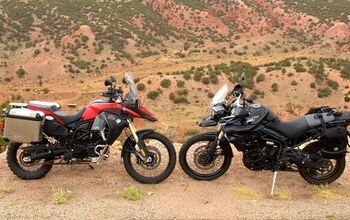
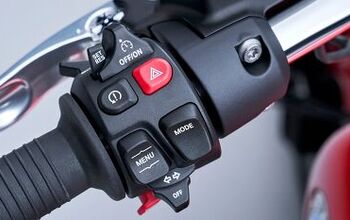
Triumph blatantly copied BMW to create the Tiger 800XC, even down to the placement of the external power outlet located next to the ignition switch. For that, BMW should be proud to be held as the benchmark for other OEMs, but when it comes to light that we preferred the Tiger to the F800, BMW might not be so happy.
Pete says it best, “In light of what I suspect is the reality that most A-T bikes see more pavement than harrowing river crossings, I’ll hedge the Triumph as the better overall package, but only by the slimmest of margins, and that is thanks primarily to its enjoyable engine. If you’re the dirtbike guy or gal looking at these nearly identical twins, then the Beemer’s few shortcomings on the street are a small sacrifice for its superior off-road capabilities.”
|
The BMW emphasizes the adventure in adventure-touring, as it is the better bike when it comes to more aggressive off-road riding, thus leading to more adventurous experiences. But, if our assumptions are right and either model will see more road than off-road miles, then the Tiger is the better overall package.
The Tiger retails for $11,800 with its ABS option ($11,000 without), while the $11,455 base MSRP BMW F800GS’s ABS comes as either an individual option for $900 or a package with heated handgrips and an on-board computer (gear indicator and stopwatch) for $1,445. Either way, the BMW remains slightly more expensive than the Triumph.
|
BMW is likely developing a new version of the F800GS to withstand this new competition from Triumph. The question is, will BMW make it even more dirt worthy or will the company upgrade its street performance and comfort to better compete with the Tiger? It’s your move BMW.
| By the Numbers | ||||
| BMW F800GS | Triumph Tiger 800XC | |||
| Engine Type | Liquid-cooled, DOHC, parallel, 2-cylinder | Liquid-cooled, DOHC, inline, 3-cylinder | ||
| Displacement | 798cc | 799cc | ||
| Bore & Stroke | 82mm x 75.6mm | 74mm x 61.9mm | ||
| HP (BHP or Rear Wheel) | 94 bhp @ 9300 rpm (claimed) | |||
| Torque | 58 lb-ft @ 7850 (claimed) | |||
| Frame | Tubular steel space frame | Tubular steel trellis | ||
| Wheelbase | 62.1 in | 61.7 in | ||
| Rake/Trail | 64°/117mm | 23.1°/91.1mm | ||
| Front Suspension | 45mm upside down forks, 230mm travel | Showa 45mm upside down forks, 220mm travel | ||
| Rear Suspension | Monoshock, preload adjustment, 215 mm travel | Showa monoshock remote reservoir, preload adjustment, 215 mm travel | ||
| Front/Rear Wheels | 21 in x 2.15 in/17 in x 4.25 in | 21 in x 2.5 in/17 in x 4.25 in | ||
| Front/Rear | 90/90-21 and 150/70-17 | 90/90-21 and 150/70-17 | ||
| Front Brakes | Twin two-piston calipers with 300mm discs | Twin two-piston calipers with 308mm discs | ||
| Rear Brakes | Single caliper with 265mm disc | Single Nissin caliper with 225mm disc | ||
| Seat Height | 33/.5 in/34.6 in | 32.2 in/34.0 in | ||
| Wet Weight | 455 lbs | 473 lbs | ||
| Fuel Capacity | 4.2 gal | 5.0 gal | ||
Related Reading
2011 Triumph Tiger 800 & 800XC Review [Video]
2010 BMW F800GS Review
2009 BMW F800GS Review
2010 BMW R1200GS and GS Adventure Review
2010 Ducati Multistrada 1200 vs. BMW R1200GS