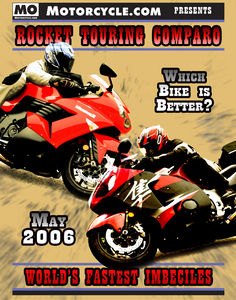
That's the question a rational person would ask when confronted with the concept of a 160-plus horsepower motorcycle designed to cruise comfortably at triple-digit speeds. However, we at MO don't take the moniker "MOron" lightly, so we decided last year to do a real-world test of the fastest sportbikes on Earth as soon as they were both available at once. Is it better to tour on a heavyweight hyperbike than on something less powerful and more sensible? Can a sane, law-abiding person get any benefit from a 500-pound vehicle that makes more power than most 3,000-pound cars? Do stick-on Mohawk wigs stay on at 160 mph?
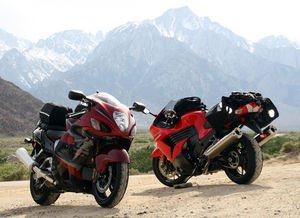
What sort of bikes are we talking about here, anyway? At the Kawasaki ZX-14 intro we attended a few months ago, Kawasaki's media relations people referred to the 190 hp device as a "flagship" sportbike. It's an expression of the manufacturer's corporate prowess, a symbol of engineering excellence. When it comes to such a vehicle, engineers are given almost free reign to build the fastest, best-handling, most comfortable and prestigious motorcycles.
The class is a small one. Both Honda and Yamaha have had such bikes in their inventory, but they've dropped them for various reasons. Those who remember the YZF1000R have fond memories of a big, stable bike that was comfortable enough to ride all day and had a wicked mid-range and top-end stomp. Alas, Yamaha sold it in the USA for just one year--1997--before replacing it with the razor-sharp and much lighter YZF-R1, which was too much of a focused racetrack tool to be considered a GT-type bike like the YZF1000R.
The Honda CBR1100XX Blackbird was Big Red's last entry into this class, and that was a refined, smooth and comfortable Gentleman's Express that was also plenty fast--136 hp at the back wheel was unbelievable in the mid-90's--but it was too refined to get the bad boy reputation a flagship vehicle needs. Like the Viper, Ferrari Enzo or Porsche GT3, a superbike needs to have a whiff of danger to it, enough character and mystique to make it a desirable object.
We all know about the legendary Hayabusa, of course. Introduced in 1999 and reviewed by MO, the GSX-1300R was intended by Suzuki to replace the GSXR-1100 as that firm's Gentleman's express, a bike that would be both the most powerful production motorcycle on the planet as well as being light, compact, good-handling and easy to ride. They named it "Hayabusa" after the legendary Japanese falcon that primarily dines on blackbirds. Get it?
No matter how cheesy the joke, or how over-the-top the Salvador Dali melting-clock bodywork looked, nobody could deny the Hayabusa's comfort, sharp handling and most importantly, smooth and tractable yet frightening power. The Hayabusa has a following from all sorts of riders, from suburban mid-life crises-ers to rap stars who bling out their `Busas in chrome and gold plate.
Kawasaki didn't take this lying down and responded in 2000 with the all-new ZX-12R. With an all-new motor and monocoque chassis, the 12R had lots of technical credibility along with a touch more power than the Hayabusa. However, it failed to charm riders the same way the Suzuki did, even after a significant revamp in 2002. It had a reputation for being too big, heavy, long and uncomfortable and never really won the love it deserved. The Hayabusa ruled the roost for year after year, with no competition in sight.
All that changed in 2006 when Kawasaki announced a completely new bike, the ZX-14. We covered the technical details in our press intro story, revealing an all-new monocoque chassis and all-new 1352 cc motor that was more compact than the 1198 cc mill it replaced. Pop it on the dyno and 171 horsepower is speedy-deliver-ied to the back wheel, trouncing the anemic 159 hp of the `Busa.
Is it just about power? If you think so, you can stop reading now and turn to more productive time-wasting. But if you think a motorcycle is more than just numbers and want to know how these two bikes fared against each other on the open road, around town, and in the canyons, keep reading.

Ali v. Frazier Battle it Out for Heavyweight Championship of the World
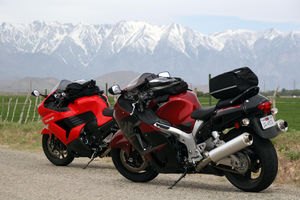
We at MO, a long time ago, would have put heavyweight sportbikes like these out on the racetrack to find out which was best. However, neither of these bikes are intended as racetrack weapons, so it would be unfair to put them there. They're built for high-speed sport-touring, so we drew up a route going halfway across California, on all kinds of roads, from straight and boring to tight, twisty and bumpy. We went from the foggy gloom of the coastal marine layer to the roasting heat of the Mojave Desert, to the snow-bound mountains above 7,000 feet and back.
After hundreds of miles of evaluation and saddle time, we think we have a handle on what bike is good for what and which bike we'd buy for our money. We'll examine each bike a little closer, discuss its strengths and weaknesses, and pick a winner, based solely on the all-important MO criteria of what we'd buy with our money.

.jpg)
2006 Kawasaki ZX-14:
The Young George Foreman Invents the Fat-Free Home Grill
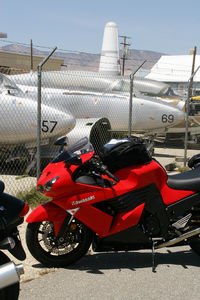
All-new for 2006, the Kawasaki Ninja ZX-14 delivers a knockout punch with comfort, smoothness, ease-of-use and the most powerful engine ever fitted to a production street motorcycle.
We attended the launch of this significant new model not too long ago, and you can read about its more distinctive technical aspects there. We'll quickly highlight some of its more important differences from its rival.
While the Hayabusa relies on a more traditional frame, the Ninja uses a second-generation "monocoque" chassis made from aluminum sheets welded together to form a rigid structure. Kawasaki claims this is more rigid than twin-spar designs; we think it's to keep bulk, weight and cost down ourselves. The chassis locates the 190-section rear wheel and tire in an extra-long swingarm. Wheelbase is a compact 57.5", compared to the Hayabusa's 58.5" stretch, and the entire package weighs in at a claimed dry weight of 474 pounds, four pounds less than the Suzuki's claimed dry weight.
Hanging under that frame is a compact 1352 cc four-cylinder with a shorter stroke and bigger bore than the `Busa's. It also sports dual gear-driven counterbalancers for extra smoothness at high rpms. Compression is a point higher than the Suzuki, at 12.0:1. It's all good for 171 hp and 105 foot-pounds of torque at the back wheel on MO's Dynojet Dyno.
Brakes and suspension are special, too. A 43 mm inverted cartridge fork adjustable for preload, rebound and compression damping sits up front, with a three-way adjustable shock working with a linkage in the back. Rake is 23 degrees, and trail is 3.7 inches, compared to the Busa's 24 degrees of rake and 3.8 inches of trail. The front Bridgestone BT-014 is mounted on an aluminum three-spoke rim with 310 mm "petal" rotors grabbed by radial-mount four-piston calipers with one pad on each caliper. The brake and clutch master cylinders are also radial jobs.
It's encased by a sleek fairing festooned with thematic styling touches like the heel guards and engine louvers. The double headlamp cluster is aggressive looking, while the high windscreen promises good wind protection. Dual analog clocks display speed and RPM below a huge rider information display. A programmable shift and launch light aid beginnner dragracers.
This engine could easily be used as a time travel device with its ability to seemingly warp time...
Our test unit was finished in Kawasaki's Passion Red paint scheme, a color metrosexual Senior Editor Gabe Ets-Hokin found "very sexy." We enjoyed the aggressive, integrated design of the bike: "the bike seems to be one piece from front to back", according to Editor Pete Brissette. It looks low, sleek and menacing, with a shape that says "I go fast" even when standing still.
Once aboard, the rider is greeted by a very humane riding position and soft seat. Pete declared the "Ninja makes eating the miles a pleasure", with a well-proportioned saddle, clip-on and foot peg relation. Pete "never felt cramped, and any discomfort from holding the throttle or sitting came on far later in the trip than it would have on most other bikes, short of touring-oriented machines I've ridden." Gabe agreed, although he thought the seat was too soft and could use firmer foam. The wind-tunnel designed fairing and windscreen gives great wind protection, for the taller frame of photographer and web guru Alfonse "Fonzie" Palaima as well as our editorial stunt-dwarf team.
The motor fires up easily and cleanly, with no hint of stumble or slow warm-up, regardless of altitude or atmospheric conditions. It's also incredibly smooth and powerful: Gabe called it a "bottomless, all-you-can-eat shrimp and lobster buffet of power", and Pete speculated that "this engine could easily be used as a time travel device with its ability to seemingly warp time". Pete pointed out that this bike is "approaching 120 mph in second gear", before redline. We at MO think this is both absurd and sublime.
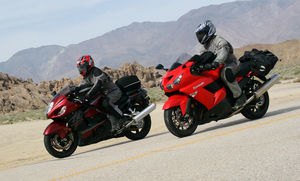
Fueling was flawless, with the exception of what we speculate must be a built-in flat spot in the power curve around 3,500 to 5,000 RPM (doubtlessly to help prevent the ZX-14 from being worn as a hat by nascent drag-racers). It's most noticeable when trying to pull a clutch-less wheelie from low speeds. Some of the more with-it drag-racing types at the Ninja's press intro said this was programmed into the ECU and that it could be fixed with wire-cutters.
A minimal amount of vibration found its way up through the foot pegs and clip-ons, but the motor was so smooth we often rode for dozens of miles before realizing the transmission was in fifth or even fourth gear at 80-plus MPH. The gear-position indicator is very handy for just this reason; Gabe said the motor "felt almost the same in any gear, regardless of speed or RPM." That transmission worked flawlessly, too; Pete complained of a "minimal amount of lash" that Gabe attributed more to the "wheelie wire" issue, but was impressed with how perfectly the cogs snicked from gear to gear. The clutch is also a thing of wonder, with sensitivity and feel usually not found in hydraulic clutches.
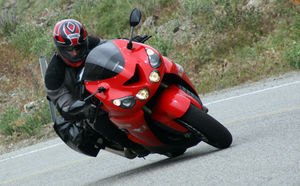
The ZX-14 offered a very plush ride while droning down the freeway. It did an excellent job of isolating most road imperfections from the rider, although some high-speed bumps could produce a sharp jolt through the front end, possibly from too much compression damping. Potholes, bumps, expansion joints or whatever, on the whole the big Ninja provided a great ride on all kinds of road surfaces and would be flawless with a bit of fine-tuning.
Once off the interstate and on the two-lane roads, the ZX-14 shows a measure of handling prowess unexpected in a machine this heavy. Gabe and Pete agreed that initial turn-in was surprisingly quick, but Pete noticed that "large changes in direction require more energy from the rider, and the ZX doesn't snap from left to right nearly as quick as the 'Busa." Gabe just thought the 14 felt larger, heavier, and not as responsive as the Suzuki did, despite its sportier rake, trail and wheelbase numbers. The bike responds without complaint to things like mid-corner line changes or braking, but it lacks the knife-edge precision feel that the Hayabusa has.
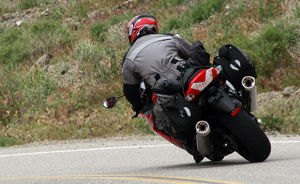
At higher speeds, the Ninja has the lead. Gabe said "the bike is stable in turns at triple-digit speeds, making riders feel confident, where on a lesser bike they'd be assuming crash positions." Al discovered that "never before have I taken a turn as fast as I had on this bike." The stout chassis, sorted suspension and general gravitas of the big bike convert high-speed sweepers into amusement park rides.
Luckily, the brakes are fully up to this kind of challenge. It's a similar setup to the ZX-10R, with radial-mounted calipers (sporting one pad per caliper) and a radial-pumping master cylinder and 310 mm petal rotors, but for some reason these brakes are more memorable. That's probably because we're comparing them to a seven year-old system on the Suzuki, but these are really great brakes, and we at MO love good brakes almost as much as we love big power. On a twisty road, loaded with luggage and maybe even a passenger, you will appreciate these stoppers, which help you feel confident and in control at all times.
Pete summed it up for all of us: "Short of expensive after-market systems, I haven't used a better set of binders. They offer incredible power and sensitivity; one finger at almost any speed would haul the bike in. If only the other OEMs would install such perfect brakes." Gabe compared their effect to "running into a vat of tapioca pudding". We have no doubt that an updated Hayabusa would include the wondrous brakes installed on the GSXR 1000, but for now the ZX-14 clearly has the superior binders.
Put it all together and you have an outstanding package from Kawasaki. The ZX-14 is smooth, comfortable for long trips, handles well enough to be fun, and looks really cool. The only real complaints--when compared to the Hayabusa--are its slightly heavy-feeling low-speed handling manners and the flat spot in the power curve we noticed. These issues can either be fixed or ridden around, leaving a very satisfied owner to enjoy what is the most powerful production motorcycle and at the same time a refined, comfortable, all-day sporting machine.

.jpg)
PAGE 22006 Suzuki GSX-1300R Hayabusa:
The Aging Ali Still Floats like a Butterfly and Stings Like a Bee
Some of us peak at 18. Some of us don't blossom until we're much older, and some of us can keep kicking ass at an age when others are driving golf carts with Paul Harris in Florida.
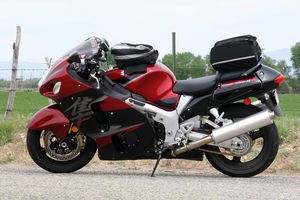
The Suzuki Hayabusa is such a creature. Ancient by cutting-edge sportbike standards, the fast and bulbous creature is still as fast, sharp-handling and commanding as it was in 1999. It's a motorcycle that impressed us on the staff and was surprisingly good, even compared to the faster and more comfortable ZX-14.
Tech stuff can be perused in this ancient text from the dusty annals of MO, but some things have changed in the intervening eons, so we will enlighten you a bit more.

Suzuki's engineers started with a motor, a 1,299 cc liquid-cooled, dual-overhead cam affair with an 11.0:1 compression ratio, Suzuki's Twin Swirl Combustion Chambers and a single gear-driven counterbalancer. It's fed with 46 mm throttle bodies (the Kawi's are but 44 mm units) and has a cable-operated back-torque limiting clutch. Moto-Urban-Legend has it that the 1999 model is the fastest, but the 1999 we tested (in 1999) made 157 hp at the back wheel while our 2006 made 159. That legendary motor is ensconced in a twin-spar extruded-aluminum chassis festooned with high-spec hardware. The bridge-type aluminum swingarm is attached to the three-way adjustable, remote-reservoir rear-shock with a linkage. The front 43 mm inverted fork is titanium nitride-coated as well as being adjustable for preload, compression and rebound damping. Chassis numbers are sporty for such a big bike, especially given the age, with a wheelbase of 58.5 inches, 24 degrees of rake and 3.8 inches of trail. Brakes are big six-pot caliper jobs clutching 320 mm rotors.
It seems odd to place the once mighty and all-conquering Hayabusa at anything less than "stellar" in the power department, but compared to the newest Ninja its vintage is showing.
The bike has received surprisingly few updates since its introduction. In 2003, the fuel injection map was altered a little, the forks got that titanium-nitride treatment, and the brake calipers were given the gold treatment to add a touch of exotic class. Other than seven years of Bold New Graphics treatments, that's apparently all the improvement Suzuki feels the bike needs. However, the aftermarket provides a dizzying array of products for the `Busa, from chrome wheels to 300 hp turbocharger kits. The Hayabusa's styling is controversial, but far from boring. It takes some getting used to for some, but Pete found "the odd, bubbly bodywork attractive", even though the "'Busa doesn't exhibit itself as one fluid line like the Ninja does."
Gabe thought the soft, swoopy late-90's shapes seemed as "dated as the Macarena and $2 per gallon gas" but they are definitely distinctive; passers-by seemed drawn to the Hayabusa's recognizable profile and naughty reputation. If you like to ride something that stands out--and Suzuki offers an extreme-bling Anniversary edition in silver and white livery that has everything but chrome spinners--the Hayabusa fits the bill.
Pete thinks that the Hayabusa "looks small for a big bike", but hopping aboard reveals that it feels smaller, too. The footpegs are close to the rider, and the bars are lower and closer than they are on the ZX-14. The riding position is not quite as cramping as a GSXR, but the feel is definitely not Sport-Tourer. The seat is sofa-cushion pillowy, which feels good for the first hour, than starts to hurt as the foam packs down.
The cockpit on the Suzuki shows its age. Pete thought the "instrument cluster is Spartan and oft times difficult to concentrate on while at speed." Gabe found the faux-carbon fiber surround a little "tacky", and Al also thought it was hard to read at a glance. Like much on this bike, it needs an update. Hopefully, Suzuki will jump on the bandwagon and install a nice big LCD for next year, along with a fancier rider display and gear indicator. Other amenities abound, including bungee mount points and a nice, big grab-handle for your passenger. If you're not carrying a passenger, there's ample storage under the big, camel-like hump that replaces the passenger seat.
When it's time to experience the legendary motor, you notice that the Hayabusa still has a quaint fast-idle lever on the left handlebar, although the only time we needed it was at high altitudes or on very cold mornings. Even with it, our test bike wouldn't hold an idle for a minute or two, although immediately riding it away was not a problem. Overall, the fuel injection didn't show its age much; Pete described it as "very drivable in virtually all scenarios."

It seems odd to place the once mighty and all-conquering Hayabusa at anything less than "stellar" in the power department, but compared to the newest Ninja its vintage is showing. In our less-than-scientific-means of measuring roll-on power, the ZX-14 effortlessly walked away from the Suzuki. Pete declared that the "poor old bird just isn't at the top of the power heap any more", even though he conceded that "overall the engine is still amazing." Even though we could only (only?) coax 159 hp out of our test unit on the Motorcycle.com DynoJet Dyno, it was noticeably more buzzy, especially around 4,500RPM, than the Ninja, and it didn't have quite the mid-range and top-end hit the Kawasaki did. There's also more vibration that works its way through the bars and pegs to the rider. Still, it's a fun motor that would seem miraculous for power and response if not for more modern powerplants. The transmission also shows its late-90s origins. At seven years old, it's "certainly not the smoothest in Suzuki's stable; it felt notchy compared to the Ninja and even had one false neutral", according to picky Pete. Gabe also noticed a longer throw and little more resistance to gear changes in the Suzuki's `box, although it seemed very fluid and nice to use. It's a fine gearbox, just not as precise and refined as the Ninja's. The clutch seemed robust and smooth enough to us, though.
If you had to pick a decade to be stuck in, the 90s wouldn't be the worst one; Suzuki's 1996-2000 SRAD GSXRs set a very high bar for handling and performance. With a 159-hp motor rigidly mounted in a light, stiff twin-spar frame, this bike is essentially a very powerful, slightly larger GSXR 750. The 43 mm fork looks like race-spec equipment, and Pete described it as "perfectly sorted in the suspension department." Gabe couldn't complain (a feat for him) about the handling, although a racetrack jaunt might reveal shortcomings. The stock settings offered the right blend of good comfort level without sacrificing stability or sensitivity to front-end feel.

The 'Busa obviously draws heavily on the racing success of its smaller brothers with its quick, yet stable handling which belies its true size. Gabe was actually stunned with how different the `Busa felt on twisty pavement. "It's a night and day difference that I didn't expect between the two bikes." Pete reports that "initial turn-in is quick and easy; like a Ronco Rotissere, the stout chassis means you just set it and forget it." The bike feels smaller and lighter, ultimately being easier and quicker to turn, which results in improved rider confidence. The higher, less-comfortable pegs also provide more cornering clearance, adding another spoonful to your confidence plate. What it all means is that the Hayabusa is a great bike to attack twisty roads on if you also like bending the laws of physics when you join the corners together. It's ironic that this bike is best-known for being a polished-frame showbike or a top-speed record-breaker, when it handles so well.
The brakes measure up to the motor, but like everything else on the bike, they are showing their age. The six-pot calipers felt spongy and weak to us compared to the excellent binders on the ZX-14, requiring two fingers to slow the bike to sphincter-relaxing velocities where the Kawasaki only required a single digit. Good brakes with power and feel are very important on a bike that is essentially designed to go faster than you think; at the very least we hope Suzuki upgrades the brakes in the future.

Comfort is good on the Hayabusa, but not great. Around town, it's not too bad. The low-ish seat lets short folks like Pete and Gabe get their feet down (but not all the way) at stops, and the torquey motor and light feel make the bike easy-to-handle at city speeds. The brakes, if a little lacking at warp velocities, are more than sufficient at 30 mph to loft the back tire. On the freeway, the windscreen that might have been ample eight years ago now subjects the rider to wind blast unless she's in a racer crouch at illegal speeds. The lower bars and higher pegs prompted some complaints: Pete found he would get uncomfortable much sooner on the `Busa, and Gabe felt "10 years older on the Suzuki" because his back and knees would stiffen up before 75 miles went by on the bird of prey. It's hard out there for a legendary motorcycle. As the years go by and technology advances, you still have to stand out against the latest and greatest. What surprised us about the old bird was how well she stands up against the supremely-engineered ZX-14. It's not quite as fast, comfortable or smooth as the Kawasaki, but it's faster, smoother and more comfortable than many big machines out on the market right now. It also handles more lightly and accelerates better than any sport-tourer you could name. Is it better than the ZX-14?
|
Tester's Notes |
![]()
|

Page 3
The Thrilla in Manila: Which Bike is Better?
Of late, moto-journalists have grown to hate his question, as just about every bike wheeled out of a showroom these days is a marvel of technology. On some levels, though, it is easy to answer this question.
The ZX-14 is clearly a better bike.
All three testers noted its comfort, smooth motor and gearbox, great comfort level and wind protection, as well as the way it accelerates like a bullet train launched off a cliff. It has a smooth, integrated, flowing design that looks great and attracts plenty of attention, and it's got a seamless, well-designed quality to it that befits a flagship-level motorcycle like this. It's the most expensive Kawasaki sportbike at $11,499, and well-heeled consumers expect a flawless and freshly-styled bike to gaze on in their roomy, spotless and well-lit garages.

So did it kick the crap out of the poor old Hayabusa?
Hardly.
In fact, Editor Ets-Hokin reported a moment of panic when he first read Editor Brissette's notes and his clear preference for the less-refined but better-handling and more charismatic Suzuki. "What will the readers say?" he moaned, unwrapping another one of the Fentanyl lollypops he had stolen from Evel Knievel's hospital room. "They'll be like a pack of viscous animals when they hear we picked a seven year-old bike to beat the latest and greatest machine from Kawasaki, the kings of speed!"
Luckily for us, Photographer and Executive Editor Al Palaima chimed in with his own opinion to break the tie; he also preferred comfort and smooth function over the great handling of the Hayabusa. Even if he hadn't, we would have used Editorial privilege to break the tie and go with the ZX-14; it might not impart the same confidence in the canyons or (Oy Vey!) on a racetrack, but 95 percent of you do more commuting and touring on your bikes than quick canyon blasts or trackdays anyway.

As an all-around motorcycle, the ZX-14 is clearly the best choice, but we have new respect for what is probably one of the best heavyweight sportsters made, a bike deserving of legend status.
What is exciting is the thought of an updated Hayabusa for 2007 or 2008, a bike that refines and smoothes the bike to improve power, comfort and braking, but retains the light feel and touch that make the big Suzuki a pleasure to hustle down a twisty road. Until that day, the ZX-14 is the bike to have in this category, although owning a `Busa is still pretty cool. Like in many other categories, you can't go wrong with either Rocket Tourer.
|
What I'd Buy | ||||||||||||||||||
|
Gabe Ets-Hokin, Senior Editor I don't know about your state, but here in Kaly-Fornya, cash-strapped governments and jumpy locals make it much harder to speed with impunity. The deserted, two-lane roads connecting Nowhere to the Middle of Nowhere that should be these machine's native habitat offer nowhere to hide from the black-and-white
killers of joy, so any fantasies I had of streaking across the desert at triple-digit speeds emerging from a shimmering mirage dissolved, for the most part, into a hum-drum slog at sub-minivan speeds. What's the point? The point is that motorcycles are not sensible purchases in general, so if you're going to be un-sensible, you might as well go all the way. Riding a wave of high-rpm horsepower on a bike like the R6 is fun, but dropping a gear or two on one of these and hammering the throttle at 80 mph is intoxicating, a rush of power and speed that embodies the reckless energy and movement that make us want to ride in the first place. If you don't mind spending over 10 grand on your do-it-all bike, these aren't so crazy, really. The heavy weight makes for a good touring or commuting platform, and the insane power output compensates for the extra lard. 160 hp also means you can gear to the moon, resulting in 40+ mpg at law-breaking cruising speeds. That economy will almost compensate for your increased tire bill, although astronomical insurance rates will more than consume those savings. But of these two, which is better? I thought the Kawi would easily beat up poor old `Busa, pantsing it and locking it in the girl's bathroom, but the seven year-old bike surprised me with a very well-rounded package that still works. It's almost as fast, almost as smooth, and it handles tight roads noticeably easier than the newer bike. However, the brakes need upgrading, the motor is rough compared to the liquid-smooth Kawasaki powerplant, and the styling is beyond dated. Most importantly, the Kawi is much easier on my flaccid, disintegrating body with a humane riding position, incredible wind protection and an eerie lack of vibration. It's truly a classic road-burner on par with the Brough-Superior or Vincent Black Shadow. Somehow, Kawasaki's engineers managed to really tap into what makes an unlimited sportbike so enticing. The fuel injection is almost flawless, delivering tons of power while still feeling controllable. The brakes match the motor nicely, and it's plenty comfortable for many hours in the saddle. It's also a blast at the drag strip, capable of turning the least-skilled loser into an instant hero. The bike is a great package that easily accomplishes its mission of displaying Kawasaki's engineering prowess and reputation for providing consumers with more than they need. Present and future Hayabusa owners, take heart in the fact that your motorcycle is really excellent and still holds up well, decades after it was first built. It's truly a classic road-burner on par with the Brough-Superior or Vincent Black Shadow. It took the better part of 10 years to unseat it, but it was inevitable that someone would. In my opinion, the ZX-14 is the new king of the open GT bikes, a versatile, fun motorcycle that will reign for many years, and the one I'd put in my garage if I were in the market for a bike like this. Pete Brissette, Editor "The King is dead!" I exclaimed, referring to the crushing blow the ZX-14 had dealt to the mighty Hayabusa as Gabe and I performed our very unscientific roll-on acceleration test, while rocketing up the freeway into the Mojave Desert. Not so fast, Ninja-san. Although getting older, Suzuki's bird of prey is not so easily dispatched. Coming on its eighth year in production, the 'Busa hasn't seen any significant
changes and remains largely the same since 1999 save for an ECU upgrade and titanium-nitride coated forks in 2003. That is a very, very long time for any one motorcycle to rule the land. Kudos to Suzuki. I remember when this bike first came on the scene. I marveled along with everyone else that such a high performance, large displacement sport bike would be created. "How ridiculous; it would be a 1,300 cubic-centimeter death-machine in the hands of most who purchase one!" I thought. Nevertheless, despite my sage standing in society, time marched on and the bike-buying public snapped them up. The Hayabusa is a bike that has launched countless Internet message boards and caused turbocharger manufacturers to wring their hands and wipe the drool from their proverbial mouths. Again I thought--in error--that such ludicrousness wouldn't last. The fact that such incredible top speed was available in stock trim created a whole subculture of people seeking status in motorcycledom as a 'Busa owner. I sincerely believe that the Hayabusa is integral in the formation of the cultural assignment that so many seek today: to be a "balla". Even more reason for me to not take the bike seriously. Then I rode one. If covering the seemingly endless freeway miles that criss-cross this large country in relative comfort while cruising into the stratosphere of triple digit speeds is on your agenda, the ZX-14 will oblige, effortlessly. Don't be fooled as I was by the overall heft and girth of this, the mightiest of all Suzuki sportbikes. It genuinely handles like a much smaller motorcycle. It most certainly draws on the traits of its smaller brothers that have made them so successful in the worlds of supersport and superbike racing. Once I ventured off the open road and into the tight stuff, a quick steering, nimble-handling motorcycle emerged from bulbous bodywork that belies its knife-edge handling. Kawasaki has made an incredible motorcycle in the ZX-14. It's about as stable as anything you'll find on two wheels that can attain speeds of just under 190 mph in stock trim, and I don't know if I've ever used a better, more powerful and sensitive set of brakes. They're simply outstanding! If covering the seemingly endless freeway miles that criss-cross this large country in relative comfort while cruising into the stratosphere of triple digit speeds is on your agenda, the ZX-14 will oblige, effortlessly. The saddle, foot peg and clip-on relation is such that the miles clicked off for me with little discomfort. That's a rare thing these days unless I'm on a BMW R1200RT or Gold Wing. Hopefully, Suzuki will be giving the Hayabusa a much-needed instrument cluster revamping for 2007. It's simply dated as compared to the well thought-out speedo-tach-LCD combination found on the new Ninja. And although MO didn't try to test the flat-out speed limits of each bike, I'm pretty confident that the Ninja is faster at just about every point. Yet for a savings of at least $400 over the Ninja, I could easily remedy some comfort issues on the 'Busa with a set of bar risers and adjustable rear sets, and at no cost I could surf all the Hayabusa owner sites for the little tricks needed to de-restrict the speed limitations specifically imposed by Suzuki. No, the King isn't dead. He's just a little older, a littler slower, his bodywork is quirky and generally he's getting long in the tooth. But I like him anyway. If I were to drop over ten large of my own on one of these land rockets, I'd stick with a sure thing and blast off with the GSX1300R Hayabusa. Phonzie gets Phaster: Notes from the Man Behind the Lens Rocket touring comparison indeed, more like time travel delivered by both
Suzuki and Kawasaki. Never again will I overlook these bikes when considering a long ride, be it all in a straight line or via a scenic, winding route through the mountains. Usually my riding on these comparos is pretty mellow. I'm alwys hauling a big backpack with my multi-media gear and thinking about the next scenic spot to snap some action or static shots. Although I enjoy going fast as much as the next guy, I'm usually happy as long as I'm comfy. These two rides made me a bona-fide believer in the cult of speed. Controlling enough power to light a small city while traveling in comfort and style, all at triple-digit speeds. It'ss a Good Thing. Power, style and handling? Yes, please. I was eager to ride the legendary `Busa, and it had all the style, speed and power I expected, along with the addition of quick, light handling in the twisties. However, there was also a subtraction of comfort. It's hot pants riding... some heat escapes directly where my carbon fiber-fringed chaps end and my ass begins to hit the saddle. I also thought the black dials on black carbon framing were slightly difficult to read. The `Busa also gets rather buzzy around 4,700 RPM, something you never notice with the Kawasaki. Now that I'm a speed junkie, my pusher's name is "Ninja". The big Ninja is more my speed. Although this bike feels w-i-d-e when you first get on it, that feeling soon converts to a sense of stability. The fully-faired body and styling add width to encompass the rider's legs within the air stream, but in a way that looks terrific. What surprised me was the great handling; never before have I taken a turn as fast as I had on this bike. I also liked the smooth, low, integrated and modern styling and data-packed instrument panel. Now that I'm a speed junkie, my pusher's name is "Ninja". The power on this big red bike is incredible; I don't think we've ever pumped 171 hp through our old DynoJet before. That power comes on smoothly and controllably and can make the flattest, straightest piece of road interesting, as long as the Man isn't there to kill your buzz. I'm still happy with a lighter, more upright kind of bike for commuting, but picking between these two I would pick the Kawasaki for its power delivery, high style and up-to-date instrument panel. Luckily for my license, my financial situation dictates more sensible transportation choices, so I can stay out of speed-junkie rehab for a few more seasons... maybe. | ||||||||||||||||||