2006 Middleweight Supersport Shootout

Honda CBR 600RR : Kawasaki ZX-6R : Suzuki GSX-R600 : Triumph 675 : Yamaha YZF R6

PAGE 2

Get the Flash Player to see this player.

Fifth Place: Suzuki GSXR 600
If you're a club racer, you probably ride a Suzuki. The Blue Team's products are so balanced, so race-ready, that even a lowly commuter tool like the SV650          is on almost every club-racing grid in the United States. So it surprised us when the fabulous, all-new GSXR 600 came in last place.

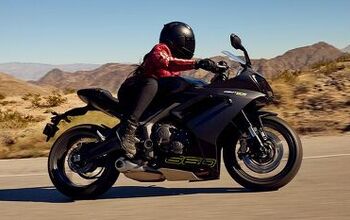
If you're looking for a ride to show off on, the GSXR shows itself off pretty well. The styling is aggressive and balanced, with some futuristic touches like the exposed engine cases, built-in turnsignals in the rear and tucked-in rear fender. We all liked the electric-blue treatment on the wheels; Ole called it "absolutely gorgeous" and liked the way it made the wheels stand out. Sean The GSXR in its native habitat. said the bike was "an absolute stunner in direct sunlight." Mike was a little less appreciative, saying that the instrument display "just looked exceptionally cheap" and that the long shift linkage looked like an afterthought. However, nobody could deny the bike has a compact, aggressive look that sums up what a 600-class sportbike should be. 

Slipping aboard, we all noticed a very tight riding position. The bars seem lower than the larger GSXR's, and the pegs a bit higher, too, although they are adjustable for three positions over a 14 mm range, a classy and welcome touch. Eric noted that even if it did feel "like it had a "sit-in" (instead of "sit on top" feel), the short-tanked GSX-R felt best... [it's] the most oddly comfortable of the lot." Gabe also liked the cramped quarters, noting it felt comfortable and familiar on the track, the way GSXRs often do. Tall guys might not agree with our more dainty testers; Ole complained that "for riding long distances, the GSXR6 is the worst of this bunch". However, nobody buys these things to tour on (unless they are masochistic or jockeys, or both) and we          mostly agreed that the difference in comfort levels between the bikes was negligible.

What we do buy middleweight sportbikes for is that precision-engineered, high-rpm kick-in-the-ass we love from these little screamers, and the GSXR has it. We all noticed the soft low- and top-end power from this motor, with Sean calling it "a bit lacking" in the power department and Eric noting he was "dropping down into first and second on the Suzuki where I was in second and third on the Triumph." The rest of the testers found the power delivery somewhat bland, contributing to the overall average feel of the bike.

Sean spanking his other monkey. The gearbox is typical Suzuki-good, with a short throw and positive, smooth action; Eric stated "as always, the GSX-R wins the slick-tranny award". Only Mike noted slight difficulties getting into first or neutral without feeding a bit of throttle. Overall, as a street motor, the GSXR is probably the weakest, even if it is tied for most horsepower with the Yamaha R6 at 111.3. Unfortunately, it makes that power at rpms that most riders never use at a street-riding pace.

We might not have been too impressed by the motor, but we liked the handling. The GSXR, although it might have a "screaming, head-banging, mosh-pit kind of" reputation, according to Ole, is a pussycat in the handling department. Even though Sean found it "not as plush" as the other bikes, the suspension and chassis are very well set up, making everyone confident and comfortable in most sorts of turning situations, whether making U-turns for photo passes or 100 mph, knee-down racetrack turns. The brakes are great, too, with all the power and sensitivity you'd expect from this kind of brake arrangementut.

Extra-bendy journo on a super-rigid bike. Like the motor, where the chassis on the GSXR really shines is on the racetrack. The harder you push it, the better it feels, which some of our testers liked and others didn't. Ole said that "it felt like I had to work at it a bit more to get the best out of it", but Gabe and Eric turned in some of their best times on the GSXR; it seems to reward aggressive, wild antics on the track. "You can          just rail on that thing" said Eric, breathless and wild-eyed after his first session on it, and Sean relished how it allowed him to "dance around the apex while carrying excellent corner speed." It's a well-engineered bike that allows a good rider to become better the faster he goes but lacks the character a less experienced rider might notice on the track. The GSXR finishing last illuminates what a tightly-contested class this is. It's really outstanding in its own right and would make any owner ecstatic, especially if they lived at the base of Latigo Canyon or right outside Mid-Ohio Sportscar Track. The GSXR is an incredible bike but is probably too track-oriented to really be considered better overall than the other machines here. The 675 and 636 have better motors, the R6 is sharper handling, and the 600RR edges out the Suzuki with its refinement and balance. However, a racer or serious trackday rider -- especially if she's a Suzuki fan -- would be foolish to discount this bike on the basis of its position in some magazine shootout written by five idiots. We think this is a winning bike, Suzuki, just not in this test.

2006 Suzuki GSXR 600 Tech Briefing

Suzuki must have been busy for the 20th anniversary of the US introduction of their mind-bending, earth-shattering GSXR sportbikes. They revamped their 1000 last year, and blew the minds of motojournalists everywhere with what might be the best sportbike ever made. Unfortunately, their 600cc tool was getting a bit long in the tooth and wasn't getting the attention and respect they felt it deserved.

The solution is the all-new 2006 GSXR 600. The fellas from Hamamatsu started with a similar frame as the 1000, with just five cast sections for maximum rigidity and minimum weight. It's mated to a swingarm that's boasts a 25mm larger swingarm mount and measures 38mm longer for better traction and suspension action. Overall, chassis dimensions are smaller and more compact, with revised rake and trail figures.

Hanging out in that frame is an all-new motor, smaller and more powerful than before. The crankshaft and transmission is designed to be smaller and more compact, (although the crank is 16 percent heavier to "add traction during cornering") and the whole assembly is rotated forward in the frame for better mass centralization. An all-new back-torque limiting clutch is also new for 2006.

Brakes are still twin four-piston, radial-mounted calipers, but they now grip 310 mm discs. The rear caliper is now lighter as well. Forks are 41 mm and adjustable for preload, damping and rebound, and the rear shock sports a "16mm larger rod", according to Suzuki's website. It must be getting the same spam we are.

Other features include a new instrument cluster with a gear position indicator, all-new aerodynamic bodywork, super-light aluminum alloy wheels, a bigger, trapezoidal radiator and some very cool, adjustable footpegs that every sportbike should have. The whole package weighs in the same as last year's bike at 355 pounds and sells for $500 at $8,799. It's available in four colors: red, blue, black and grey.


Fourth Place: Honda CBR 600RR

The Honda makes even the slow look fast. How can a bike this refined, this well-balanced, this exquisitely well-crafted come in fourth place in this shootout? The competition is really tough, but how can Honda, with R and D resources like the Pentagon's not beat the smaller upstarts?

This is a bike that is nearing the end of a four-year life cycle, eons in middleweight sportbike years. However, we've always really liked it. Gabe and Sean both picked it as their favorite track bike in our 2005 comparison test, so it doesn't lack in handling prowess. So why didn't it win?

None of us had any complaints about the styling. The aggressive, RC-211V- inspired bodywork looks great, and the center-up exhaust set the standard for trick, even if it does reduce under-seat stowage to almost zero. Overall, the styling is as polished and finished as the rest of the bike is.

On board, the bike fires up smoothly and easily, with an electric-smooth feel from blipping the throttle. The motor is eerily smooth on this thing, as is its bigger brother, the 1000RR. The gearbox is also faultless, with a feeling like you are clicking the knobs on an expensive piece of medical equipment as you row through the gearbox. The fuel injection is the best, "combining great accuracy with smooth delivery", according to Dirty, who knows a thing or two about injection.

Smooth and sophisticated (the CBR, not Gabe). Comfort and day-to-day living with this bike is pretty run-of-the-mill for a middleweight sportbike. The bars are low, the pegs are high, and the seat is hard. "No part of the Honda's ergonomic layout stood out", according to Eric, but Gabe didn't find the comfort level as objectionable as he thought he would. Around town, the push-up body position can be painful for extended periods if you're not going fast enough for the wind to prop you up; again, that's to be expected in this company. We're not on sport tourers here.

What this bike is built to do is deliver confident, effortless handling under all kinds of riding conditions, and it has that in spades. Every one of us noted how easy the Honda is to ride fast, and how well-built it feels. Whether Ole was on the street or track, he reported it was "totally effortless and easy to go very fast" on the little red bike. Eric said the Honda spoke to him "in all the right ways. It has an electric-smooth powerband, flicks easily, is super-stable and the chassis gives great feedback." Even Sean, demanding an expert that he is, praised the RR for feeling like it was "carved from billet."

Braking and suspension action are top-notch as well. The big brakes deliver outstanding feel and response from one or two fingers, and the unit pro-link rear suspension is as precise and well-balanced as the rest of the bike is. It all adds up to what Mike called a "well balanced, almost reassuring" feeling.

Rowr! The brilliance of the CBR is the way it can inspire confidence on the track, and we all liked its racetrack performance. Ole said "on the track, the 600RR was totally effortless and easy to go very fast on", and Sean maintains that it "plasters a grin across your face as soon as you roll it out of pit lane. No other machine can combine this much racetrack prowess with a friendly a nature like the CBR." Like the GSXR, this is a good choice for those who want an incredibly competent chassis to build their cornering skills in a controlled environment.

However, that competence is marginalized by what we all thought was a soft or characterless motor. Gabe loved the smoothness, but even Mike, with the least track experience, complained of having to downshift more often to pass or gather a head of steam. On the dyno, the RR puts seven less hp on the ground than the top middleweights, with not much on tap below 8,000 rpm. Eric Putter wryly complained of having to ride the "low-power version" of the Honda and was reminded that "these damn 600s are weaklings; the CBR the weakest of the weaklings", but was happy to spend his first two track sessions on the "mellowest bike of the group". It seems tough to nit-pick the Honda over seven horsepower, but in this kind of competition, that's a large gap, especially compared to the R6's monster top-end rush and the Triumph and Kawasaki's mid-range stomp. Anybody who buys a Honda will not be disappointed, for sure. It's an incredible-handling, balanced bike that has enough power to win races with a competent rider aboard, but on the street, most riders will notice a comparable lack of power. Great handling and quality feel isn't enough alone to get top billing in this test; the Honda was close to tying the next two bikes, but close only counts for horseshoes and hand grenades. For $8,999, the same price as the much more-exciting 675 and just $200 less than the explosive and dripping-with-technology R6, Big Red doesn't offer enough of a value to top the list here. To quote the Soup Nazi: Next!


Two-way Tie for Second: Yamaha YZF-R6 and Kawasaki ZX-6R

Mean and green and comin at 'cha. What is interesting about this two-way tie (and we rarely tie here at MO; a first-place tie will result in the senior editor casting a tie-breaking special vote) is how different these two bikes are. Both machines make similar horsepower and weigh almost the same, but they take different approaches to how they get deliver riding goodness.

We covered the Kawasaki 636 in last year's shootout, and it took second place last year as well. It's a balanced, comfortable bike that has a stomping mid-range hit; whether you think adding 36 cc of displacement to get that stomp is cheating is beside the point.

Styling is just OK; we don't think it has the same visual impact of the 2003-2004 ZX-6R. It's more bulky and burly than the other bikes, with little to distinguish it visually from the ZX-10R. The tail-mounted exhaust looks great but reduces underseat storage. In the cockpit waits that same crazy bar-graph tachometer that has been replaced in the ZX-10R. Eric complained "with all the ZX-6R's horsepower fighting for my attention, that tach is a terrible joke." Almost everybody griped about it, and all we can say is that the 636 has enough midrange so you don't really need to look at your tach. However, there's also a lap timer and a programmable shift light, which classes up the instruments package to an acceptable level.

Mike tries out a 'little' bike. Once in the saddle, you can notice how comfortable and plush it is, which belies the less-comfortable low bars and high pegs. Sean declared that "on the street, the Kawasaki's cushy seat is compromised by what seems like too long of a reach to the bars." Gabe spent a few days cruising around the LA basin on the 636 and thought the comfort was totally acceptable, as long as you don't spend too many hours in the seat and you keep moving fast enough to keep the weight off your wrists and lower back with the wind blast. Mike noted the 636 "felt bulky and heavy compared to the other 600s, even though I know it weighs about the same", and Eric agreed; "With its wide tank, the Kawasaki felt like the biggest of the group -- and this wasn't a bad thing on the street." Some of us don't want a bike so tiny it disappears; the Kawi has a substantial, comfortable presence, making it a good street ride. Ole even went so far as to say that "If I was choosing a middleweight with the expectation of doing repeated 500-1000 mile days, I'd choose the 636."

What helps is that motor. With 108.6 hp and as much torque as the Triumph's 675 cc triple, this is the bike for the lazy middleweight pilots among us. The midrange -- fatter on the dyno chart than the 675's -- lets you leave it in a higher gear than some of the more peaky bikes. Gabe noticed carrying two gears higher in some turns at Buttonwillow, and Eric liked the "killer midrange pull". Still, how that midrange feels is subjective, and Ole thought it still felt "like just another 600cc (or so) inline four." 675 ownership makes one jaded, apparently.

Did you guys see that Walmart... the Google directions put it around here somewhere! You can't hide from that famous Kawasaki intake shriek. Dirty said "this new bike seems a bit louder than last year and there's a mischievous note to it throughout the mid range." It sounds so good you want to ride in that higher rev range all the time, but the "vibration in the tank and seat from 7,000 to 10,000 rpm" was noticeable to Eric, which might put a damper on listening to that music as much as you'd like.

We don't buy bikes to listen to (or do we?), so how is the 636 in the handling department? Like the Honda, the Kawasaki makes the rider feel at home much of the time with precise, yet stable handling. Mike noted the bike felt stable leaned over, yet quick to steer. Sean thinks he might have set his fastest times on the green machine if our track day hadn't been rained out. Gabe appreciated the balanced and neutral feel the bike had; that high comfort factor goes a long way towards making you faster in the twisties as well as making long commutes tolerable.

On the track, the meaty powerband, balanced handling and comfortable feel made it a favorite bike for many of our testers, although Eric said it "offers less chassis feedback than some of the sharper tools in this pack", even though it was setup well for trackdays. This could be a perception caused by the larger, wider feel this bike has. Brakes and suspension are top notch, and the slightly shorter front tire profile (a 120/65-17 rather than the 120/70-17 the other bikes use) didn't cause any noticeable handling issues.

That's the Kawi; a solid, dependable, comfortable bike that also has pretensions of being a "headbanging rocker which would make you want to grab the shotgun and a couple of Molotov Cocktails and have a little fun", according to Ole. However, it's anything but. Instead, you get a good all-around mount that can still carve it up at a trackday or win a club race or two. And even if it does have all the power and torque the 675 does on paper -- and much more midrange than the R6 -- it still doesn't stand out enough to overcome that big, heavy feel. What do you expect from a company that calls itself "Heavy Industries"? Still, the 636 is a terrific bike that would make most riders happy for a long time, as long as they haven't ridden a 675 or an R6. "I was just about to sign the check for a 636" said Ole. "Now, I'm glad I didn't."

For $8,699, this bike is a value compared to some of the other bikes and a solid performer. Second place two years in a row is impressive in this company; well done Kawasaki.


View all Photos | VideosPHOTOS & VIDEOS

06 600s BikesMulti 2122
06 600s Kawi 1886
06 600s Kawi 1886
Z Logo Pirelli Corp
Z Logo Pirelli Corp
06 600s Triumph 2567
Get Motorcycle.com in your Inbox