1999 600cc Supersport Shootout

Head-On Collision

story by Staff , Photograph by Bruce Kusada, Created Feb. 23, 1999
BACK TO THE ARTICLE PRINT

LOS ANGELES February 23, 1999

The hype has been intense: At the end of '98, pervasive rumors claimed that Yamaha was developing a 600 supersport counterpart to their ground-breaking YZF-R1. Honda, it was said, was tooling up a fuel-injected replacement to the F3. Suzuki? Nothing new here, they just kicked butt on the race track, taking home the coveted AMA 600cc Supersport Championship in 1998 on their supposedly out-dated GSX-R600.

Meanwhile, Kawasaki redesigned the ZX-6R, melding both track performance with street-going comfort, offering a combination of light weight, comfort and performance that proved so popular in Great Britain that for the first time in years the ZX-6R outsold Honda's CBR600F3.

Parity in the 600 class, it seems, had been achieved. Pete Rozelle wept from his luxury box in the sky. Some of the rhetoric proved to be true: Both Honda and Yamaha developed two all-new 600cc supersports: The still-carbureted but significantly refined CBR600F4 and the R1's close cousin, Yamaha's YZF-R6, respectively.

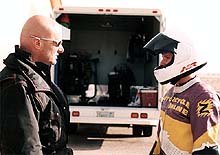
MO Editor Brent Plummer, AMA Pro Thunder and 250 Grand Prix Champions Paul Harrell & Roland Sands get ready to burn it up. Managing Editor Mark Hammond and Plummer decide who will be to blame for the missing van door.

"It seems that enthusiasts are being polarized into two basic platforms from which to choose their dream machine -- all-around high-performance bikes such as the Kawasaki ZX-6R and Honda's CBR600F4, or more single-focused track scratchers such as Suzuki's GSX-R600 and the Yamaha's YZF-R6."

Overview

Back to the real world, early 1999 to be exact. You've impatiently waited for the new machines to come out, and now it's time to plunk down some hard-earned money. So you want to know the skinny, right? Well, to aide in your quest, Motorcycle Online enlisted the help of reigning AMA Pro Thunder and 250 Grand Prix Champions Paul Harrell and Roland Sands to help us out in our 1999 600 shootout.
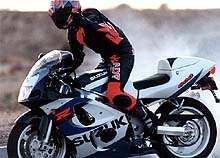
An unusually pensive Roland Sands caught in a rarely seen moment of calm reflection.

We chose to test the motorcycles using stock tires since many of our readers will use them until they are worn out and because changing tires can significantly change the characteristics of a motorcycle. Not that it mattered much, because the tires are very similar -- the Honda, Yamaha and Suzuki are shod with Dunlop D207's street tires and the Kawasaki comes with Bridgestone BT56s. The only drawback in using stock tires was that track and drag strip times would suffer -- surprisingly, we struggled more at the drag strip with the relatively slick stock tires than at the race track -- otherwise using stock tires didn't favor one bike over another. Each bike's performance stood on factors not related to tire selection. Still, for those of you who are fit to be tied that we didn't swap tires, flame us now.

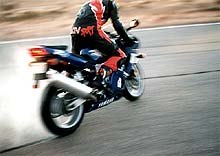
Sands on the highly anticipated R6, performing his most dangerous stunt, the Headless Burnout.

The most anticipated bike heading into the shootout had to be Yamaha's YZF-R6, a motorcycle seemingly designed to elicit over-the-top superlatives from the motorcycle press. We rode the CBR600F4 at the Las Vegas Speedway and came away impressed with it's superb balance. We looked forward to putting more miles on the ZX-6R as it'd been months since we rode one. It had also been a while since we rode the GSX-R600, two years in fact, back in our 1997 test, and we were interested in seeing how it faired against the new generation 600s on the Streets of Willow Springs, at the Carlsbad Raceway Drag Strip and highways of greater Los Angeles.

Anyhow, enough of the bollocks, let's get on with the test.

4: 1999 Suzuki GSX-R600
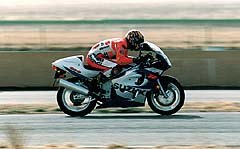
Paul Harrell carefully assessing the Gixxer's roll-on power: "Yeeeeeehaaaaa!!"

The oldest platform in the test, the Suzuki GSX-R600 has been tweaked throughout its three-year lifespan. In 1998 it received a larger airbox, revised exhaust system, different cam timing and reshaped ports to improve power across the powerband, and in 1999 Suzuki fitted the Gixxer with revised carburetor intake funnels, different jetting and a new igniter box for improved high rpm power.

Peak power was improved: The GSX-R600 made 91.9 bhp at 10500 rpm and 45.1 ft-lbs of torque at 9500. That's a decent jump over our 1997 test model that posted 88.7 bhp at 12,000 rpm and 43.4 ft-lbs at 10,000 rpm.
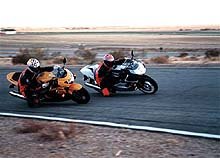
The GSX-R on the track, passing other bikes, leaving them behind, until it's out in front and, ultimately ...

"Mid-range power also improved, and next to the F4 the GSX-R made the second most amount of torque."

The driveline lash that was so prominent on our 1997 test bike wasn't noticed in this year's model, but the riders complained of a flat spot around 10,000 rpm. We noticed carburetion difficulties on the 1997 GSX-R600 and we suspect that Suzuki still hasn't sorted out this problem.
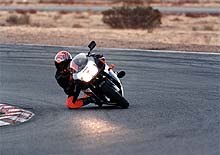

... alone. (sob) Oh, this world can be a hard, lonely place for the swift. Oh, cruel humanity ...

"It doesn't really feel like a flat spot," quipped Editor Plummer after drag strip testing, "but rather, it seems that either the carburetor needles are wrong or the throttle slides are rising at the wrong rate, either too slow or too fast, but in any event the power feels flat when you're on the gas and shift gears at redline -- there's a highly noticeable lag in the power. In a sense, that's good news, and jetting is easily correctable, while some strange cam/exhaust pipe problem isn't." The Suzuki made the least amount of peak horsepower, a factor that might have helped produce the slowest times at the drag strip -- 11.149 seconds for the quarter-mile at 124.84 miles per hour.

However, we believe that imprecise carburetor settings were the most likely culprit, as Editor Plummer -- who does the drag strip testing -- felt the Suzuki "would have hauled ass" on the drag strip if the carburetion problems were solved. In addition, the GSX-R600 was our least favorite street bike in this test, with many testers complaining of inordinate amounts of vibration, especially at higher rpms. The uncompromising riding position on the GSX-R didn't win a lot of positive feedback and the bike never felt quite right unless ridden at a ten-tenths pace.

"Suzuki pays more to club racers than anyone else in America."

Still, the brakes were good and the GSX-R600 might have the best stock chassis set-up in the entire test, although the shake and rattle lends to a perception of a less-than-finished motorcycle. Yet straight out of the box the Suzuki was perhaps the best race-ready motorcycle. Editor Plummer recorded his fastest lap times at the Streets of Willow Springs on the GSX-R (the fastest GSX-R time was Roland Sands at 1:15.02, Plummer was about a second behind) and it wasn't until the suspension set-up began to be significantly adjusted that the racers' lap times on the other three bikes began to pull away from the GSX-R600. "Roland and Paul started going much, much faster on the other bikes in the afternoon," says Plummer, "but I never could get a confident feel from any of them, especially not in the front end -- no street bike seems to feel as planted and secure as a good old GSX-R. While pros have the ability to go beyond their immediate impressions, for the rest of us, it's hard or impossible to go fast on a bike that doesn't feel planted. If I were going club racing, the Gixxer would be my choice, for sure."

Also in it's favor, the Suzuki GSX-R600 has been around for a few years and there is a host aftermarket parts available for racers, not to mention the Suzuki Cup -- at over a million dollars, Suzuki pays more to club racers than anyone else in America.

3: 1999 Kawasaki ZX-6R
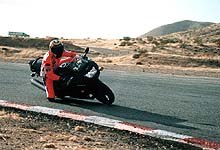
(Sung to the tune "No Particular Place To Go" by Chuck Berry) "Riding along on my ZX-6R ..."

Last year something rare happened over in Great Britain: For the first time in years the top selling 501 to 700cc class motorcycle was not a Honda, it was the Kawasaki ZX-6R. Aiming at the CBR600F3, the ZX-6R offered light weight, high performance and excellent handling characteristics along with improved aerodynamics, weather and wind protection, and relaxed ergonomics for a more comfortable street ride. The design worked, and Honda was forced to play catch up.

In 1997, the ZX-6R placed last in our comparison. Vague front-end feedback along with low-profile stock Bridgestone tires resulted in a front end that "pushed" and "tucked" in corners.

Even with race-compound tires the vague feedback on the 1997 ZX-6R continued and the lack of front-end feel was responsible for relegating the old 6R to last place.

The 1997 ZX-6R had very narrow triple clamps that didn't give much turning leverage. Kawasaki engineers addressed this by widening the handlebars, which also made the ZX-6R more comfortable, even though we thought the old ZX-6R was not an uncomfortable motorcycle. Kawasaki also stiffened the chassis and improved the suspension. As a result handling improved all around. At 445 pounds with a full tank of gas, the new generation ZX-6R is also about 18 pounds lighter than its predecessor, but is still the heaviest motorcycle in the test.
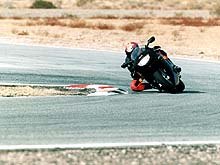
"To go fast on this bike is not really that hard ..."

Throttle response on the ZX-6R was excellent, so was the positive-feeling gearbox and strong clutch (try as we might we couldn't fry the clutch at the strip). The linear power delivery and higher-profile stock Bridgestone BT56 tires helped the ZX-6R post the fastest times in the quarter mile.


With peak power outputs of 94 bhp at 12,750 rpm and 44.2 ft-lbs at 10,500 rpm the 6R ripped off a 10.937 second quarter mile at 127.41 miles per hour at the slower, slicker, sea-level Carlsbad Raceway (the 1997 ZX-6R posted a 10.79 quarter-mile at the LACR, a faster track at higher elevations that also posts very generous corrected times, usually by about three or four tenths of a second).

"Overall we thought the Kawasaki was an excellent street bike..."

Stoplight to stoplight Kawasaki intends to be the fastest, and with the ZX-6R they're living up to their promise: "The Kawasaki rocks!" barked an elated Plummer after ripping off a 1.7-second 60-foot time and a high 10-second quarter mile. "It's the only bike with precise throttle response and inherent traction off the line -- if you want to smoke your pals at every street light, you'll be hard-pressed to find any bike, big or small, that'll run with the 6R from zero to 60."
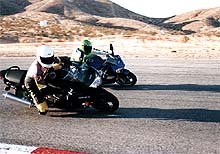
"Around and around on a track don't you know ... There's no particular place you go ..." (Repeat with appropriate air guitar)

A comfortable, easy-to-ride street bike with a great engine, smooth throttle response and wide powerband that handled well on the street, the ZX-6R lagged behind the Honda and the Yamaha at the track. It's at least 10 pounds heavier than the competition, feeling slow entering corners and not reacting well to mid-corner line changes.

The six-piston caliper brakes -- which are the same excellent Tokico calipers used on the GSX-R and the Team MO race bikes -- didn't have the same initial bite as the others, so consider changing brake pads if you own one. The ZX-6R's fastest lap at the Streets of Willow Springs was Roland Sands' 1:14.31, faster than his best GSX-R time but almost a full second slower than the fastest times recorded by the CBR600F4 and the YZF-R6.

Still, the new ZX-6R is an enormous improvement over the old '97 model. Overall we thought the Kawasaki was an excellent street bike -- two staff members gave it second place votes -- with a wonderful motor but its size kept it from overtaking the lighter, more agile Yamaha and Honda.

Page 21 (Tie):1999 Yamaha YZF-R6

Like Yamaha's YZF-R1 last year, the YZF-R6 is perhaps the most anticipated motorcycle of the year. Perhaps the sexiest looking Japanese sportbike made, the YZF-R6 is an uncompromising extreme supersport, which for some riders may be its biggest flaw. This is a motorcycle that is certainly not for everyone, evident from the diversity of opinions from our testers: It received three first-place votes and two third-place votes.

This bike likes two things: Going fast and leaning.

The YZF-R6 is a motorcycle that demands a more aggressive, physical riding style and rewards form. It can be unforgiving: The rear end is light, and tends to spin the tire if it's not warm -- Harrell almost highsided the R6 while putting around the track for the first time and at slow speeds. At higher velocities it has a slight tendency to run wide and it requires a smooth throttle hand. Although the power charts don't really show it, the R6 spins quickly up into the higher rpm range. The power and acceleration rush reminds one of a two-stroke GP 250 bike, soft at the bottom but accelerating fast and hard to redline. But don't forget the R6 is a four stroke. Engine breaking exists, in fact it is a bit more pronounced than on the others.

It likes those two things so much ...

If not careful, a ham-handed rider used to slower-revving and more-forgiving four strokes might find himself involuntarily wheeling away from a stoplight (not necessarily a bad thing) or draped over the handlebars under braking if he's not careful.

With the exception of needing heat in the rear tire, handling is rock-solid: Pick your spot (any line is fine, but early is better), lean over, accelerate throughout the turn then try to wipe the smile off your face. And you'll still feel like you could have pushed it harder through the corners.


... that try as we might ...

At 420 pounds measured the YZF-R6 was the lightest motorcycle in the comparison. Although Paul Harrell recorded the fastest time of the day on the F4, the R6 has a prodigious amount of ground clearance, and with race-compound tires we suspect that the R6 might have posted faster lap times because the F4 was already at the limit of its ground clearance.

Of course, with a race pipe and footpegs, the Honda could've kept up, so suffice it to say that, in box-stock form, the Honda is slightly faster. Paul's best time aboard the R6 was 1:13.47. Roland's fasted lap of the day on any motorcycle was aboard the R6 at 1:13.96.

... we couldn't photograph the stupid bike doing anything else.

The YZF-R6 was such an anticipated motorcycle that the hype at times overtook reality. True, the R6's redline is an over-the-top 15,500 rpm, but its power peaks where the remainder of the test bikes top out -- at 12,750 rpm -- although the R6 still produces a whopping 88.8 bhp at 15,000 rpm. Such prodigious over-rev will be a great advantage to racers while a relatively big bike that revs to 16 sure does look cool on the street. The other piece of hype that should be discounted is that the R6 will produce well over 100 bhp at the rear wheel. While our R6 produced only 94.8 bhp, most stock R6s tested so far made between 94 and 97 bhp, excellent numbers but not quite the 103 - 107 that a few journalists (including MO) speculated.

Leaning way over, going really fast, leaning way over, going really fast ... Sheesh.

The YZF-R6 didn't perform particularly well at the drag strip, posting a 11.107 second quarter mile at 125.96 miles per hour, third fastest in the test. The R6 doesn't have a lot of torque -- 42.2 ft-lbs at 11,750 rpm was the lowest of the four bikes -- nor power down low but it revs so quickly that it makes up for it, particularly on the track.

Smooth launches were difficult, however, the quick revving engine and the enormous power hit between 9500 and 12,750 -- an over 40 percent increase in power (from 66.5 to 94.8 bhp) -- along with its light weight conspired to repeatedly lift the front wheel off the ground, even in second gear.


Is this a dull pile or what? If all bikes were made this way, can you imagine how utterly boring bikes would be?

Still, with its tight handling, great brakes (the strongest initial bite) for track riding, its adrenaline-producing power and acceleration, and its sleek, aggressive styling, the YZF-R6 was the bike of choice among the pro racers and our in-the-midst-of-a-mid-life crisis Managing Editor. It isn't as comfortable on the street as the F4 or the 6R, -- especially annoying is the handlebar position, which smacks your hands into the gas tank at full lock in either direction -- but it is not uncomfortable and it's certainly better than the GSX-R. Besides, Yamaha already makes an excellent all-purpose 600, the YZF-600, MO's 1997's 600 Supersport victor. Positioned as an extreme supersport for more skilled riders, the Yamaha YZF-R6 promises to become the canyon scratchers and part-time racers' bike of choice.

1 (Tie): 1999 Honda CBR600F4

Not again. One man's fun is another's headache.

The battle for 600 Supersport supremacy boiled down to a choice between raw attitude versus refined balance. While attitude carries more pop currency, balance should not be ignored.

What Honda achieved with the CBR600F4 is nothing sort of remarkable, creating a high-performance 600 supersport capable of winning Championships while not sacrificing the comfort and versatility that made its predecessor the top selling sportbike in the world. It should also be noted that while Kawasaki, Suzuki and Yamaha produce other, more-street oriented 600s, Honda chose to make only one 600.


Harrell, hauling bootay and carefully examining the asphalt for imperfections.

To do what Honda did -- design a motorcycle that in many circumstances will outperform other OEM's race-replica supersports yet remain as comfortable and easy-to-ride as the competition's street-oriented 600s -- should not be underestimated. Perhaps no other manufacturer could pull this off.

If you take delivery of a stock CBR600F4 with the suspension set at stock and ride home down the freeway, you'll swear you were on a plush sport tourer. When you're home, crank on the very accessible and easily adjustable spring, preload and compression and you'll have a super-fast, super-tight, aggressive canyon scratcher.

Ahhh, upright.

The F4 is light: at 428 pounds wet, only the R6 is lighter. The versatility of the F4 is amazing: This is a bike that can be enjoyed equally by both the expert card holder and the intermediate rider fresh from track school.

Pick any line going into the corner, flick it over and the F4 obeys without complaints. Mistakes are forgiven while smoothness is rewarded. The brakes are excellent, and although they don't have the same initial bite as the R6's, they are more progressive.

"The thing is, the bright yellow bike is so comfy that going in a straight line for awhile isn't such a bad thing."

If it's true that the YZF-R6's uncompromising handling and performance are also its flaws the same may be said for the CBR600F4's forgiving and refined balance. Without nary a care you can throw the Honda into a corner and the F4 will do as commanded. However, the CBR600F4 is almost too easy to ride, it takes almost too little forethought.

With appropriately hot tires, Plummer begins his patented "One-Wheel Pass".

While a blessing for intermediate riders, experts might actually become bored on the F4, even if they are in reality going faster.

For example, while both racers preferred the R6 over the F4 and Paul Harrell was unequivocal in his preference for the Yamaha, his fastest lap of the day was actually on the F4 at 1:13.17 seconds, a half a second better than his fastest lap on the R6 and almost a full second faster than Roland Sands' best lap, which was on the Yamaha. Paul commented, although facetiously, that on the F4 he almost felt like he was on a cruiser, so friendly and comfortable and effortless was the ride.


Not quite a wheelie, the trick is to gently lift the front wheel only an inch or two off the ground ...

For some riders -- Paul included -- Honda's emphasis on refinement and balance is less desirable than viscerally thrilling acceleration. Thrills aside the Honda had the most powerful motor, with horsepower measured at 97.4 bhp at 12,750 rpm and torque at 45.2 ft-lbs at 10,500 rpm.

The CBR600F4 posted the second fastest drag strip times of 11.049 seconds at 127.04 miles per hour. There is ample power down low, yet the throttle response was not as smooth as the Kawasaki's, and like the Yamaha and GSX-R there was a slight hesitation when first opening up the throttle before the power suddenly hit, making the F4 susceptible to wheelies off the line.


... and hold it for the duration of the pass. This is a difficult skill to master, and we're not quite sure how or why he did it, but we were all impressed anyway.

The F4 shifted as smooth as butter -- better than any of the other bikes tested here -- but its clutch turned out the be the weakest among the bikes, frying after only 11 passes.

The CBR600F4 was clearly designed with street riding in mind. It was the most comfortable bike for long distance and freeway riding. Wind and weather protection is excellent, and the rider is a little more upright and the footpegs are a little lower than on its competition. This makes for great street ergonomics but sacrifices ground clearance. On the track, in order to keep up with the Yamaha, we had to grind the heck out of the footpegs and muffler.

Overall the CBR600F4's balance and refinement helped push it into a tie with the YZF-R6 for 600 supersport supremacy. It was the only motorcycle to either be voted in first or second place by each evaluator. For racers and extreme riders, the R6 seemed to be the bike of choice, but for those who need that rare motorcycle that can do everything from high performance track scratching to spirited sport touring to comfortable long distance freeway riding, the CBR600F4 is your motorcycle.

True, the F4 is street oriented, yet it surrenders nothing when it comes the supersport performance. Thrills and raw performance grab attention, particularly among motorcycle journalists, yet refinement and balance is not any less valuable. There might not be a more refined high-performance sportbike made, for that not-so-small feat of engineering we believe the F4 deserves a share of top honors.

Page 3Conclusion

Basically, the voting guidelines are as follows: Money is not a factor because all the motorcycles are roughly the same price. Evaluators were asked pick the bike they'd most likely plunk down their own hard-earned cash on, then rank the remaining bikes in descending order. Yes, these decisions are somewhat subjective but we've come to believe that there is no quantitative way to evaluate motorcycles. Bikes are a passion and many factors come into the mix, some of which are more important than others, but none of which are universal for all enthusiasts. A motorcycle might have all the right parts yet for a number of reasons the evaluator just didn't click with it.

Man, machine, and track, locked together in an -- uh ... Where'd everybody go?

To help protect against tests becoming too subjective we try to enlist as many opinions as possible in order to achieve a consensus. Also, the voting system keeps personal bias out of our stories -- any form of conspiracy would, by default, require that everyone agrees to conspire, which is far too complex for our simple minds, as we're still fighting over what's for lunch.

The bikes were ranked 4, 3, 2 and 1, respectively, with the last place motorcycle receiving one point per evaluator and the first place bike receiving a point total equal to the number of motorcycles tested plus a one point bonus for being voted first. In this comparison a bike chosen for first place received four points plus an extra point for a total of five points per evaluator. The second place bike received three, the third place two and the last place bike received one.

The results broke down as follows:

Paul Roland Brent Mark Greg
1 YZF-R6 YZF-R6 CBR600F4 YZF-R6 CBR600F4
2 CBR600F4 CBR600F4 ZX-6R CBR600F4 ZX-6R
3 GSX-R600 GSX-R600 YZF-R6 ZX-6R YZF-R6
4 ZX-6R ZX-6R GSX-R600 GSX-R600 GSX-R600

The Honda CBR600F4 and the Yamaha YZF-R6 tied at 19 points a piece. The ZX-6R came in third with 11 points and the GSX-R trailed with seven points.

Zees Roland is a jaynyus! Zee whole verld ees hees subjekt! Zee track ees hees canvas, zee motorized cycle, hees broosh!

"In short, this is a class where just about every riding style and desire is satisfied."

The racers liked the GSX-R for its excellent performance on the track but voted it lower than the Yamaha and the Honda because its design is a little long in the tooth and it's a little heavier and down on power.

The journalists simply didn't like it on the street. The racers didn't like the ZX-6R because it was the heaviest and the hardest to handle on the track. The journalists liked the ZX-6R because its was comfortable, had great throttle response and went the fastest in a straight line, great for dusting that annoying squid next to you at a traffic light. Everyone respected the balance and refinement of the CBR600F4, journalists more than the racers, who, along with the Managing Editor, leaned toward the R6 because of its styling and thrill factor.

In short, this is a class where just about every riding style and desire is satisfied. Expert and extreme canyon scratchers may lean toward the YZF-R6 while those who want a high performance motorcycle without sacrificing comfort may lean toward the CBR600F4. The ZX-6R will have many fans among those who are enthralled by its awesome motor and straight-line speed, while the GSX-R will still remain the club racers ride of choice because of Suzuki's large contingency program and the ready availability of racing parts and accessories. There isn't a bad motorcycle in this bunch, so pick your poison and try to stay an at least one wheel.

Deep Thoughts:

1. Brent Plummer, Editor-in-Chief

"Exhilarating" and "Awesome" were the words spoken by everyone who rode the R6, and while I agree that it's a titillating ride, my only caveat is that you be honest with yourself about what you're going to be doing with your spiffy new 600.

The overwhelming majority of our readers spend their days in general commuting tasks, with sport touring a distant second.

In these two arenas, Honda's F4 and Kawasaki's 6R are better choices, so if your ego can deal with not having the latest and best 600, test ride them both -- chances are, you'll know which one is for you within a couple miles.

If flash and thrills are your ticket, bully for you, get the R6, you'll love it. Better yet, get an R1, it's twice the fun!

2. Paul Harrell, AMA Pro Thunder #1 Plate Holder

4. Kawasaki ZX-6R:

Kawasaki did their homework as far as the motor is concerned. It had power in all the right places and exiting hard on the gas made for simple, nice and easily predictable slides. It had a similar powerband to the Honda with a little more grunt on top. Unfortunately the chassis didn't support the motor. It felt heavy entering corners and was difficult to change lines mid-corner. The brakes were not as responsive as the others, making me a bit leery in places where harder braking was called for. All in all the ZX-6R can be a lot better bike if massaged in the right places.

3. Suzuki GSX-R600:

Good brakes, good chassis and an okay motor with a flat spot at about 10,000 rpm. The bike doesn't feel any different than last year's model, but it will be a serious contender if they can get more out of their powerplant. Just a good, solid bike out of the box, good for the track, good for the street.

2. Honda CBR600F4:

It was so close between the F4 and the R6. Super power and great delivery as well as a chassis to back it up. You can throw it into a corner without a care in the world and if you need to change a line, just point and fire. The brakes were great, leaving plenty of room for error. I thought: "Man, this is the bomb." That is until everything started dragging. What's up with that?

1. Yamaha YZF-R6:

This is the definition of the latest, greatest 600 supersport bike in all aspects. After the first few laps, only two words came to mind -- "bad" and "ass." It felt like a mini superbike. I found myself going back to the Yamaha every time after getting bored with all the others. The transmission is quiet and shifts well. The thing revs to the moon, which is perfect for racers who don't want to compromise one-half a tooth shorter or taller. It also felt extremely light and had plenty of ground clearance. Take any line any time, wait to see God, then brake. Even though it looks small, it has plenty of room and it's comfortable. After the track testing was over I stepped away and noticed that the bike's aggressive appearance set it apart from all the rest. It made me want to beat it with a bat just to find something wrong with it.


3. Roland Sands, AMA 250 GP #1 Plate Holder

Four strokes. I wasn't so sure about the whole four-stroke concept at first. I'm a two-stroke guy and it seems like nearly every four stoke I've ridden has left me with a somewhat empty feeling. This is not the case with the new 600s. It was a gas riding these bikes.

Truly, I was in shock at how well the new R6 handled and how much grunt the F4 had. The Kawasaki was very fast and if not for a somewhat large-feeling chassis I would have really liked this bike. The Suzuki is tried and true, a bit outdated with this bunch but a still very strong overall package.

My favorite:

"The acceleration on top was phenomenal. It screams like a banshee."

The YZF-R6. Somebody at Yamaha had the wise idea to put a 600 motor into a TZ250-like chassis. The results are stunning. The Yamaha is a four stroke that actually handles and has rock-solid feedback right off the showroom floor. I was very impressed. It felt so solid throwing it into any corner, it would just stick and say: "Hey, what up guy, I thought you could ride, but you're just slow." I always felt like I could push it harder going into the corners. The acceleration on top was phenomenal. It screams like a banshee. The powerband is like a two stroke -- soft on the bottom with power on top. Can you say whoosh? And the brakes are just bad ass.

The CBR600F4 was my next choice. I liked this bike a lot but felt it to be geared more towards the street. The motor was just fabulous with plenty of torque and top-end boost. I was able to use the gears as I pleased with plenty of usable power throughout the rev range. Shifting was smooth as butter. My only problem was it felt as if I was riding on top of the bike instead of in it. It felt more top heavy than the R6 and was less stable upon corner entrances. Once in the corner it seemed to grip well and had very good feedback from the rear tire. I could slide the F4 effortlessly. It was also my favorite wheelie bike of the bunch. The brakes were good but not as solid feeling as the R6's.

Next was the Suzuki GSX-R600. I was very comfortable pushing this bike hard right. It has a very racy seating position and begs to be pushed hard from the get go. I love this chassis, but that is also its downfall. When your not riding to its limits it feels a bit strange. It lacks in bottom end and it also shakes and rattles more than the rest of the bikes, lending to a less-than-finished feel. Its true self only shines on the track and with this group of bikes, it's under-powered and a bit out-classed, but it's still a kick in the pants on the track. Needs some more brakes, motor and some bolts tightened or something to stop the rattling.

The Kawasaki ZX-6R had great motor, the feel and the sound of the engine gave me wood. I really dug how it came on gradually and progressively built to a howling banshee. It felt great, but I have some problems. It felt like the biggest bike of the bunch. My legs felt far apart and stretched out and it was more of a reach to the bars. The suspension felt soft and without much feel from the front or the back. We worked on the chassis and got it to turn in good but the bike just wallowed and spun the tire way earlier than the other bikes at the corner exits. It made for some exciting moments but wasn't very fast on the track. The brakes were decent but didn't have the exceptional bite of the Honda or the Yamaha. The gearbox was nice and positive.

All in all, I haven't had this much fun in ages riding street bikes. Nothing is more fun than burning the rear tire off one of these bikes coming out of a corner.

4. Mark Hammond, Managing Editor

This is me. This is what I do. All day. Every day. I look like this. Why? For a lot of reasons. Perhaps because I just read an e-mail from some maniacally angry male reader who says he's gonna write to every advertiser and potential advertiser not to patronize MO because the umbrella girls stories and the Bartels ads degrade women. Why is it that these complaints almost exclusively come from men?

Perhaps it's because one of the OEMs wants their overdue bike back today, now, pronto, but since Norman is off with the MO Van and Brent took the truck and went who-knows-where I have to pretend I'm not in when they call. Could also be because crazy George charged the race team $800 for cylinders he didn't cut right, which we shouldn't have had to buy except that the sets we already have are defective, but he won't warranty his stuff and forces us to buy new sets.

"I want a bike that makes me forget about work, forget that I live in LA, which offers great and crummy people."

Gee, here comes the tool guy with another set of $500 screwdrivers. Just what we need. Oh yeah, there's also the anal fuel guy who never invoiced us then threatens to sue over a 60-day late $35.00 race fuel invoice, never mind that it takes almost $100.00 to file suit in California anyway. It's raining, too. Wonderful. When is the landlord gonna fix the roof? Will AT&T ever stop calling? We don't want your long-distance service and no, we don't want to save money because if we did we wouldn't be racing.

The Chicago Bulls might have the worst basketball team this decade.

What does this have to do with my choice for best 600 Supersport? Everything. Like most of you, I find work, even with the cool perks MO offers (press intros, newest and coolest bikes, often before the public, being the envy of the Rock Store, etc.), for the most part a drag. I need to blow off steam. I need get as far away from work as possible. The quicker the better. That's why I ride. That's why I/you/we ride, isn't it? Because we want to, not because we need to. Instead, I need to call the plumber, the toilet won't stop hissing.

I want a bike that makes me forget about work, forget that I live in LA, which offers great and crummy people. The bike has to look cool. It has to be exciting. It has to make me focus. It has to draw me down into the garage to admire it for hours on end.

Among these four motorcycles the bike that does it best for me is Yamaha's YZF-R6. Greg and I argued about the R6 versus the CBR600F4. In an attempt to dissuade me -- if I'd swung my vote, it would've broken the tie -- he went point by point, through every conceivable category and attribute. I found that head-to-head I either preferred or believed the F4 to be superior in 15 categories, the YZF-R6 in 9 and tied in 7. Believe me, I'd be ecstatic owning any of these motorcycles, but if I had to choose, I'd own the YZF-R6 over the F4 or the Kawasaki or Suzuki. Why? It's plain and simple: it gets me off.

5. Greg McClure, Associate Editor

"My friends are so depressed/I feel the question of your loneliness …" Anthony Kiedis's words echo rhetorically through the hallways of Mark's impression. Or something. The fact is, the R6 is one fine piece of two-wheeled engineering, fast and edgy, with a breathtaking top-end rush that forces your face into a big, fat smile. Nevertheless, Mark is following his heart and not his head, and this is where most love affairs, in the end, go terribly awry.

"Give me the Dana Scully of bikes: The F4. She's intelligent, beautiful without being too beautiful, over-educated, and she secretly carries a gun and handcuffs in her pocket at all times which can come in handy if you decide to get a little wild."

What if the R6 was a potential mate? She would definitely be hot, probably hotter and faster than is healthy for most men, which is always the one you think you want but in the end turns out to be the one that rips your still-beating heart from your chest and, as you watch helplessly, devours it bite by bite, your blood dripping down her chin while she laughs and tells all your friends what a lousy lover you were.

Not that I have any experience with this, I'm just saying, you know, "hypothetically". But the point is made.

The R6 is a high-maintenance mistress, riding style-wise. She doesn't tolerate mistakes as well as others, she isn't super comfortable in casual situations, and while she's got loads of ground clearance, unless you're truly in a position to make the most of it, you'll never appreciate her true talents as often as you'd like. Sure, she's gorgeous and can fill your nights with ecstasy and your friends' hearts with envy, but she's demanding like some certain Italian mistresses that come to mind, and she won't take your crap. Nah, too much work for me, this Cindy Crawford of motorcycles.

Give me the Dana Scully of bikes: The F4. She's intelligent, beautiful without being too beautiful, over-educated, and she secretly carries a gun and handcuffs in her pocket at all times which can come in handy if you decide to get a little wild.

The F4 is wholly desirable because of her refinement. She's way comfortable without sacrificing sheer agility in the canyons (heh). You can spend hours with her and still feel like she's your best friend. She's forgiving. Get caught distracted on a sunny Sunday ride and find you might go a little wide at speed? Don't worry. Just lean her in a little more. It's okay with her. She doesn't mind. She loves you.

But decide you need to catch the guy on the R6 that just passed you? If you've got the way, she's got the will. The fact is, she's so secure with herself, the R6 doesn't intimidate her. She knows that her powerband is even and usable all through her rev range, and there aren't any sudden rushes or surprises. Sure, sure, I know: But what about passion? What about excitement? Well, it's there. There's definitely great low end and streetability, and if that isn't quite as thrilling as a night with a supermodel, well, Dana's a lot smarter. She'll never bore you and she'll indulge your weird fantasies like "Let's pretend you're an alien and I'm the curious FBI agent!"

The ZX-6R is similar, just not quite as educated and a little tamer. She doesn't carry a gun. She might still have handcuffs though. She'll indulge your fantasies, but not the weirder ones. But she's so very comfortable and surprising in a different sense. As soon as you get her alone she kicks in with that engine, and baby, you're in for a ride. Hold on, smile, enjoy it. It will always be there, and it's all yours. The ZX-6R's like Willow on Buffy, the Vampire Slayer. She's not quite as hot as Buffy, but she's got a few tricks up her sleeve.

The GSX-R is really only built for one thing, and she's looking a little grey here and there. But she's available and still pretty firm so if you're into what she's into then you can't go wrong. There's lots of examples I can think up, but nothing that won't get me in trouble or four hundred "You're-An-Egocentric-Male-Bastard" emails.

copyright (c) 2013 Verticalscope Inc. Story from http://www.motorcycle.com/shoot-outs/1999-600cc-supersport-shootout-15410.html