
In the Bag
How do we carry around our stuff?
Some of us are blessed enough to ride a big scooter or Sport Touring bike with large storage compartments. These sensible riders arrive at their destinations and can lock up their helmets, riding attire and take out a briefcase or gym bag containing their daily necessities. Maybe they even stashed some nice shoes in there, so they can change out their riding boots and look like a normal person at school, work or other activity.
And then there are the rest of us who choose a more minimal existence. We want high performance and a light feeling that a big commuting scooter can't provide, and saddlebags and a big, heavy sport-tourer cramp our style when we are lanesplitting or performing the other worthy activities that make outsiders question our transportation choices. How do we carry around our stuff?
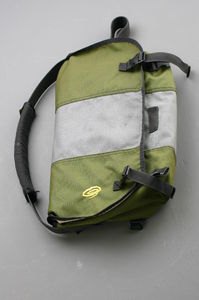
Over 20 years ago, there was a revolution in bicycle messenger bag design.
I've been using messenger bags for the last ten years or so. I like messenger bags because they don't bump into the back of your head the way backpacks do, are easier to get on and off when wearing riding gear, and hold bulky loads tighter and closer to your body so they don't shift around and affect your balance. You can also get into your bag while sitting on the bike with your helmet on by loosening up the strap and swinging the bag around to your front, where a backpack requires you to remove and unzip it, which usually means you have to remove your gloves, jacket and maybe even your helmet. I also like the tough, streetwise look the messenger bag embodies - you look like somebody who spends a lot of time riding, somebody committed enough to his riding to require specialized equipment.
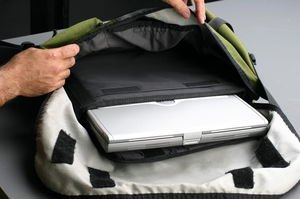
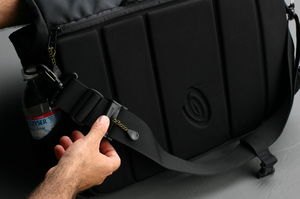
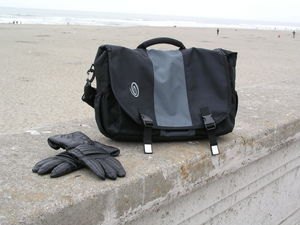
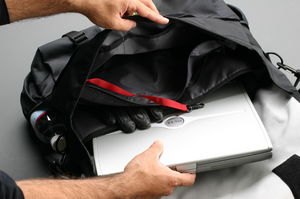
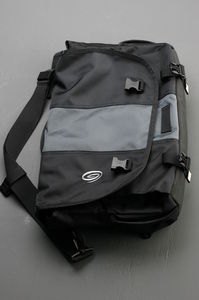
At Timbuk2, they gave me two of their messenger bags, a Commute XL messenger bag in black/grey, and a Laptop Messenger in black/red. They are very similar bags, with a few significant differences. The Commute XL (they also make the regular Commute, which is just two inches smaller lengthwise.) is more a briefcase, 18" by 11" by six inches, with a padded back wall and a detachable main strap. The Laptop Messenger is basically the standard-issue Timbuk2 medium messenger bag, but with a padded laptop compartment inside. It's a bit bigger than the XL Commute, although it's tapered towards the top, measuring 19" across at the opening and 14.5" at the base, and then 11" high and eight inches wide.
Both bags are very nice looking, well-built items. They are built out of heavy-duty Cordura and Ballistic Nylon with heavy nylon straps and hardware. The material is backed with vinyl waterproofing, and every structural seam is double-stitched. Picking them up reveals a hefty, solid feel many consumer products seem to lack these days.
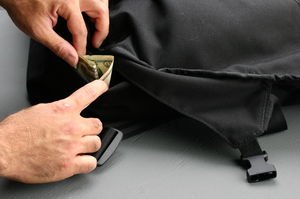
The Commute has a bewildering array of pockets. On the front of the bag, there are two large side pockets flanking a small, central pouch with a zippered compartment for change or other small objects on the front and pen cubbies inside. There is a water-bottle holder on either side of the bag, and inside, in addition to the padded and corduroy-lined laptop sleeve, there is a huge zippered compartment with two big pockets inside and a long, red ribbon with a key hook on it. On the outside of this zippered pouch are more pen pockets, along with other pouches and pockets, one lined with soft corduroy material for sunglasses or cell phones. That should be enough pockets for anybody, at least those of us fortunate enough to be medicated. Perhaps you have some undiagnosed psychological problem? No sweat: this bag has so many pockets I actually lost stuff in it. Unzip the nice padded back (complete with channels to prevent sweaty-back syndrome), and you have access to a hidden compartment, complete with still more pen pockets, cell-phone pouches and yet another spot for sunglasses. It's actually an ideal size for papers or files. The wide pouches in front are good for your laptop accessories, like a mouse, power supplies or spare batteries.
When it comes to two-wheeled use, I was much more excited and impressed by the Laptop Messenger. It's essentially the same as my six year old medium-sized Timbuk2 Messenger, but with the improved interior pockets and a laptop sleeve inside. This means it has the simple yet durable and reliable "quick-adjust" device for the 2" wide nylon strap, a paddle-like plastic cam-buckle that is incredibly easy to adjust, even if the bag is full of books and you've got your gloves and helmet on. You just pull the bag to your front, flip the adjuster lever up, pull the strap down until the bag is tight, and swing the bag around to your back. An optional (but recommended) stabilizer strap goes around your middle to keep the bag from swinging forward during stoppies or evasive maneuvers. A padded sleeve is another recommended option, which goes around the strap to prevent the kind of groove appearing on your shoulder that probably appears on both of Anna Nicole Smith's shoulders.
Speaking of both shoulders, the Timbuk2 messenger bags are designed to be used on either shoulder, which is good for southpaws and for those of us who have been repeatedly told by chiropractors to switch shoulders from time to time so we don't start walking like Quasimodo after 15 years of messenger bag usage. Some bags are setup so the sinister (Latin for "left-handed") among us can't use them.
Day-to-day living with a Timbuk2 bag is pretty sweet.
An empty or lightly-loaded Timbuk2 Messenger is unobtrusive, the tight feel of the straps giving a rider a secure feeling. With more than 10 pounds in it, though, I can feel the weight digging into my shoulder enough to make me uncomfortable, but it still doesn't effect my riding too much. More than 20 pounds and you definitely slow down. And for those short trips, say back from the grocery store where you have more than 30 pounds, wearing the strap loose and letting it rest on the seat behind you is recommended.
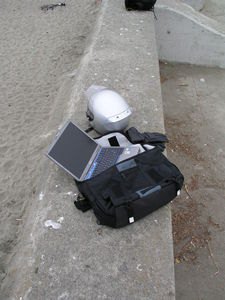
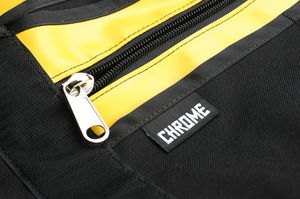
For many years now, I've seen bicycle messenger carrying around large, stylish bags with cool airline-style buckles on the front. Closer examination of the buckles reveals the Chrome logo, so I headed over to the Chrome headquarters on Folsom Street to check them out. "When people buy Chrome, they know it's made to last a lifetime."
Chrome's marketing director Rob Reedy gave me a black and yellow "Citizen" bag. Chrome is a unique company, with a commitment to only using US labor. Their factory in Colorado makes all their bags. I asked Rob why Chrome didn't follow the parade of domestic manufacturers who have take advantage of overseas production to boost profits. "First, we've been in business for 11 years, manufacturing domestically. We're American-made, period. Second, we're able to oversee everything, compared to overseas, where you don't know what they're really doing in their factory and you're just hoping things will come out perfectly. We could save 60 or 70 percent on our labor costs, but we're not interested in that - it's just not us. When people buy Chrome, they know it's made to last a lifetime." says Rob. In fact, Chrome bags do include a lifetime warranty.
The company makes four different sizes of their messenger bags, from the 20" by 11.5" Mini Metro to the garage-sized 28" by 17" Kremlin. The Citizen bag I tested is considered "medium" by Chrome standards, but it can easily swallow both of my TimBuk2 bags and still have room for dessert.

More by Gabe Ets-Hokin










Comments
Join the conversation