just forcing us to seek more time in the saddle and drooling at the prospect of trying trick new setups and aftermarket parts combos. Returning the Husky to its rightful owners was akin to pulling politicians away from PACs. Dress Her Up The '96 Husqvarna model line is adorned with considerable new stuff and unique features. Leading that category is the new Marzocchi front end, similar to the '96 KTM fork, with a different lower leg casting (and subsequent caliper mounting scheme) and Husky-specified valving. Lower leg ground clearance is good, for a conventional fork, and the Husky Marzocchis don't wad up debris in the caliper, like some others do. Husky ditched the Nissan brakes this year too, returning to quick change Brembos. The bike continues to maintain a right side final drive (chain and sprockets are found on the right side of the engine, like our old Trail King), going against convention and making the rear Brembo an identical mirror image of the KTM rear caliper--pads and major parts should still be interchangeable. Front calipers between the two bikes are completely the same.
In the unique/weird/neat category, the WXE/WXC 250 is the only 250 on the market with a six speed tranny. For that matter, even the '96 360 gets the six speed--we like this. For motor updates, a reduced-weight flywheel and Mikuni TM38 carb are the major changes, while ergonomically, the bike still comes with the best kickstand tuck-in scheme in the business and has the thinnest seat of any bike on the planet (short of a no-seat trials bike). Peek-a-boo fluorescent yellow-green/white/blue plastic finds this year's fenders fluorescent yellow-green with the rest of the bike wrapped in white. Fork guards are blue. Contemporary splash graphics decals round out the package and are plenty thick and mostly tasteful, without being boring.
PowerplantEvery rider that took a turn on the Husky came away impressed by its quick reacting and sure handling manners.
Motor performance in this trim could best be described as sedate. In the stock configuration, there is absolutely no hit anywhere in the power band, as the engine is totally choked by the stock pipe. The bike had trouble pulling top (sixth) gear in mostly level straights! I know this is going to sound bad, but with the stock pipe, the power is comparable to an untuned RMX or perhaps even a KDX. You might think that all this choking and smoothness makes the bike a chore to ride--not true! Its actually a blast once you adjust, and we're told that most New Englanders (rock riders) prefer it this way, for the lack of explosion on top. Bottom line, the stock 250 motor must be ridden like a 125 to make it go, but with the right attitude, things get moving pretty swiftly. However, where's there traction and open country, some motor fiddling (a la RMX) will be required. No doubt all top riders will want more ponies, so we went a-searchin'. First we tried messing with the jetting in the stock configuration, figuring that perhaps the perceived slight leanness was slowing things down. This proved fruitless, as output got sloppy and blubbery with our richening attempts, and performance suffered. Conclusion: the jetting specs noted above were about optimum for our temperature and altitude. No free lunch here.
Next step was to try an aftermarket exhaust system. Dyno Port is the closest pipe builder to the Trail Rider offices, so Clip dropped a line to Rich Daily at Dyno Port and not soon thereafter we had the needed hardware. Our plan was to try the aftermarket pipe with the stock silencer/spark arrestor, and then the Dyno Port Cheater silencer. The most revealing impression when removing the stock pipe is that it is so heavy that it feels as if it has a solid core! We put it on the scale and it weighed in at a portly 10.5 pounds, while the stock silencer tipped the scales at four pounds even. For comparison, the Dyno Port pieces are 5.5 pounds for the pipe and two pounds for the "Cheater" silencer (pretty easy way to shed seven pounds from an already light bike, huh?). In conjunction with the pipe change, we increased main brass from 430 to 440. Performance improvements in this configuration were huge. Now the motor pulled slightly better through the bottom end and into the transition to midrange, but most noticeably, the Dyno Port pipe really improves boost in the top half of the power band. While the bottom end still chugs, and builds power at a controllable linear pace, now the top end answers the call when things open up.
We first ran the Dyno Port pipe with the stock silencer/spark arrestor with good results; it really woke the engine up, with very little change in sound output. Later, we slapped on the Dyno Port cheater silencer and were surprised to find little increase in noise output. While the stock silencer easily weighs a couple of pounds more than the Dyno Port, there was only a subtle change in performance. On the positive side, the motor lost none of its low end grunt with the aftermarket silencer, while providing perhaps a small degree of additional top end burst.
In all, the stock pipe is a heavy double wall unit, built for sound abatement first and performance second, and just plain chokes motor performance. The stock silencer is fairly light, offers good performance and is easy to service. Replacing the stock exhaust system with the Dyno Port set up has to save better than ten pounds! This turns what is already one of the lightest fully equipped enduro 250s into a virtual cheater bike, weighing in at less than 220 pounds!
A couple of motor odds and ends. Regarding starting ease, a smallish kickstarter with short stroke gets things spinning pretty easily with the tranny in neutral and really tucks in well. The kickstarter catches on the foot peg at the bottom of its stroke until it is broken in (read: a groove worn from striking the footpeg). Once this happens, everything is fine. Motor compression/sane kickstarter gear ratio keeps kicking effort within reason. Problems occur when you stall the bike out on the trail, as the clutch has a tendency to drag, making in-gear starts difficult (but not impossible). The trick is to crack the throttle open, and then give the bike a healthy boot. Even with this technique, it often took several kicks to get things started in gear. More on this later. Another potential trouble spot is the mounting of the new Mikuni carb. Problem is that the corner of the carb bowl rests on top of engine cases. This spells potential trouble over the long term. It is possible and highly recommended that the carb be repositioned within the carb/airbox boots to fix this.

PAGE 2Handling and Suspension
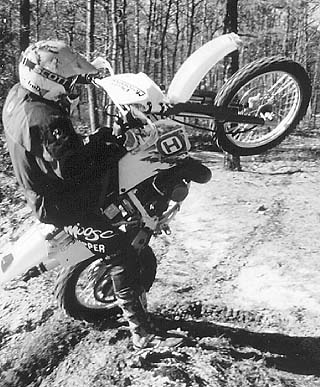
The salient word that comes to mind when riding the '96 250 WXE is "nimble." Excellent suspension action that reacts to small size bumps as well as killer whoop-de-dos, without deflection or bottoming of either end is coupled to a good steering frame that provides positive, predictable directional stability. Every rider that took a turn on the Husky came away impressed by its quick reacting and sure handling manners. The bike is light to start with (222 pounds claimed dry weight for the WXE, 220 for the WXC) and even feels lighter because of the slim ergos and grunty low-end motor. This is a mount you could manhandle all day long and hardly break a sweat. Not that you'd need to, however. The riding position allows the Husky to be steered where
you want it to go, with little concern for minor changes in terrain, like ruts, roots or holes. Steering is quick and without any hint of headshake at speed.
We didn't spend nearly as much time fiddling with the Husky's suspension as with the motor. The reason for this is simple: the 250WXE comes with such a fine suspension setup and frame geometry that it works nearly perfect right out of the box. Literally, all we did was set the sag and go riding. Here's the suspension settings we settled on. Sag 105mm. Fork settings: left fork (compression) four in from full soft (full CCW) with a total of fifteen clicks adjustment; right fork (rebound) four clicks in from full soft (full CCW), again with a total of fifteen clicks adjustment. In both cases the owners manual specifies only twelve clicks advertised.
A tech tip for adjusting Marzocchi forks from Don Knight: It is recommended that all fork adjustment measuring start from full open (CCW) rather than full closed (CW). This is because the adjuster is a tapered steel needle that seats in an aluminum orifice. Excessive closing force here (full CW) will deform the aluminum orifice, change the valving and confound the adjustment process.
Showa shock settings found the compression set at eight out from full hard (full CW) and rebound at nine clicks out from full hard (full CCW). Both shock compression and rebound adjustments provided 24 clicks adjustment. The forks come with stock .42 N/mm springs and provide 12 inches of travel. We ran them with stock oil and oil level (SAE 10 weight at 180mm) and found them to be pretty close to what's needed. The rear end comes with a .51 spring and delivers 12.6 inches of rear wheel travel.
Rolling Chassis
The '96 frame is unchanged from its '95 predecessor, and includes a Honda-like removable, aluminum subframe. Riding position is excellent and contributes heavily to the light-feeling handling. Aside from color and graphics, the '96 body work is identical to the '95 model, which provides a 3.2 gallon fuel cell and full coverage radiator shrouds. The rear brake pads were not up to the chore of wet weather riding, as we wore out rear brake pads in about 70 miles of slogging through melting snow, ice and associated mud. In a long, muddy enduro, you'd have to plan on starting with fresh pads, and probably have to change the stock pads anyway. We did, however, try a set of metallic EBC pads, which exhibited slightly improved wear resistance with like braking action.
Fine Takasago Excel rims are shod with venerable Metzeler Unicross tires which are good performers in many soil conditions. Enduro goodies: A 12-volt lighting coil is found on both the WXC and WXE models. The coil drives the 35 watt headlight and 3 watt tail light, standard on the WXE, both of which stood up to the rigors of our entire Trail Rider test. The WXE comes with the obligatory mechanical odo with a sano cable-saving lower fork leg clamping scheme. KTM riders could easily pirate this clamp for their sleds, greatly reducing potential odo cable failures.
Clutching and shifting--if there's to be any bad news, then this is it.
The Husky comes with the only six speed tranny in the '96 litter, and 14-48 gearing, well suited for our test. A workable steel shifter is up to the task, and provides positive cog engagement with or without the aid of the clutch, even under heavy load. This is fortunate, since clutch pull is fairly heavy for a modern dirt bike, certainly greater than those of other major brands. While the clutch engagement itself is sweet, with a smooth actuation that allows power to be fed in gradually, the clutch doesn't disengage cleanly, and has a tendency to drag, confounding in-gear starts. Problem amounted to this: with the clutch free play adjustment at a minimum (to reduce dragging and aid in-gear starts) the lever position is extremely far from the handlebar, and requires a considerable effort to reach and pull in.
The entire Husky line is chock-full of trick features that promote longevity and ease maintenance chores
At the other extreme, with the free play adjustment a little on the sloppy side, the actuation effort felt much better, however, there was considerable dragging with clutch pulled in, making in-gear starts nearly impossible. Lubrication and routing did little to improve performance. In addition, any change in leverage is essentially robbing Peter to pay Paul--an easier clutch effort inevitably yields more clutch dragging. Perhaps a change in springs might improve things, but we were lacking the time to find out. On the bright side, even 125-like clutch abuse resulted in little change in clutch action or fade.
Operation and MaintenanceThe entire Husky line is chock-full of trick features that promote longevity and ease maintenance chores. Zerk fittings are found on all rear linkage and swing arm pivot points and a Kawasaki-like viewing window is found in the clutch cover for engine oil level inspection. Airbox access is from the top, after seat removal, and requires no tools to change the stock Twin Air filter. The enduro-sized fuel cell still permits good spark plug and carb access. We completed plug changes without the use of maintenance midgets, and accomplished all carb jetting changes (float bowl and slide removal) by simply loosening the airboot clamps and rotating the carb. A two ring piston should be good for extended top end life, while the final drive benefits from the stock DID 520 O-ring chain. Finally, the Husky owners manual is thorough and well written, providing all required adjustment and maintenance specifications.
Coup de GraceSPECIFICATIONS
HUSKY 250 WXC/WXE
Engine Type: Liquid-cooled 2 stroke
Displacement: 249.6cc
Bore/Stroke: 67 X 70.8mm
Transmission: Six-speed WR
Gearing: 14/48
Chain DID o-ring
Tank Capacity: 12 liters (3.2 gal.)
Carburetion: Mikuni TM38
Ignition: CDI, 35w lighting
Forks: Marzocchi Magnum 45
Suspension Travel: 305mm
Front Brake: Brembo hydraulic disc
Front Tire: Metzeler Unicross 90/90X21
Rear Suspension: Showa mono shock
Suspension Travel: 320mm
Rear Brake: Brembo hydraulic disc
Rear Tire: Metzeler Unicross 130/90X18
Seat Height: 890mm
Wheelbase: 1450mm
Ground Clearance: 370mm
Claimed Dry Weight: 222 lbs.
Sugg. Retail Price: $4999 (WXC), $5199 (WXE)
Advanced Husky Fiddling:
With the short time allotted to complete the accompanying Trail Rider test, we were more than scrambling for Husky tech info and hot set-up tips to try out before deadline. This quest eventually lead us to Don Knight of Knight's Cycle, who is perhaps the preeminent authority on tricking out Husqvarna bikes here in the US. Knight's experience comes from factory sponsored programs to build Husky race bikes for European enduro competition and the ISDE. Knight's shop built all of the Huskys rented for the Oklahoma ISDE and does considerable R&D work directly for Husky (Cagiva) of Italy. While we were unable to try out all of Don's recommendations, all of the advice we did try proved spot on. As a result, here some of the tricks of the Husky trade and set up specifications that we were unable to get to.
Suspension Knight's recommends 4.0 springs in the fork. Oil and oil level is as follows: the compression leg gets Spectro 85/150 at an oil level of 150 mm. The rebound leg gets Spectro 125/150 with a 190 mm oil level. Damping adjustments are compression, seven clicks from full soft (CCW) and rebound, eight clicks from full soft (CCW). Note that there are no valving changes recommended. For longevity, Knight's builds and sells aftermarket shock bodies and shim stacks for Husky.
Since when can you put a price tag on happiness?
Engine Knight's highly recommends an aftermarket pipe and has built racers with both Dyno Port and FMF products. The Dyno Port is more suited for technical tight woods work, rocks, mud, off-camber, etc., while the FMF pipe is hot in more open conditions. Jetting specifications are: 440-450 main; 35-40 pilot; air screw 1.5 turns out; a 6AEJ1-64 needle in second or third position (from the top, depending on temperature); and a 4.0 slide. The needle noted is special needle that Mikuni made for the '92 Husky 250 only. As such, it is only available from Husky, and will not be recognized by Mikuni parts suppliers. Regarding the slide, Knight claims that the stock 3.5 slide is a little rich off the bottom. The recommended 4.0 slide cleans up this transition, improving mid-range power. All of Knight's scoots are fed a steady diet of race fuel. Don says that you have to run the high octane fuel, real 100 octane, to avoid detonation. Knight recommends against octane booster as some octane boosters don't play nice with pre-mix oil and could lead to premix dissolution and eventual engine damage. Clutch A potential improvement in clutch action can be attained by slightly straightening the 90 degree metal elbow at the end of the clutch cable where it terminates on the top of the engine cases. Accomplish this by removing the clutch cable and straightening the end elbow fitting slightly, just enough that it just clears the water hose. Pack the fitting with grease when reassembling.More of the same advice, and some of the finest Husky tuning work, can be obtained from Don Knight, Knight's Cycle, 611 N. Chrisman Ave., Cleveland, Mississippi, 38732; (601)843-3251