2008 Kawasaki ZX-14: First Ride - Motorcycle.com

It was a little over a year ago when the rumors surfaced about a more powerful Suzuki Hayabusa being in the pipeline. Now hitting dealers, the reborn ’Busa packs larger, 1340cc brass knuckles, and this was going to be a threat at usurping the 2006 king-of-the-mountain 1352cc ZX-14.
The ZX-14, introduced in early ’06, was a worthy competitor to the legendary Hayabusa. Its turbine-like motor out-muscled the Suzuki – no mean feat – and, as a whole, the big Ninja proved to be a smoother, more polished road burner.
In an effort to keep pace with the new threat from Team S, Kawasaki engineers have tweaked the ’08 ZX-14 to produce more power while meeting stringent Euro 3 emissions standards. Press materials state that Kawi engineers “were not willing to leave the door open to potential challengers,” a thinly veiled reference to the ’Busa. As a result, they’ve now delivered this mid-cycle freshening that we were recently able to sample on some twisty SoCal roads and at California Speedway’s dragstrip.
“Enhance the bottom-end,” said Kawi Product Manager Karl Edmondson at the event. “That was the whole goal.”The mega-Ninja’s new cylinder head is the biggest mechanical change. Revised intake porting is teamed with 20% larger secondary air ports for a less restrictive passage into the exhaust. A new air-switching valve is able to handle a bit more flow. The sub-throttle injectors were tweaked to provide a wider spray angle for improved atomization, part of what boosts the lower-end and midrange power. A new ECU monitors and controls the electronics, offering revised fuel and ignition mapping.
To comply with tightening noise regulations, Kawasaki made a few changes to reduce mechanical noise so they could keep the exhaust note relatively burly and the system as unrestrictive as possible. A urethane coating is used on the valve cover to keep mechanical noise inside, and revised piston profiles generate less racket. A host of changes to the exhaust system include 75%-larger balance tubes between the headers and the accumulation of a third catalyst to clean up tailpipe discharge.
In addition to more low-end and midrange power, Kawi claims to have whipped up three extra ponies up top, now a claimed 190 horsepower at the crankshaft. Peak torque of 113.5 ft-lbs is reached at 7500 rpm. Another 10 horses are gained with the benefit of ram-air induction at top speed, which is still electronically limited to 186 mph as per a gentlemen’s agreement among manufacturers.
“We might reasonably expect nearly 175 hp out of this new one.”
Last year’s ZX pumped out a whopping 171 horsepower at the rear wheel, so we might reasonably expect nearly 175 out of this new one. The new ’Busas are regularly topping the 170-hp mark on the dyno, so we’re anticipating an ultra-competitive shootout when we get the two bikes together for comparison. Anyway, kudos to Kawasaki for making a bike that produces fewer emissions while making more and better power.
While the bike’s outward appearance is unchanged, the skeletal structure underneath has been modified. The aluminum monocoque-style frame is now formed by a die-cast method rather than a gravity-cast design to slightly reduce weight. Despite this, the ZX’s claimed dry weight is up from 474 lbs to 485 lbs, a result of the heavier exhaust system. The flowing aero design of the original bike remain, with its distinctive quadruple projector beam headlights and turnsignals neatly integrated into the fairing and rear tailsection.Our day on the updated ZX began with a street ride into the San Bernardino Mountains that were recently hit hard by wildfires. I’d like to make a clever analogy about the big Ninja ravaging the roads like the marauding flames, but the massive damage from the fires wasn’t very evident on the main roads on which we traveled. Moreover, the ZX proved to be pleasantly docile, not the beast you might expect. In fact, the 14 could easily be managed by a relative newbie if the tach was kept below 6000 rpm, such is its liquid-smooth power delivery that is unintimidating at low revs.
But if given a handful, the ZX-14 responds like a beast from the netherworld. Pine trees quickly become blurred, and that corner which a second ago seemed so far away is rapidly looming in the foreground. Good thing for the longish 57.5-inch wheelbase that keeps wheelies to a minimum, because this road missile romps through 100 mph harder than a 600 can at 60.
Which isn’t to say I really noticed the extra power harvested in the revised motor. The old bike already smashed your eyeballs against the back of your cranium under its wicked acceleration, so any added power was just another degree of flattened retinas. The sheer ferocity of the way this thing gains speed can frighten even a self-confessed speed freak.
But it’s no secret the super-Ninja is outrageously fast. Buried under that headline is how this wonderfully silky GT comports itself during typical street sorties. The riding position is sporting but not punishing, and its longish wheelbase handily sucks up mid-corner bumps. Its cockpit is quite inviting, with a reasonable amount of wind protection and a clean set of gauges including a gear-position indicator that is referred to more often than you might imagine. A low seat height inspires confidence in dwarfs like myself.
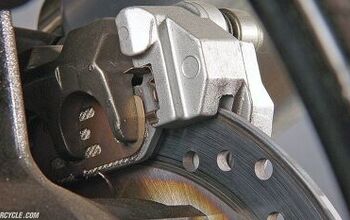
A relatively steep 23.0-degree rake angle and a short 94mm of trail results in a fairly sharp-handling machine for its size. On/off throttle response isn’t abrupt, and its radial-mount caliper twin discs up front have a potent squeeze that’s quite appropriate for a rocket like this.
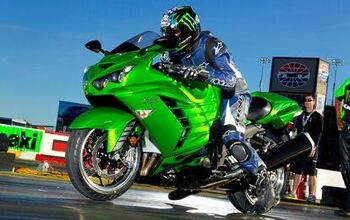
And to find out how rocket-like the ZX can be, Kawasaki had the Auto Club Dragway at California Speedway rented out for us. After logging the quickest elapsed time during the original 14’s introduction in Las Vegas, the pressure was on to uphold my honor. Giving us advice for how best to launch the Ninja was Kawasaki-sponsored dragracing superstar Rickey Gadson. The affable Gadson is not only a multi-time dragracing champion in several classes, he’s also the instructor for his own drag school , so there’s no one better to help coach a newbie down the track.
At the bike’s intro in ’06, Gadson recommended launching the Ninja at just 4000 rpm (about 6000 revs below an optimum sprint on something like a 600cc sportbike!). Incredibly, Gadson instructed us to launch this revised ZX at just 3500 rpm, which gives an indication of how the ZX’s engine has been retuned for greater grunt this year.
Although skeptical of launching a bike at such low revs, I accepted Gadson’s advice and posted a couple of runs in the low 10-second range – not bad for a completely stock bike on a course that gains 80 feet of elevation by the end of the quarter-mile. I knew I could squirt off the line a little bit harder, and the fruit of this theory was a time-slip that read: 9.996 at 141.82 mph, which was quicker than anyone had gone on stock bikes during the morning sessions.
Most impressive was the ZX-14’s clutch action. There are some terribly abusive forces at work when transmitting 200 horsies to a 190/50-17 tire, but the ZX’s hydraulic clutch carefully meters out that power with a highly controllable friction zone, aided by a radial-pump master cylinder. And these clutch packs can handle repeated abuse. At the ’06 press intro, Kawasaki brought plenty of extra clutches, only to discover that they could suck up the abuse of more than 60 runs. They eventually changed them then as a precautionary measure, not because they were slipping.
With each journalist getting just a dozen or so runs on four bikes at this event, there were certainly no clutch issues – just perfect modulation that allowed each journo to cut increasingly quick ETs. On my sixth and final run on the stock bike, I cranked off what became the quickest pass of the day thus far, a 9.854 at 143.75 mph. Corrected for altitude and temperature, it works out to about a 9.60 at 147.63 mph. For those who perhaps aren’t aware of quarter-mile times, just know that there’s not a production street car that can come close, not even the million-dollar Bugatti Veyron or Lamborghini Reventon.
Want to go even quicker and faster? A key dragracing trick is to lower the center of gravity to reduce chassis pitching – this inhibits wheelies that are fun but slow. Kawasaki had prepared two bikes that received the simple additions of some tie-down straps up front and a lowering link for the Ninja’s rear suspension but were otherwise stock.
An indication of how this straightforward tweak affects quarter-mile times came in the form of Gadson advising us to move our launch points up to 6000 rpm. Rickey told us that we won’t believe how much harder you can catapult a lowered bike off the line, adding that it should be worth about 0.2 second on the time-slip. So I revved it up and dumped the clutch, and the rear tire immediately broke traction and went up in smoke like the rest of that run. A little more finesse was in order, as it’s very small things that make a big difference on the dragstrip.
It all came good during my third run on the lowered bike. I let go of the clutch quickly and got hard on the throttle. The acceleration was so vicious that my legs were flung toward the back wheel, and I struggled to get my left foot to the gear lever before the shift light fired its message to my eyes. Once I nailed that one-two shift, I knew I was on my way to a stout run. Third gear came and went quickly, followed by one last gear-change before blazing through the speed trap at 144.12 mph.It took just 9.676 seconds for the sleek Ninja to go from a dead stop through a quarter of a mile. Corrected for weather and altitude, as virtually all magazines do, the ET works out to about a 9.4-second pass at 148 mph. Remember, this was done on a bike that meets harsh Euro 3 emissions regs!
At the end of the day, it was the odd dichotomy of the ZX-14’s intense speed and power juxtaposed against its implausible smoothness and grace that stands out most about this impressive speedster. It’s mainly in its element when the roads are open (and lightly patrolled!), of course, but it’s also quite competent at filtering through commuter traffic, unwinding twisty roads and strapping on some soft saddlebags for a weekend jaunt to somewhere else.
It’s also a killer tool at demolishing a quarter-mile. Stay tuned to see how it stacks up against the retooled Hayabusa!
| The Perfect Bike For… | ||
| A rider who lives near open roads and who wants a bike that won’t get left behind by anything else on street, whether that road is on the Great Plains or at the local dragstrip. | ||
| Highs: | Sighs: | |
- Mega motor | - Long for a sportbike | |
Duke’s Duds:
HJC AC-12 Carbon helmet
Shift SR-1 two-piece leathers
Spidi Penta Sport gloves
Gaerne G.RW boots
Related Reading:
2007 Suzuki Hayabusa First Ride
2006 Kawi ZX-14 Review
Rocket Tourers: ZX-14 vs Hayabusa
More by Kevin Duke




Comments
Join the conversation