
2004 Honda CBR 1000 RR

Back in the saddle again...

story by Sean Alexander, Photograph by Fonzie, Created Feb. 05, 2004
BACK TO THE ARTICLE PRINT
"Not a wiggle." There you go, end of review, that about sums up the new 2004 Honda CBR 1000RR. This bike is simply planted when ridden hard over less than ideal surfaces. Yes, it's also 152+ Hp fast, Superbike nimble and great looking, but the overwhelming impression is one of stability and confidence.

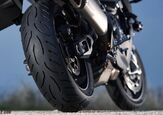
I think credit for this goes not only to the new HESD steering damper, but also to the excellent Pirelli Diablo Corsa tires and slightly higher curb weight that the CBR carries around.

Believe me; I'll gladly trade that extra 25Lbs of weight, for a bit more confidence through a rough Angeles Crest transition.
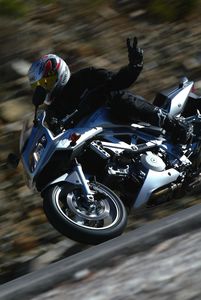
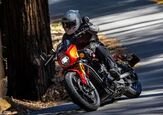
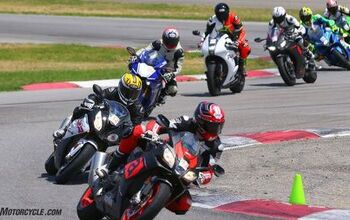
The CBR's outstanding stability is evidenced by this one-handed 90mph pass through a rough decreasing radius corner

After the street ride, MO was lucky enough to sneak a CBR back to our dyno. Though it didn't break the MO dyno record, the CBR 1000RR did tie it, with 156.4 uncorrected rear wheel horsepower.

However, due to varying meteorological conditions, it's SAE corrected number was 5Hp shy of the current 157Hp record set last spring by a stock GSX-R1000. On the street, I can assure you that you and I both would be faster on the Honda, due to the vastly different way in which the two bikes deliver their power. If the GSX-R is a cannon, making no attempt to soften its blows or make itself easy to wield, the CBR is a 44 Magnum, not quite as intimidating, but far more effective to use in a civilian setting. Sure, that was a silly analogy, but after spending time on both bikes, there is no doubt the CBR is at a higher level of refinement and effectiveness than last year's open class king.
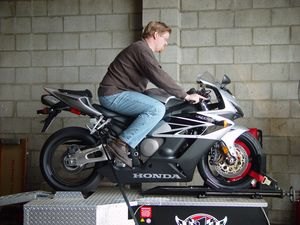
Sean gives her a quick twist up to 195mph.

Honda's goal was to make the 1000RR more manageable, by adapting the lessons learned from the RC-211V.The extra long swingarm, Unit Pro Link rear suspension, and extreme foreward packaging of the engine, exhaust and radiator all serve as evidence to this fact. It's all stuff we saw on last year's CBR 600RR and it seems to work as advertised.Cosmetically, the 1000RR is even closer to a 211V than the 600RR was, just check out the relationship between the leading edge of the fairing, the radiator and the back of the front tire. It's some very attractive origami indeed. Ergonomics are a tad bit tight in the seat-to-peg relationship, due to the racy rearsets, but the seat itself is quite comfortable and the reach to the clip-ons is moderate enough that wrist pressure never became an issue for me.
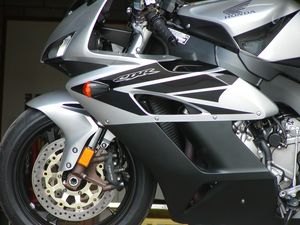
...some very attractive origami indeed.

Freeway droning wasn't unpleasant, but the racing orientation of the engine and chassis does come through loud and clear, via the buzzing that's transmitted through the handgrips. If you happen to get bored on a long freeway drone, an 80mph downshift to 2nd and a feathered clutch will spice things up, with the easiest and most graceful wheelie you've ever seen (not that we'd ever condone such behavior). Yes indeed, an honest to god 152+ hp at the contact patch can turn any situation into a party. Of course, such parties can quickly land you in the pokey or worse.... Thankfully, the radial mount 4-piston calipers and 310mm front disks are set up with outstanding feel and offer plenty of bite for bringing such crazy festivities to a controlled stop.

Freeway concerns are quickly dispatched, once you are on the twisty and narrow. The chassis, HESD, suspension, brakes and tires work together in such a well-integrated way, that you can devote most of your focus to situational awareness, line selection and the day's lunch menu.
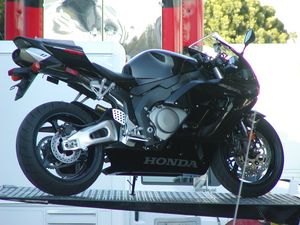
All black CBR 1000RR makes for a very clean looking design.

As I was slicing up the Crest on a beautiful 70-degree So Cal winter day, I found myself quite relaxed and for some reason I noticed more of the surrounding scenery than usual. I've experienced this same effect, when riding cruisers, but on this occasion, I was probably going faster than a cruiser could hit in free fall, off the cargo ramp of a C-141 Starlifter. Honda's HESD (Honda Electronic Steering Damper) isn't simply a case of tech for tech's sake; it works spectacularly well and will probably be copied by every manufacturer and aftermarket company in the business. The Unit Pro Link rear suspension, coupled with the long swingarm and grippy rubber do a fantastic job of transmitting all that torque through the contact patch. It is so effective, that I was less worried about highsiding the 1000RR than I was on most of the 600s I've ridden.
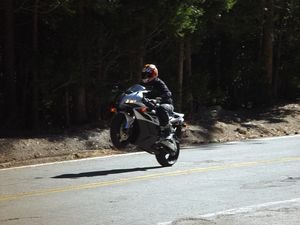
Of course, If you want to wheelie, just ask and the big CBR is more than happy to oblige.

The CBR's long swingarm and forward weight distribution also enable it to accelerate very hard, without wheeling. Of course, If you want to wheelie, just ask and the big CBR is more than happy to oblige. We'll have to wait and see whether or not the new CBR's added stability offsets it's extra weight, when pitted head-to-head with the lighter and equally new ZX-10R, YZF-R1 and carry-over GSX-R 1000 on a racetrack. However, I suspect it'll do fairly well. Stay tuned, I hope to be able to answer this very question for you in the April timeframe. What I can answer for you today is: "What's it like in the Real World?" To be truthful, it's pretty freaking spectacular. It strikes all the right Superbike chords, with terrific traction, stellar steering, mondo motor and lovely looks (sorry, I couldn't resist). If all of Honda's new bikes are this good, then I'm sincerely glad to be back in their good graces.

The Steering Damper Comes of Age

Introducing the Honda Electronic Steering Damper (HESD)
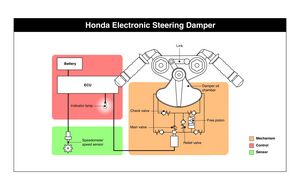
Steering dampers are not new to the motorcycling scene. For decades, riders have resorted to using steering dampers, most often for extreme-use high-speed racing conditions in off-road competition as well as road racing. Regardless of the application, steering dampers help reduce excessive steering movement by incorporating a damper connecting a motorcycle’s fork and frame. Some units use simple friction dampers, while others are of hydro-mechanical design.

Page2In general, Honda® avoided installing these devices on motorcycles because all existing designs included inherent drawbacks that compromised the benefits. Typically, when a steering damper was set for high-speed performance, the motorcycle’s handling would be adversely affected at moderate and lower speeds--not a good trade-off for general-purpose riding.

If a compromise setting was selected to mollify a steering damper’s negative effects on low-speed handling, the high-speed benefits were similarly reduced--again, not much net gain. So when Honda’s engineers decided a maximum-performance machine such as the CBR®1000RR would benefit from the positive aspects of a steering damper, they simply decided to reinvent the device to reap the full rewards while eliminating the historic drawbacks.

"Once again, Honda has harnessed technical sophistication into a seamless package that enhances the pleasure of riding."

Unlike past designs, the new Honda Electronic Steering Damper (HESD) has no fixed damping characteristics. Instead, damping action is controlled by the CBR1000RR’s Electronic Control Unit (ECU), which automatically varies damping force according to vehicle speed and acceleration over a wide range of riding conditions. Jointly developed in cooperation with Kayaba, the HESD mounts atop the steering head and a linkage arm connects the HESD to the triple clamp.

Within the damper unit, a large chamber filled with oil is divided into two sections by a moving vane connected to the linkage arm. In response to steering movements transmitted by the linkage arm, the vane forces oil between the left and right sides of the chamber through various passages, including a main valve controlled by a linear solenoid that receives its control signals from the ECU.

At lower speeds, the damper’s main valve opens fully and therefore creates virtually no perceptible damping effect. Result: a light steering feel. As speed and rate of acceleration increase, the linear solenoid constricts oil flow between the two sides of the chamber, resulting in the desired amount of increased steering damping. Four one-way check valves ensure that oil flows through the main valve in only one direction, whether the vane is moved to the right or the left.

A relief valve maintains internal pressure below a designated set level, while another small piston compensates for temperature-induced changes in oil volume. Technical aspects notwithstanding, CBR1000RR pilots will reap the benefits of the new HESD in the form of confidence-inspiring handling, making the riding experience all the more enjoyable. Once again, Honda has harnessed technical sophistication into a seamless package that enhances the pleasure of riding.

CBR1000RR
** Information And Specs Provided By Honda **

Introduction

Honda’s 2004 CBR1000RR ushers in a whole new era of inline-four Superbike performance. Taking its technical cues from the MotoGP-winning RC211V, the CBR1000RR redefines Superbike domination.

Unique Features

  • All-new liquid-cooled 998cc inline four-cylinder engine.

  • All-new aluminum frame patterned after RC211V MotoGP racer’s.

    Honda Electronic Steering Damper™ (HESD™) for optimum steering effort and stability.

    Cassette-type close-ratio six-speed transmission.

    Centrally located fuel tank increases mass centralization and allows more compact frame design.

    Radial-mounted front brakes.

    New-style center-up exhaust system.

    Unit Pro-Link® rear suspension and swingarm design inspired by RC211V.

    New Line Beam Headlight features three-piece reflector design.

    Dual Stage Fuel Injection System (DSFI) features two injectors per cylinder.

    All-new aggressive styling.

    Engine/Drivetrain

    All-new liquid-cooled DOHC 16-valve 998cc four-stroke inline four-cylinder engine features bore and stroke dimensions of 75mm x 56.5mm.

    Sixteen-valve cylinder head features 29mm intake and 24mm exhaust valves with an 11.9:1 compression ratio for efficient combustion and high horsepower.

    Lightweight nutless connecting rods.

    Direct shim-under-bucket valve actuation system ensures high-rpm durability.

    New iridium-tip spark plugs improve fuel combustion and performance.

    Dual Stage Fuel Injection (DSFI) system features two injectors per cylinder--one upper and one lower--controlled by an ECU that senses rpm and throttle opening. Lower injector enhances rideability while upper injector improves top-end horsepower. At lower rpm only the lower injector is working. At higher rpm, both injectors are activated. The system uses 44mm throttle bodies.

    All-new Denso injectors feature new lightweight valving for faster reaction time and 12 holes per injector for improved atomization of fuel mixture, resulting in optimum combustion efficiency and power.

    Auto-enriching system is integrated into PGM-FI module, eliminating the need for a manual choke.

    Forged aluminum pistons with moly surface treatment for reduced friction.

    Aluminum composite cylinder sleeves are high-pressure-formed from sintered aluminum powder impregnated with ceramic and graphite. The lightweight composite sleeves provide better wear resistance and superior heat dissipation compared to conventional sleeves.

    Electronic ECU provides two digital 3-D fuel injection maps for each cylinder and two digital 3-D ignition maps for cylinder pairs, creating ideal fuel mixture and spark advance settings for superb rideability.

    Ram-air system provides a high volume of cool air to the 8.35-liter airbox for linear power delivery and incredible engine performance.

    Stainless steel four-into-two-into-one center-up exhaust with twin outlets and titanium core increases lean angle and reduces wind drag.

    Liquid-cooled aluminum oil cooler is lightweight and efficient.

    Maintenance-free automatic cam-chain tensioner.

    Starter gears located on the right side to produce narrow engine and increased lean angle.

    Race-spec radiator with 40 percent greater volume compared to CBR®954RR’s.

    Eight-plate clutch is compact and tough, featuring durable friction plate material.

    Cassette-type, close-ratio six-speed transmission is easily accessible for rapid gear ratio changes and maintenance at the race track.

    Durable #530 O-ring-sealed drive chain.

    Chassis/Suspension

  • New lightweight twin-spar aluminum frame borrows RC211V technology.

  • New aluminum-hybrid rear swingarm is longest in class for superior traction under hard acceleration.

  • New aluminum subframe is lightweight and easily removable for ease of maintenance.

  • Honda Electronic Steering Damper (HESD) is a rotary type steering damper that electronically modulates steering damping based on road speed. An ECU unit senses road speed and acceleration, and sends a signal to a solenoid. The solenoid controls an oil pressure relief valve within the damper unit. At slower speeds the relief valve is open, allowing for a free flow of oil through the damper unit, resulting in reduced damping force and lighter steering effort. At higher speeds the flow of oil is restricted, resulting in increased damping force and additional stability. HESD is the first steering damping system that makes it possible to increase high-speed performance while maintaining low-speed handling.

  • 43mm inverted aluminum-slider Honda Multi-Action System™ (HMAS™) cartridge front fork features spring preload, rebound and compression damping adjustability, and offers precise action and unparalleled rigidity.

  • New Unit Pro-Link rear suspension system is patterned after RC211V MotoGP racer’s. In this system, the upper shock mount is contained within the swingarm rather than the frame. With no top frame-mount for the shock, this unique system prevents negative suspension energy from being transmitted into the frame, allowing optimum frame rigidity and improved rideability out of corners. The HMAS shock offers rebound and compression damping, and spring preload adjustability.

  • New front brake system features radial-mounted four-piston calipers and 310mm floating discs, and a 220mm rear disc with a single-piston caliper for exceptional stopping power.

  • Super-light aluminum-alloy hollow-spoke wheels feature race-spec 3.5 x 17-inch front and 6.0 x 17-inch rear dimensions.

  • Centrally mounted 4.8-gallon fuel tank is positioned low in the frame, increasing mass centralization and allowing a more compact design. This design positions the rider farther forward for optimum handling.

    Additional Features

  • High-capacity, 350-watt AC generator.

  • High-tech instrument display features tachometer, LCD readouts for speedometer, coolant temperature, odometer, two tripmeters and a clock. A low-fuel LED light and shift indicator light is located in the tachometer.

  • Line Beam Headlight features three-piece reflector design utilizing two H7 bulbs for optimum light distribution and unique compact design.

  • All-new LED taillights for improved appearance.

  • New plastic tank shell cover protects tank and airbox.

  • New one-piece fan assembly increases cooling efficiency.

  • Convenient ignition switch/fork lock for added security.

  • Folding aerodynamic mirrors.

  • Handlebar switches and controls use internationally approved ISO graphic symbols.

  • Convenient push-to-cancel turn signal switch.

  • Maintenance-free battery.

  • Transferable one-year, unlimited-mileage limited warranty; extended coverage available with a Honda Protection Plan.

  • Ownership includes one-year complimentary Membership in the Honda Rider™ Club of America. Benefits include discounts, travel benefits, roadside assistance and much more. For HRCA® details, call 1-800-847-HRCA.

  • Full Specifications

    Model: CBR1000RR

    Overall length: 2023mm (79.6 in.)

    Overall width: 712mm (28.0 in.)

    Overall height: 1133mm (44.6 in.)

    Wheelbase: 1415mm (55.7 in.)

    Seat Height: 820mm (32.3 in.)

    Ground Clearance: 130mm (5.1 in.)

    Dry Weight: 179.8kg (396 lb.)

    Weight dist. (f/r): 92/87kg (203.5/192.5 lb.)

    Engine Type: 998cc liquid-cooled 4-stroke


    Cylinder arrangement: Transverse inline four-cylinder

    Bore and stroke: 75mm x 56.5mm

    Compression ratio: 11.9:1

    Carburetion: Dual Stage Fuel Injection (DSFI)

    Throttle body size: 44mm; two injectors per cylinder; 12 holes per injector

    Valve Train: DOHC; four valves per cylinder

    Valve timing: Intake: opens 18 degrees BTDC
    closes 46 degrees ABDC

    Exhaust: opens 39 degrees BBDC
    closes 11 degrees ATDC

    Valve lift: Intake: 8.9mm; Exhaust: 8.4mm

    Valve head diameter: Intake:29mm; Exhaust: 24mm

    Springs @ valve: One

    Valve angle (included): 23.75 degrees

    Valve adjustment: Shim under bucket

    Valve adjustment int.: 16,000 miles (24,000km)

    Cam drive: Silent-type chain

    Redline: 11,650 rpm

    Oil capacity: 3.8l

    Airbox capacity: 8.35l

    Clutch: Wet, multi-plate; hydraulic actuation

    Transmission: Cassette-type close-ratio six-speed, constant mesh

    Primary reduction ratio: 1.604:1 (48/77)

    Gear ratio I: 2.538:1 (13/33)

    Gear ratio II: 1.941:1 (17/33)

    Gear ratio III: 1.579:1 (19/30)

    Gear ratio IV: 1.381:1 (21/29)

    Gear ratio V: 1.250:1 (20/25)

    Gear ratio VI: 1.160:1 (25/29)

    Final Drive: #530 O-ring-sealed chain

    Final reduction ratio: 2.563:1 (16Tx41T)

    Ignition: Computer-controlled digital with three-dimensional mapping

    Starting system: Electric

    Alternator: 14V/350-watt output

    Frame: Twin-spar aluminum

    Front Suspension: 43mm inverted HMAS™ cartridge fork with spring preload, rebound and compression damping adjustability; 4.7 inches travel

    Rear Suspension: HMAS Unit Pro-Link single shock with spring preload, rebound and compression damping adjustability; 5.3 inches travel

    Front Tire: 120/70ZR-17 tubeless radial

    Rear Tire: 190/50ZR-17 tubeless radial

    Front Brake: Dual full-floating 310mm discs with four-piston radial-mounted calipers

    Rear Brake: Single 220mm disc with single-piston caliper

    Fuel Capacity: 4.8 gallons, including 1.06-gallon reserve

    Rake (Caster Angle): 23.75°

    Trail length: 102mm (4.0 inches)

    Battery capacity: 12V/10AH

    Spark plug: Iridium

    Headlight: Twin-bulb Line Beam; 55/55 watt

    Colors: Red/Black, Metallic Silver/Black, Black

    California version meets CARB 2004 emissions standards.

    MSRP: $10,999 USD


    MO Measured Horsepower: 152.0 @ 11,200 RPM
    MO Measured Torque: 78.4 @ 8,200 RPM

    copyright (c) 2010 Verticalscope Inc. Story from http://www.motorcycle.com/manufacturer/honda/2004-honda-cbr-1000-rr-1171.html