Ducati Motorcycle History: History of Ducati
- 1926Societa Radio Brevetti Ducati is established, though not as a motorcycle manufacturer. The company makes radio equipment.
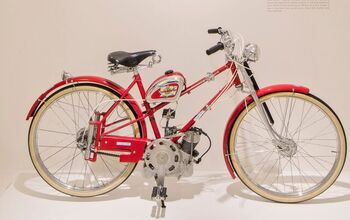
- 1944The Ducati factory was destroyed in the war. After the bombing, Ducati looks to build other products, and with the encouragement of the Italian government, the company focuses on a motorized bicycle.
- 1946The 50cc Cucciolo (“pup”) motor is introduced. The motor is not a Ducati design; it was created by Aldo Farinelli. The purchaser has to attach it to his own bicycle. Over the next few years, Ducati will improve the Cucciolo, which will grow to 60, 65, 98, and finally 125cc.
- 1950The 65cc sport edition is released. It’s a proper little motorcycle, with swingarm and telescopic fork.
- 1952The 175cc Cruiser was introduced, featuring an automatic transmission and electric starter. Also released that year was the Ducati 98 as a bare-bones performance model.
- 1953The very economical Spartan 98cc bike was introduced.
- 1954Fabio Taglioni, an engineer, is hired to design a much higher-performance line of bikes. He gets to work on 100 and 125cc four-strokes.
- 1955The popular Ducati Gran Sport is released.
- 1956Taglioni designs a desmodromic 125cc Grand Prix racer. He didn’t invent the “desmo” valve operating system, which uses a second cam – not springs – to close the valves. The system was patented by Daimler-Benz years earlier. But the relatively primitive metallurgy of the time meant that valve springs were a “weak link” in racing motors.
The desmo Ducati is reliable up to a then-shocking 15,000 rpm. Gianni Degli Antoni laps the field at the Swedish GP but is killed before the next race. His death is a setback to the Ducati racing effort.
- 1957Ducati debuts the Tourist 274, a four-stroke motorcycle.
- 1958Ducatis finish second and third in the 125cc World Championship; only an injury to Bruno Spaggiari allowed Carlo Ubbiali to win again on the MV Agusta. The Elite 200 is released.
- 1960The popular twin-cylinder 250cc is released and is basically a fusion of two 125 “Grand Prix” motors – this is the “Grand Prix” model production bike, with spring valves we’re talking about here, not the works racer.
- 1961The Scrambler is released. It’s largely intended for the American market and was produced at the insistence of the Berliner brothers, the U.S. importers.
- 1963Again at the insistence of the Americans, Taglioni designs the “Harley beater” Apollo. It features a huge 1,257cc V-Four engine, but no tires can handle the power and torque. The Apollo is never launched.
- 1965The classic Mark 1 250 is released. It features a rare five-speed gearbox and plenty of sporty features.
- 1968The Mark 3 series was unleashed in 250cc, 350cc and 450cc variations. Also that year, the 250cc and 350cc versions of the Scrambler appear with their wide-casing engines.
- 1969The 450 Single appears, and production models are available with Desmo valve actuation.
- 1970Taglioni grafts two 250cc top ends together to create a 90-degree V-Twin 500cc Grand Prix racer.
- 1971The Ducati 750 GT (Gran Turismo) makes its debut in June. The bike featured a twin-cylinder engine with a 90-degree configuration known as an ‘L-Twin’. A sixth speed was added to the gearbox to help optimize the engine, but the gearbox and electrical equipment were troublesome.
- 1972Paul Smart wins the Imola 200-mile race on a Desmo version of the 750.
- 1974The 750 SS is released; a road-going version of Smart’s racer.
- 1978The 900 SS (Supersport) is released. Mike Hailwood comes out of retirement and rides it to victory in the TT F1 class at the Isle of Man.
- 1979The 900 MHR is released; a replica of Hailwood’s 900 SS. Ducati builds it for hardcore riders and the bike is not even fitted with an electric starter.
- 1980Ducati releases the Pantah 500 at the start of the new decade and it proves to be one of the most successful bikes in Ducati production history. This marks the beginning of belt-driven (as opposed to bevel-driven) camshafts – a major simplification.
- 1984Ducati releases the minimalist 750 F1, which proves to be a highly sought-after model.
- 1985The Cagiva Group buys Ducati.
- 1986Two years after the release of the 750 F1, three ‘special’ versions of the bike are released: 750 F1 Montjuich, 750 F1 Laguna Seca and 750 F1 Santamonica.
Also in 1986, the 750 Paso hits the market. It’s named after Renzo Pasolini, a rider killed at Monza. The bike is designed by Massimo Tamburini.
- 1987The liquid-cooled, four-valve 851 hits the market, just in time for the rise of World Superbike competition. The new motor is designed by Massimo Bordi. His choice of four valves and a much tighter included valve angle reinvigorates the now-traditional Ducati Desmo design. This will establish a pattern for Ducati Superbikes that will hold for almost 20 years.
- 1989Taglioni steps down as technical director.
- 1990Raymond Roche wins the World Superbike Championship.
- 1991The 888 is released. Doug Polen uses it to win the World Superbike Championship.
- 1992SBK: Polen, again.
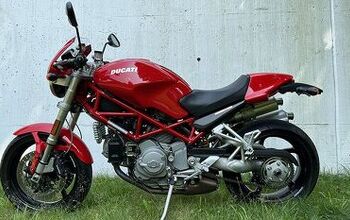
At the Cologne Motor Show in the fall, a Monster is born. Ducati displayed its Monster 900 for the first time. The bike includes the trellis frame from the 851/888 series and the 904cc air/oil cooled engine from the Supersport range.
- 1993The 4-stroke Single Supermono was released. It featured liquid cooling, electronic injection and twin con-rods.
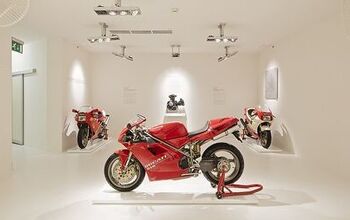
- 1994Carl Fogarty wins the World Superbike Championship on the then-severely-limited-production Massimo Tamburini-designed 916.
- 1995The public gets to buy the 916 in reasonable quantities, and Tamburini’s design is already seen as a classic. Fogarty repeats.
- 1996The Texas-Pacific Group buys 49% of the company, providing a much needed injection of cash.
SBK: Troy Corser wins another title for Ducati.
- 1998TPG buys most of the remaining shares.
SBK: Fogarty, on the now venerable 916, proves he can still set things on fire just by looking at them.
- 1999TPG takes the company public, selling 65% of the shares in the IPO. The company is renamed Ducati Motor Holding SpA.
SBK: Fogarty, 996.
The 996 SBK replaced the 916 SBK. Like the 916, the 999 featured a desmodromic double camshaft, L-Twin cylinder engine and a trellis frame. New on the bike were lighter three-spoke wheels and an improved Brembo braking system. - 2000The MH900e, a retro-classic tribute to Mike Hailwood, becomes the first motorcycle to be sold exclusively on the Internet. It is the first of what becomes known as the SportClassic line.
- 2001SBK: Another Troy from Australia. This time, it’s Bayliss.
Taglioni dies.
- 2002Ducati unveils its much talked about 999 to rave reviews. They’re raving about it, alright. But in largely negative terms. The truth is, chief designer Pierre Terblanche had an impossible assignment when he was faced with redesigning the iconic 916/996/998. Nothing could possibly have satisfied the Ducatisti.
- 2003The question on everyone’s mind last year was, “Could Ducati develop the Desmosedici MotoGP V-Four and still keep momentum up in the World Superbike Championship?” The answer comes a resounding “yes,” with Hodgson winning the SBK title and Loris Capirossi immediately competitive in MotoGP.
The ugly-duckling Multistrada is launched. (Luckily for Ducati, it’s only ugly until it’s been ridden.)
- 2004SBK: James Toseland.
- 2005TPG sells its remaining stake in the company to Investindustrial Holdings, an Italian investment company.
- 2006SBK: Troy Bayliss wins on the 999, but the bike’s a lame duck. Ducati is committed to a larger-than-1000cc displacement for their flagship. The company lobbies the championship’s organizers to increase the displacement for Twins to 1200cc.
- 2007The 1098 supercedes the unloved 999 as the flagship superbike. It evokes the Tamburini 916 again; all is right in the world of the Ducatisti… and to prove it, Casey Stoner dominates in the MotoGP World Championship. Ducati wins its first-ever title in the premier class.
The Multistrada begets the Hypermotard.
MotoGP: Casey Stoner wins the World Championship! It all comes together for Ducati in the first year of the new 800cc formula. The Desmosedici gets great fuel mileage, allowing it to make more power when it’s needed. Stoner is the rider who adapts best to the Magneti Marelli traction-control system. It’s decisive.
- 2008The 1098 gets a baby brother, the 848.
With the 1098R, Ducati is the first manufacturer to introduce true traction control in a production machine. Though the engine’s actual displacement is 1198cc, the company decided against naming it such due to negative perceptions from Americans and their similarly named tax forms.
Troy Bayliss wins his third and final world superbike championship, fulfilling his goal to win three championships on three different generations of Ducati superbike: 998, 999 and 1098. He then capped off his fairytale season by retiring on top.
- 2010The Multistrada is all-new and features an advancement in its electronic package. Four different modes adjust power and traction control settings for different environments. The S model also allows for electronic adjustment of the Ohlins suspension.
- 2011In a bold move, Ducati shocked the world with its power cruiser, the Diavel. This iteration of a cruiser has already been met with better reception than its first cruiser attempt, the Indiana.
In another bold move, though one that wasn’t as much of a surprise, Valentino Rossi leaves Yamaha and joins the Ducati MotoGP team, replacing Casey Stoner, who defected for Honda.

Motorcycle.com presents an unrivaled combination of bike reviews and news written by industry experts
More by Motorcycle.com Staff


Comments
Join the conversation