'03 Ducati SuperSports

Ducati Applies the Spin in Spain

story by JohnnyB, Created Mar. 16, 2003
BACK TO THE ARTICLE PRINT
That's DS for Dual Spark, the tell-tale sign of which is a spark plug poking out from the right side of the rear cylinder head (the one in the front is less visible), of the latest air-cooled Ducati twin.

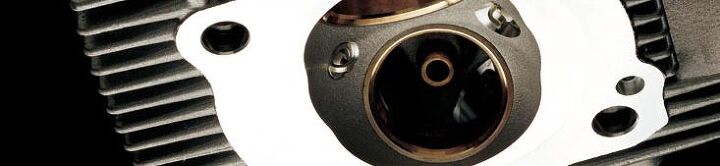
Along with the extra spark plug in each head comes, well, an entirely new head. Two-mm bigger valves--45mm intakes, 40mm exhausts--set at a steeper included angle produce 10:1 compression (9.2 in the old 900) when banged closed into new, supertough beryllium/bronze valve seats, and those bigger valves are lighter too thanks to 7mm stems. Revised desmo cams (feels like for more low end and midrange) now ride in plain bearings instead of rollers, and exhaust ports are 40 percent shorter for greater heat dissipation. Bore and stroke are now 94 x 71.5mm instead of the 92 x 68mm of the long-running 904 L-twin. A couple of new cooling fins add strength, shed more heat and give the new engine looks to go with its heritage.
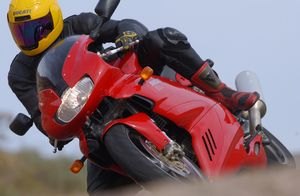
Ducati says the new heads give more complete combustion, increase power especially in the midrange, and improve fuel economy, all while weighing three pounds less per head. Ducati uses a new casting process for these heads--"gravity chilled." With the combustion chamber facing down, the first alunimum poured into the mold chills quickly around the combustion chamber, which produces smaller aluminum grains, which supposedly means better molecular structure around the chamber.

New pistons, of course, with tighter-sealing nitrided-steel rings live in thicker cylinder barrels. New rods are made from 3ONiCrMo4, which flows very nicely during forging, we're told, thereby making possible a rod of optimal cross-section--thinner but wider fore-to-aft. After forging, both mechanical and chemical stress-relief processes are used, the end result of which are rod surfaces free of imperfections. These reciprocate on a new, more rigid crank with better mass centralization, and oil delivery ports redesigned around structurally critical areas. Speaking of oil, a new pump and channels produce the kind of higher flow the new cam bearings require, which also happens to aid engine cooling in the process.
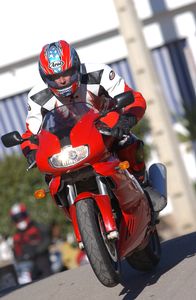
This kind of stuff sure is fun on someone else's bike.Wait there's more. The clutch basket and plates are now of a special aluminum alloy, which Ducati says will have much greater service life compared to the old steel units, as well as being quieter due to the lower resonance value of aluminum compared to steel (come to think of it they're right). And a double-row bearing on the countershaft output gives greater strength where power feeds into the new, MOunted-to-the -spline-with-one-big-nut countershaft sprocket.

In short, there's a lot more going on here than bigger pistons and an extra couple of spark plugs (which are not of the $20-each iridium type).

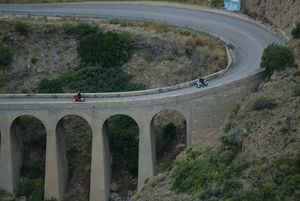
To find this all out, I drove to LAX, flew to London in a middle seat, changed planes to Barcelona, stayed overnight there at the Hotel Alfa on the outskirts, flew to Almeria the next day, and rode a bus to an almost empty hotel/time-share deal there on the Mediterranean which looks almost exactly like the ones I've been to in Baja--same scheme, different continent. In the middle of nowhere in the off season, there was little for the American/Canadian motopress to do but eat, drink, sleep, discuss bacon and ride motorcycles. I don't know if Ducati was trying to guard us from Spanish terrorist cells or ourselves?
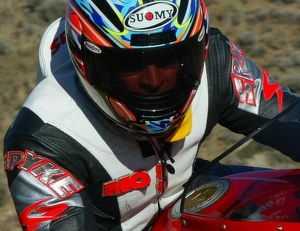
Your fearless Editor, JohnnyB Anyway, the plan worked--there was only one man unaccounted for on the bus to Circuit Almeria the next morning to ride the new 749. Naturally, it was raining not quite sideways when we got there, though the track did dry long enough to get in a few laps. More on the 749 later. Suffice to say for now that its strengths compared to the 999 remain the same as

  748 to 998: less power but greater revvability result in a more engaging riding experience if not quite as quick of one, and a $13,495 sticker for the base 749 opens the Ducati Superbike door to more potential customers (while making you curious as to the mark-up on the 999 since they're so nearly the same motorcycle?).

As they've been doing ever since the introduction of the 916, Ducati's air-cooled Supersport models have gotten used to playing second fiddle, and the day-two street ride upon the new DS1000, and the new 800 and 620 Sport models, felt like a sort of consolation prize following the 749 near rain-out. Looked like rain again that day, too, which luckily failed to materialize since there was no way, it turned out, I was going to get my decade-old rainsuit over the hump in my Spyke leathers. In my day we had no humps....
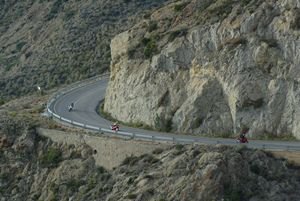
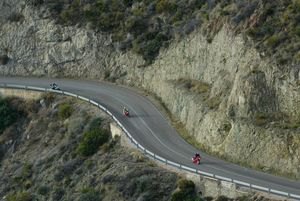
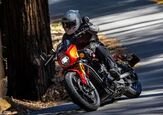
A pulsing Ducati Twin beneath you...
And wicked canyons ahead...
Equals pure bliss! What more can you possibly want from life?

What happens at these press events lately, is that the organizers lay out a nice little route, and provide maps and even laminated roll-chart type cards which tell you exactly where to turn according to your tripmeter--and they even post their people at crucial junctions to wave you in the right direction (the point of which is to herd the group to its pre-ordained pho tography stops since the whole damn production is aimed at getting words and pics of the new bikes out there), and almost every time I wind up riding mindlessly along, taking in the local color through the little towns (where all the critical direction changes take place), and assuming the people ahead of me must know where they're going since they seem so confident--barely even glancing at the maps thoughtfully taped to their tanks by Ducati. (Yet another lesson that confidence is so often directly proportional to cluelessness.)

The mud road was one indication that we might be off-route. "Damn Ducati people I can't believe they'd send us down a dirt road on these bikes," spat Ken from Rider magazine, while our fearless leader Dave Searle of Motorcycle Consumer News fame (Ken calls him "the Searlmeister") appeared as usual unfazed or is that well-sedated? The Spaniard directing traffic through the construction site informing us our motorcycles probably wouldn't make it through the foot-and-a-half deep puddle down below was another clue that we might have made a wrong turn. No big, we turned around, me first since I'd been at the rear. Say, this is some nice gooey mud, isn't it? Yes, and once headed the opposite direction, it was roost heaven on the big DS1000, point and shoot. The mud gave way to pavement soon enough, but the tires of everything that had come before left a nice slick residue for miles; the big air-cooled bike starts producing really useful torque at around 2500 rpm, but is so well-controlled by its new 5.9 CPU brain that even in real slick stuff, you can spin the tire or not with your right hand.

The 904cc twin in the last big SS was an excellent motor, the new 992cc unit is even excellenter: smoother-running, more tractable at lower revs, and more powerful. Ducati claims 5.5 more horses (at only 7750 rpm), and its claimed hp figures lately seem to coincide closely to the rear-wheel numbers produced by our Dynojet. Ducati says 85.5 for the DS1000, which probably is just about 83.
Page 2Pardon me for pointing out once again that the torque's the thing with these bikes--and here Ducati is talking about a 12-percent increase--to 65 foot-pounds at only 5750 rpm--and that's where you can really feel the new engine's kick. Very nice acceleration, bull-in-the-china-shop audio, and a top end of just about 240 kpm (145 mph) according to the speedometer, down the motorway. The customary Ducati screescrawwwch seems to be missing from the Ducati's all-alloy dry clutch, and now you can just dump the thing and wheelie, or spin the tire, happily away, bwhooOAAAARP, bwhoarp bwhoaaarp--through the excellent gearbox. (This is the same engine, according to Ingegnere Marco Paradisi, that will be used in the upcoming Multistrada.)

New instruments are white-faced again--a traditional analog speedo and tach, with new LCD insets that monitor mileage and give oil temp and time o' day. The new console is lighter, so's the bracket that carries it, and a polycarbonate headlight lens is 800-grams lighter than last year's glass number and supposedly more luminous too. (There's still a gap between it and the fairing that lets light in the cockpit after dark.)

Was I just bitching about the 999 mirrors a week or two ago? You can see out of the much less stylish ones on the Supersport bikes, at least, though I think they were also used on many GSX-R's.

The beer in Spain flows mainly on someone else's tab.
Which inevitably leads to deep, heavy journalistic discussions...
...about the viability of...
small melons.
We think this guy has all the answers, but he's not telling.

Chassiswise, things remain much the same. The old steel trellis frame and linkage-free rear end result in a much more "lively" ride on the road than the more modern 999/749, which is not necessarily a bad thing. Just gives the feeling you're riding the bike harder, taxing it more heavily--which most riders actually like--but the DS retains its composure over even really bumpy Spanish tarmac. The 1000 uses a lightened, fully adjustable 43mm Showa fork and Ohlins shock, and the ride is really nice if a little old-fashioned feeling compared to stiffer, more modern, rear linkage-equipped motorcycles. That said, with the 1000's low-rev grunt out of corners, there's no reason not to keep up with, or even run away from, 999/749's in the mountains; the 1000 steers lighter and weighs at least 30 pounds less (and Ducati's testers say it's even better with a 170 rear tire instead of the 180 it comes with; it's a style thing).

None of the Supersports bend you over quite as much as the Superbike series, but it's a near thing, and with the Superbikes' new, more comfortable ergoes and specifically their broader seats for `03, you might rather travel on them, really. Which leaves the Supersports in a slightly awkward niche, really: tell me again which is the hard-edged racer and which the retiree? Anyway, the new 1000 motor is a blast and will make you forget your pain.

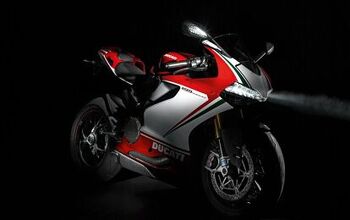
Yours for $11,395, in red or yellow.

800 SPORT/SUPERSPORT

Take last year's Pantah-based 750 Supersport, stroke it from 61.5 to 66mm, replace the 5-speed gearbox with a 6-speed, and you're almost looking at the 800 Sport, give or take--though the Italians made quite a few subtle upgrades along the way. An internal galley now carries oil from the left casing over to the clutch in the right, getting rid of the

  external line. The clutch, like the 1000's unit, is now all aluminum and there's much more cush-drive happening in the powertrain than before: the countershaft sprocket uses some sort of rubber damper, primary drive to the clutch is rubberized also, and drive to the crank is now of the quieter, less lashful, split scissors type.

Connecting rods get the same special treatment as the ones in the DS (described above), and new piston rings in anodized grooves reduce blow-by, says Ducati. Cams now spin in two roller bearings each, instead of the previous three, and have revised profiles for "increased performance." Fuel gets spritzed in through the same 45mm throttle bodies as used on the DS, regulated by the same 5.9 Marelli electronic brain used on all the Supersport and Superbike models.

For the 800, Ducati claims about 75 horses at 8250 rpm, and 52 foot-pounds of torque at 6250 rpm. In general, then, it's revvier than the 1000, geared shorter, and as a result feels almost as fast given a bit more gear-stirring--not a bad thing at all through the six-speed box's upgraded shift mechanism.

The vanilla Sport version wraps the bare bones in matte silver bodywork over a black frame and wheels, carries a non-adjustable 43mm Marzocchi fork and adjustable Sachs shock out back controlling a steel swingarm for $7,995--and I did not ride one since none were on hand.

The SS800, however, for $1200 more, is a sweet ride thanks to its adjustable, 43mm Showa fork and lighter, five-spoke wheels--and it's available in red, so....

620 SPORT

Brakes are for old ladies and sissies! Now we're talking entry-level, but the 620, which uses the same 5.9 CPU-injected engine as the 620 Monster, got most of the same upgrades as the 800 motor. Too bad it still has to make do with the old five-speed gearbox and let's call it a spade shall we? The 800 and the 1000 blow this one's doors off, but if the road's curvy (and smooth) enough and you're feeling brave enough, hey, it's a Ducati and makes all the right noises for not much more than a Suzuki SV650, which will also blow its doors off:

Still, some of us came off the 620 grinning; its non-adjustable fork can be pretty harsh under bigger pilots, but if you're around 160 pounds or less, the suspension's not bad and you can actually fling the 620 around harder, feels like, probably due to its lighter crankshaft. And 61 horses and 40 foot-pounds are not a lot, but the little motor likes to rev more than the bigger ones, and if you keep it spinning it feels bigger; speedo says 220 kph on the motorway--which is only 12 mph less than the 1000.

Still, the 620 had me longing for America and a nice cheeseburger and my Buell Lightning (especially after the bait-on-a-plate lunch in San Jose). Alas, at $7195, the 620 is fully $2800 cheaper than the Buell.


copyright (c) 2010 Verticalscope Inc. Story from http://www.motorcycle.com/manufacturer/ducati/03-ducati-supersports-14427.html