BMW S1000RR U.S. Debut
Eating elephants
How’d you like to have the latest, most advanced motorcycle in BMW’s current line-up for $1,000 or less?
Now that we have your attention we’ll clarify the above by saying that you can have, at some point, the new S1000RR literbike for a stated maximum of no more than $1,000 U.S. over the retail of what most of the Big Four will price their liter machines for the American market. This was undoubtedly the biggest news from BMW during the U.S. round of WSBK held at Miller Motorsports Park in Tooele, UT, May 29-31, 2009, where the new in-line Four made its U.S. debut in both race trim and civilian form.
However, we’ll have to deal with the vague pricing news for some time to come, as BMW won’t be announcing the actual price until after the Big Four reveal 2010 pricing for their liter steeds. Per BMW, it’s expected that Japan will be forced to raise prices again (The ’09 GSX-R1000 has already jumped $1,400 from 2008!) next year in light of the still-unstable world economy.
![]() |
For now, let’s use 2009 prices to speculate. With the non-ABS CBR1000RR dialing up as the most expensive from the Big Four at $12,999, simple math tells us the BMW S1000RR should fall in around $14K (early ’09 reports had the model listing at a little over 15K Euros in Germany).
Of course, we all know that BMW pricing almost always starts with the elusive “base model.” Nevertheless, a non-Race ABS, non-DTC (Dynamic Traction Control) S1000RR will be in a tête-à-tête with, say, the Honda, and most certainly less expensive than the $16,495 Italian stallion Ducati 1198 (another superbike without ABS or traction control as standard).
At this level of the market, and considering the typical BMW customer, most will order or purchase the German liter motorcycle with at least the ABS and traction control. These options would seemingly then push the bike’s retail past that $1,000 mark. Go with the optional shift assistant (electronic speed shifter as first found on the HP2 Sport and now available for the K1300S), and the price will climb by another $500, give or take a couple bucks. Even a wild guess at a fully optioned S1000RR ($16,500-$17,000?) should put it well below the $21,795 of the tricked-out Ducati 1198S.
But BMW’s communications manager, Roy Oliemuller, expects that in order to keep the S bike competitively priced, cost of available options won’t ratchet the base model’s pricing to the moon, as is often the case with most other BMW models. One of the first things mandated about the S1000RR before a single Computer-Aided Design image was rendered was price point. In consideration of this, BMW will likely have to take a hit on the margins it usually enjoys on optional equipment if that’s what it takes to keep the retail figure as low as possible.
Do or die mission
Pieter de Waal, VP of BMW Motorrad USA, told the U.S. moto press invited to Miller by BMW that once the decision to enter the literbike market was made only four years ago, two things were established immediately: price point and using a known quantity, so-to-speak, for the basic architecture.
![]() |
Naturally BMW would put its own twist on the mill, like the use of camshaft finger followers for actuation of the Ti valves; a design borrowed from BMW’s Formula One race car efforts. This was done almost exclusively for the purpose of high revs allowed by the compact, lightweight design according to BMW Motorrad Motorsport superbike team marketing and sponsoring manager, Andreas Ederer (he was prudent to not reveal actual rev limits set on the race S1000RR race bike when pressed by journalists).
The company had no interest in experimenting with engine design that departed radically from the in-line Four formula that’s proven so successful, and the S1000RR is a competition killer… at least on paper! Otherwise, with the exception of the mandate to make the lightest and fastest production liter machine in the class, nothing else about the bike’s powerplant and chassis are exceptionally different. How very Japanese of BMW to improve upon what already works.
This decision to stick to the beaten path would appear wise, especially when, according to de Waal, “BMW expects sales of the S1000RR to be 90% conquest” of existing brands in the class. The German bike maker is also banking on data from its own research that indicates few consumers in this market are brand-loyal. That had better be the case if the company looks to snatch market share from Honda, Kawasaki, Suzuki and Yamaha (and probably a little from Ducati and Aprilia, too). If BMW pulls this off, the company should consider a headquarters move to the strip in Vegas!
A gamble of such magnitude hasn’t slipped past BMW, as de Waal candidly remarked to Motorcycle.com that “this must be a success.” He went so far as to say that if the S1000RR doesn’t make it (presumably at least as a sales champ) the whole of BMW, not only Motorrad, will suffer a tarnished image. Whoa! Maybe de Waal should make nicey-nice with Atlas to help carry around the weight of the World of BMW.
“Look at me!”
We’re a style-conscious society here in America, at least when it comes to the bikes we ride, and this is another facet of the hardened exterior of the existing liter market that BMW must penetrate. But again de Waal comprehends the task at hand. “We understand that styling is extremely important in this market, and also understand that we’ve taken a big risk with the look [of the bike], but we set out from the beginning that form would follow function in the S1000RR,” he said.
![]() |
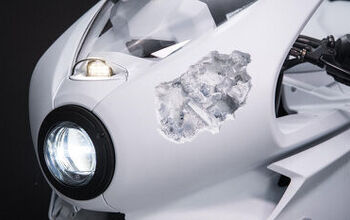
So what’s with the S bike’s quirky style? In case you haven’t heard or read elsewhere yet, the asymmetrical design of the main bodywork is entirely deliberate. The short story behind the shark gill shape on the right and large hole in the left panel is a design that vents as much engine heat as efficiently as possible, theoretically allowing for higher engine output that might not be possible without suffering the power-scavenging effects of high heat. And it should go without saying, but the overall shape of the bike stems from extensive wind tunnel testing said to benefit the rider with excellent airflow as well as the aforementioned engine cooling needs.
As for the most controversial item, the asymmetrical headlights, BMW draws from its success in endurance racing, stating in press materials that weight savings is key to the smaller high-beam lamp.
Putting my looks-is-(almost)-everything theory to the test, I performed a little impromptu, informal polling of consumers and potential consumers in the constant crowd hovering around the S1000RR in the expansive BMW vendor row display. Though quite an unscientific sampling, I wasn’t surprised to learn that most folks, regardless of past or present BMW ownership, weren’t thrilled with styling of the headlamps. However, the bike’s overall appearance wasn’t so unconventional as to dissuade anyone from considering the purchase of the RR were he or she in the market for a literbike.
![]() |
A few interested superbike fans said they preferred the look solely because it’s noticeably different than what’s on offer from Japan. When I told them of BMW’s pricing intentions, the reaction was one of pleasant surprise, many saying they would “definitely” put the BMW in the running as a bike to consider against other liters.
It turns out that thinking only about buyers’ opinions was a little shortsighted. A former BMW dealer from Indiana stated he felt one of the biggest challenges to the success of the S1000RR in the U.S. would be a relative lack of experience many BMW dealers have selling to the younger, hyper-performance-driven crowd that’s drawn to superbikes.
“Most [BMW] dealers won’t know how to sell it,” the Midwestern dealer said plainly.
He followed that remark with a measure of objectivity, saying the new Beemer will likely sell well in the population-dense East and West Coast regions. The former Beemer seller suspects that dealers between the Atlantic and Pacific shores will be eager to swap volume dealers (like BMW of San Jose whose racing history is rich) the minimum of one S1000RR that BMW may require of their stock, for a sure thing (an R or GT model for example) for more conservative regional markets.
A Southern California BMW dealer sees the possible challenge in overcoming buyers’ concerns about the S1000RR’s looks. “A lot of people in the U.S. aren’t gonna like the headlight,” he said. Yet, this same dealer sees the silver lining. Noting the potential the S bike has to draw customers into dealerships, he wonders if other sporting models like the new K1300S may pick up some residual interest from the S1000RR, as customers that may be initially hot for the literbike could find other models that better suit their tastes or type of riding. If nothing else the S1000RR might prove to be an excellent carrot and stick.
Race it on Sunday sell it on Monday… and Tuesday and Wednesday…
No doubt BMW had high hopes for racing success at the Miller round of WSBK this year as the S1000RR made its first U.S. showing. But it seems the ominous storm clouds of Biblical proportions that drifted in and out over the race weekend were something of a dark omen to the BMW Motorrad Motorsport superbike team.
Riders Troy Corser and Ruben Xaus failed to make the cut for the new Superpole format, and finished in 15th and 21st respectively in Race 1, with Xaus coming in 16th in Race 2 and Corser in 17th. In post-race interviews, Corser cited a lingering injury suffered in crashes during the Monza round.
“I damaged the ligament between the shoulder and the collarbone in the Monza crash and it has not recovered yet,” the Australian said. “Race one was hard enough, but I just ran out of strength in race two and had a hard time keeping going. Every time I braked or changed direction, I felt that there wasn’t enough strength to move the bike and that tired me out. I also had some problems with the tire moving on the rim in race two and that didn’t help us either.”
Regardless of the various issues the riders struggle against, Corser remains optimistic, noting that during Friday’s qualifying practice they were only fractions of a second off the 2008 winning time at Miller. However, BMW is painfully aware that other teams have since turned the up heat, and all are faster this year. Where most teams tackle only one, maybe two challenges at each track, being fresh to the game, the BMW Motorrad Motorsport superbike team performs an entire juggling act every time.
One would guess this season is proving a little hard for Corser to swallow considering he finished second in the 2008 World Superbike Championship, but the stoic Australian seems full of quiet determination. Xaus, though bothered by Superpole, has the exuberance of a native of a Romance language-speaking nation. In other words, he’s still passionate about the rest of the season aboard the S1000RR.
Reality check
Having to break out of their comfortable but crusty two-income-household-two-car-garage-loyal-for-life-customer shell in order to make a dent in the literbike class is a brutal reality that’s not lost on BMW. Nevertheless, the company recognizes the need to bolster its slowly dwindling main market, the “pipe and slipper brigade,” as the Brit moto media has dubbed it. Perhaps there’s no greater motivating factor in the resolute decision taken four years ago by the German giant to create a competitive literbike, than to simply gird up its customer base.
![]() |
Whatever the case, whether the raw desire to compete or simply expand market share, it would seem BMW has no choice but to jump on the pachyderm-size superbike market and go whole-hog, fork and knife flailing in every direction, rather than consuming the elephant one bite at a time.
If you’re interested in checking out the S1000RR in person, keep your eyes peeled on local bike nights and BMW dealer events. Racer Nate Kern will exhibit the bike and chat with folks at various East Coast activities, while equally experienced racer Jason Turner will be the West Coast ambassador.
Related Reading
2009 BMW S1000RR World Introduction
2009 BMW S1000RR Preview
2009 BMW S1000RR – A Closer Look
All Things BMW on Motorcycle.com