Needless to say, MV delivers Italian style and
attitude in a major way. Having logged over 3,000 miles of aggressive riding, Michael also found the MV to offer a surprisingly high level of fit, finish, reliability and even sport-touring comfort.
Read on for his detailed account.
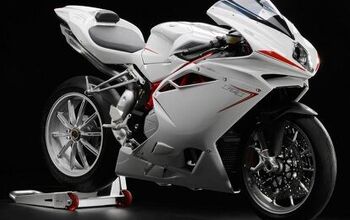
I'd ordered the MV Agusta F4 Strada a few months before my annual summer motorcycle trip.
A few friends and I take a wee tour of eastern Oregon, Nevada, and northern California each year - usually somewhere between 2,000 and 3,000 miles. Most of the trip is in the high desert where it's very sparsely populated but littered with plenty of twisties and hilly bits where you can have a bit of fun with minimal chance of a formal interview by the guys with the flashing lights. The delivery date for the bike was typically Italian, that is to say I heard the term "next week" many times. Two months later, I still don't have an owner's manual... sigh.
The bike arrived about a week and a half before my trip. Interestingly, it was shipped in the crate nearly ready to go: air in the tires, brake and clutch fluid in it. Instant Italian Superbike-in-a-box... just add water (and coolant, oil and charge the battery) and go.
Given that we were going many places where it'd be hard to find a mechanic who could spell "MV" much less work on one, I wanted to get the 600 mile service out of the way while still in Portland. After a few around-town miles and post-work rides, I finished off the first 600 miles with lunch at my parent's house. This is a 300 mile round-trip from Portland.
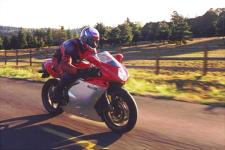
This was a pretty enlightening ride. While it was a blast on some great roads, I was introduced to the Marquis de Sade of motorcycle seats. A very nice little set of tools lives in a vinyl pouch under the seat. However, it feels like the tools are scattered on top of the seat instead. It made the seat on a Ducati 748 I previously owned seem pretty comfy. A quick call to Harper's got me a gel pad, and a couple of days before we left I managed to remove the seat cover, trim the gel pad to fit, and reattach the vinyl cover. This helped enough to at least delay butt surgery for a few months.
The other maintenance bit I tackled before leaving was to have Bardsley Donovan at Ron Tonkin Gran Turismo (my local dealership) replace the high-pressure fuel lines with braided steel lines. I contacted Cagiva North America through the dealer, asking about the two American magazine test bikes that had both ruptured their fuel lines (one wetting the rear tire and dumping the rider down hard), but the response from the Cagiva rep was completely unsatisfactory. He claimed that the test bikes with the problems had been Euro-version D'Oro series bikes and that they didn't think there was a problem with my particular model. Funny thing is, both articles show bikes with black swingarms (thus contradicting the rep's statement). Ultimately, I didn't really think I wanted to risk my life to prove the point and just paid for the lines myself. This is disappointing, considering the general quality of the bike and the great service I'd received from the dealer so far.
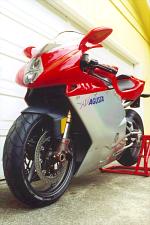
The MV's ergonomics are quite similar to the Ducati 748/916, pitching you way forward onto your hands, but with decent legroom (I'm 6'2"). Like the Ducati, a beer belly is gonna hurt you on this bike, the gas tank protruding enough to pretty much require a near-washboard stomach. Around town, stopping for lights and traffic quickly demolishes your wrists and hands since your weight is so far forward. But on the open road and in twisties, the position is fine, with the wind and/or a tank bag keeping the weight a bit further back just like on the Duc'.
My friend Russ disagreed, having to pull over after maybe 20 minutes of riding. But he's in his fifties and weighs, in his words, "an eighth of a ton."
Surprisingly, I didn't have a problem with the ergos on our trip that covered as much as 400 miles per day with only minor swelling. My hands and butt suffered the worst. My knees, back and feet were okay.

PAGE 2 The tank bag absolutely destroyed the aerodynamics, however, causing a fair bit of turbulence over 100 mph. But it was about a foot tall, and a fair bit higher than the windscreen, so no surprise there.
It actually occurred to me that sport-touring wasn't exactly the mission they had in mind for the MV. On the other hand, if I'm going to ride a couple of days to get to killer roads, I want the least compromised weapon to ride when I get there.
In terms of fit and finish, you'd never know from looking at the bike that it's a low-production model... or that it's Italian. There's a sizable difference between this bike and the 1997 Ducati 748 I had. Granted, Texas Pacific Group had just taken over back then. But still the 748 had "orange peel" in the paint, mismatched color (due to the bodywork being molded in red plastic vs. the metal tank), not enough paint, and panel fit that was pretty mediocre.
Get down on your hands and knees, take a close look at the MV and you'll swear you're looking at a Japanese motorcycle. Fasteners, fittings, paint and welds all look like they came from a Honda production line. I'm still not sure if the frame was robot-welded or done by hand - the welds are that good.
There's a lot about this bike that makes you think it's a Japanese sportbike rather than one of an Italian marque. It's not just the sewing-machine whir from the inline four at low RPMs; it's more that things don't fall off it every hour on the hour. The 748 lost a footpeg, a battery clip, two starter solenoids, a starter motor, a headlight bulb, and a coolant reservoir all in the first few thousand miles.
I had only one problem in 2,700 miles: the right turn signal stopped flashing due to a contact between the frame and the fairing upper that got out of alignment. Interestingly, they've chosen to use a strange ball contact mechanism between these pieces rather than a simple, traditional snap junction. But hey, when the turn signals do flash, they're way cool. The turn signals are mounted in the mirrors, and since the mirror housings are molded red plastic, at night the entire mirror housing lights up. Very wild... ooh... ahhh.
The dash is pretty funky, too. The bright yellow tachometer goes to 17,000 RPM (redline is actually 12,500) and the digital display gives you MPH, odometer, two trip meters, water temperature and a clock. Not having an owner's manual (grrrr....), I managed to learn through the dealership that you use the starter button while the engine is running to cycle through these functions. It's still pretty unnerving hitting the starter button while the engine's whirring away.
Japanese inflections aside, there is a lot about this bike that makes you think "Italian." Thankfully, it's the good stuff, namely the sexy Italian looks. Notice the gorgeous swingarm (for an extra $15K you can get that in gold), the mufflers molded to make an inner fender, the engine castings, the tail moldings and the very cool dash. Ziss iszzz achrt!
The sounds the motor makes are a peculiar mix of traditional Japanese in-line four and Ferrari's canvas-tearing V12. At anything under about 5,000 RPM, it's a sewing machine. Then, at around 5,000 RPM, with 1/2 throttle or better, it starts to make a small-block-Chevy burble through the intake (folks on the sidelines or on other bikes can hardly hear this, but the rider hears it since it's directly below your chin). At higher RPMs, the burble fades and the engine note progresses to a more typical inline four shriek. But there also is a deeper note that indicates the MV's Ferrari heritage. Overall, the bike never gets very loud, so you can be a bad boy and not really draw too much attention.
How they got a power curve this flat out of a high-revving inline four I'll never know. You get decent pull from around 7,000 RPM, and the power seems pretty flat from there on up to 12,500. It seems that the fuel injection is a fairly simple map of throttle position and RPM that works without a hitch.
Unfortunately, like the 748, the MV is negatively affected by altitude more than you'd think. At over 5,000 feet, it will often stall while coasting to a stop. The horsepower is, of course, noticeably down as well.
Unfortunately, the only place I've found enough room to try a top speed run has been over 5,000 feet, plus I had a tank bag on it. The best I saw was an indicated 155 MPH. At that speed, with the tank bag taking up the space my helmet wanted to occupy, I was building up neck muscles at a painful rate. Back in Portland (nearly sea level), I had the opportunity to do a few laps at Portland International Raceway during the Italian Day festivities. From a standing start, I saw 150 MPH before braking for turn one, located less than a mile from the starting grid. Is it as fast as a GSX-R750? Not quite, and the GSX-R costs half as much money. These are the only two reasons not to race it at the track.
The handling of the bike is superb. The front end feel is better than the 748, while the rear is maybe a little less sensitive. This could be a difference in tires, as the last tires I had on the 748 were a full race front and a race 3 rear (treaded). The MV came with Michelin Pilot Sports. The front end steers far lighter than the 748, with a very delicate, sensitive feel to it. I kept the adjustable Ohlins steering damper set pretty light, and the bike is superbly stable through fast sweepers, bumps or no bumps.
The front brakes are astounding, with phenomenal feel. They remind me of the RS125 I used to race. They did take about 100 to 200 miles to break in, though - a long time in my books. This must be a pad compound thing. My friend Tony took it for a quick ride and was amazed at how easy it was to pick the rear off the pavement at over 80 MPH - and there's a lot to pick up as Tony's well over 200 pounds. The rear brake, like the 748, is fairly vestigial. Use it to settle the suspension or hold the bike on a hill at a light. The rear brake reservoir is right next to the exhaust, behind a tiny heat shield. The rear brake completely faded once after a long day of high-speed, heavy-throttle riding. When I went to use them in a gravel section, coming up to a remote Nevada gas station at maybe 5 MPH, there was nothing there. There was no fluid loss apparent, though, and they came back the next day. Hmmm.
By this point, you're probably aware that I like this bike a whole lot. What's not to like? It's gorgeous, very fast, handles great and has been as reliable as a Japanese bike (at least for its first few thousand miles). I can even do 400 mile sport-touring days on it with some soft luggage and not need ass surgery at the end of it all.
The MV Agusta F4 Strada is a wonderful piece of usable motorcycle art. I believe everybody should get a chance to experience this bike at some point in time. I've let about a dozen of my friends take it for a test ride, so I'm doing my part. Now it's time for you to do yours.