


2007 Tokyo Motor Show

Considering that Tokyo’s yearly motorcycle show is the home field for four of the biggest OEMs, it's no surprise that it’s the scene for some wild new concepts – it's all a part of the competitive one-upsmanship typical of the Japanese corporate culture.
For this year's show, Honda, Suzuki, and Yamaha all had new concepts to wow the crowd, with machines ranging from futuristic engineering exercises (built as an excuse for each manufacturer to show their superior technological capabilities) to prototypes that look ready to roll off the production line and onto the street any day now. And make sure you also take a look at the accompanying photo gallery for more pics of these cool bikes.
Honda
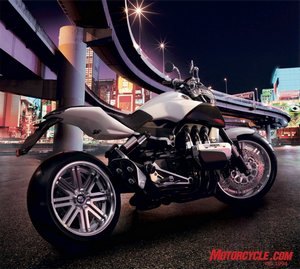
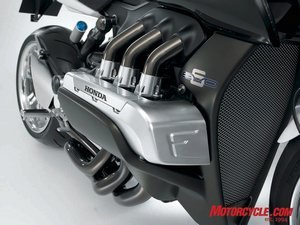
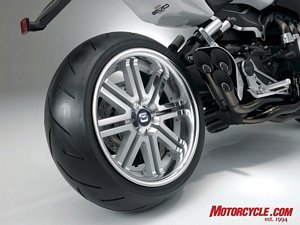
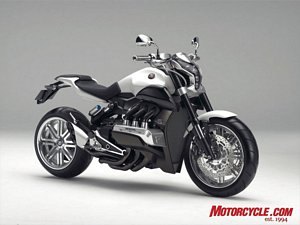
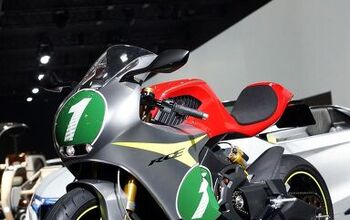
Just behind the stubby mufflers is a highly-polished aluminum wheel, its seven pairs of spokes exposed to the world by means of a single-sided swingarm - another hint that Honda's stylists are looking at current trends in the aftermarket and the custom bike scene for inspiration. The unique rear suspension features twin shocks angled in a V configuration to mount near the centerline of the swingarm and near the outside edges of the frame. Even more unusually, the shocks show no sign of a spring - although one could be concealed inside the large-diameter damper body, I suspect the EVO6 uses some other form of springing, possibly air.
Up front, you'll find beefy upside-down forks carrying another mirror-polished aluminum wheel, a futuristic 5-LED headlight cluster that flows well with the bike's lines, and a massive radiator surrounded by a subtle fairing which features a pair of wings reaching up and out to wrap around the bottom of the cylinder heads. The tank also features two mini-wings reaching forward from each side, painted in a contrasting color and reminiscent of the radiator fairings of a motocross bike - a style that seems to be becoming more and more common on today's streetfighter-styled 'naked' bikes.
The aluminum backbone frame is as unusual as the rest of the bike, at least from what is immediately obvious. Most of the visible frame pieces appear to consist of massive billet-aluminum blocks machined into the necessary shapes, with a raised ridge featuring a polished finish outlining each part, while the slightly recessed center sections are finished in a semi-matte grey that matches the radiator/cylinder head fairing.
Seemingly out of place on such a high-performance machine, Honda's sparse press material explains that the EVO6 features a full automatic transmission, which offers two automatic shifting modes as well as a six-speed manual mode shifted via a bar-mounted switch. While no further details are given regarding the transmission, the description of the shift modes sounds suspiciously similar to those used on the constantly variable hydraulic unit featured on the DN-01 (see below), leading one to wonder if the EVO6 uses a beefed-up variation of that same transmission.
The real question when looking at the EVO6 is "is this an engineering exercise or a prototype with production potential?" A case could be made for either, but I would guess the truth lies somewhere in the middle. With Yamaha soon to drop an all-new, high-powered V-Max, Suzuki's new Hayabusa-powered B-King in production, and the possibility of a ZX-14-powered Z1400 streetfighter from Kawasaki, ultra-powerful and aggressive naked bikes seem to be the flavor of the week.
A retuned Gold Wing motor could give the EVO6 class-topping power and torque figures (although that depends on where the V-Max's output ends up), and the flat-Six format would have the appeal of being extremely unique in a market dominated by V-Twins and inline-Fours - in fact, anything with six cylinders is so unusual that it tops even the uncommon V-4 layout the V-Max will feature, at least in terms of "my bike is more different than yours" bragging rights. The automatic transmission would probably be a turn-off to most riders interested in this type of bike, however, and it would certainly add significantly to the cost as well.
While the overall idea of the bike makes sense, it's unlikely a final production unit would have exact resemblance to the concept. The MotoGP exhausts would probably be ditched in favor of a couple of high-volume mufflers, although there's always the possibility that Honda could use a muffler mounted under the engine, combined with the now-omnipresent catalytic converters, to achieve enough sound reduction to allow the slash-cut megaphones to pass government regulations. As for the machined-billet frame sections, those would likely disappear in favor of something more conventional. The 220mm rear tire might make the cut.
Still, a streetfighter powered by a retuned Gold Wing powerplant would definitely be an interesting addition to the class, even if it did use more conventional running gear. The size, weight and length of the Wing's inline-Six powerplant would necessarily create a larger, heavier motorcycle than its competition, but the potential for massive horsepower could attract buyers, as would the uniqueness of the engine configuration.
Of course, this is all assuming that if the EVO6 makes it into production, it would be volume production - if Honda decided to produce a small run of extremely expensive EVO6s (as they did with their last Wing-powered concept, the Rune), they could keep the final product much closer to the concept seen here - automatic trans and all. Looks like we'll have to wait and see, but it seems feasible that an EVO6-like machine could be in dealerships by 2010.
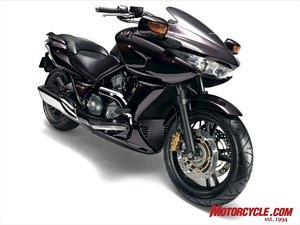
Also present in Honda's display was what is a near-production ready version of the sleek DN-01 scooter, first presented as a concept bike two years ago. Look past the spaceship-like styling and you'll see what appears to be a fairly standard sport-tourer setup, with some cruiser-like elements (like the forward-mounted floorboards). Honda is promoting the DN-01 as an all-around transport solution, and they emphasize the low 27.2-inch seat height, indicating an attempt to appeal to less-experienced riders. The powerplant is also fairly tame, a 680cc V-Twin borrowed from the European-only Deauville middleweight tourer.
The DN-01 is really something of a mixed bag. Honda calls it a "sport cruiser," while just looking at it, you'll spot a sport-tourer style fairing, cruiser-style floorboards (position-adjustable, by the way), and of course the blacked-out, stealth-fighter paint and finish treatment. An LCD/LED instrument panel gives the cockpit a high-tech feel, and ABS keeps stopping distances to a minimum, helped by what Honda claims is a very low center of gravity and a long 63.2-inch wheelbase.
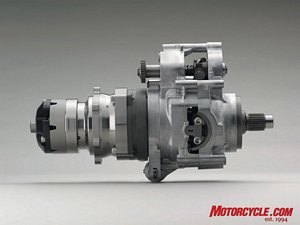
The standout feature of the DN-01 is the new HFT (Human Friendly Transmission). Rather than using dog-engagement gears and manually-actuated shifting, the HFT uses a crankshaft-driven oil pump that converts engine power to hydraulic pressure, and an oil motor for converting that hydraulic pressure back to something capable of powering the rear wheel. In between is a system of pistons, valves, and plates that create an infinitely variable transmission ratio, making use of the V-Twin's power with maximum efficiency.
The rider can select from three modes: D, for ordinary riding, S, for more aggressive situations, and M, which simulates a six-speed manual transmission to give the rider the feeling of shifting on their own. It seems likely that in D mode, the transmission is programmed to target maximum fuel efficiency, while S mode will sacrifice some mileage for quicker acceleration and sharper throttle response. Honda also claims that the transmission features a "lockup mechanism," saying that this is a world’s first for a hydraulic transmission. Whatever it does, the lockup mechanism is supposed to further improve efficiency under steady-state cruising conditions. Sounds like the DN-01 will be one fuel-efficient machine; the question is, will it make its way to the U.S.?
The last arrows in Honda's quiver of concept models are also the most standard machines of the bunch, with no outstanding high-tech features or futuristic looks to create hype. Despite that, they're actually the most practical and attractive of the bunch, and probably the most likely to make it to the sales floor of your local dealership.
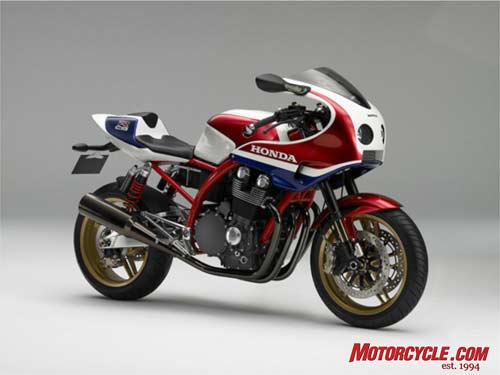
The CB1100R is a stunningly attractive example of the retro-sport category, proving that Honda has some designers with serious chops - this beauty could stand toe to toe with Ducati's Sport 1000S in the looks category, at least in my opinion. The bodywork somehow combines classic style with a hint of the crisper lines of modern design, especially the singe-seat tail section, which wouldn't look out of place on a new CBR but somehow doesn't look out of place here either! The fairing fuses traditional and modern in the functional sense, with the retro-styled twin round headlights actually using modern technology - of the pair, one is a reflector type while the other uses a projector-beam setup, providing what Honda considers an optimal light pattern for road use.
The tubular steel frame uses the air-cooled inline-Four powerplant as a stressed member, keeping things clean and simple throughout the central area of the bike. An aluminum fuel tank is a nice touch. Up front, the CB1100R sports modern-looking upside-down forks carrying radial-mounted calipers, and the dual shocks out back look equally capable - despite the archaic configuration, the shocks themselves appear quite modern, even sporting separate reservoirs mounted behind each shock body. Damped by those dual shocks is a sweet-looking braced-aluminum swingarm, and gorgeous gold-finished aluminum wheels spin at both ends.
All we know about the motor at this time is that it displaces 1140cc and uses a DOHC configuration, but I'd expect it to be plenty capable, probably with modern internal design hiding behind that archaic-looking air-cooled outer shell. All in all, quite an attractive machine, and one I'm hoping to get a chance to ride one day - if it functions as well as it looks, it ought to be quite the hit in the current, retro-enthused market. Honda says it’s “specially designed for mature riders who feel the pride of owning a Honda and the true CB spirit.”
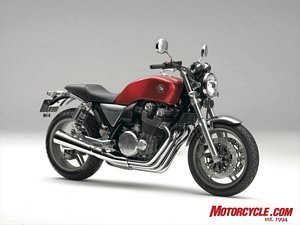
The CB1100F is a slightly tamer, more easy-going brother to the racey CB1100R, with the F being an upright, unfaired 'standard' in contrast to the R's tucked-in, retro-superbike looks. Externally, the bikes have many similarities, sharing the same frame and engine, but the F uses standard right-side-up forks and cheaper-looking brakes up front. Honda says the 1100’s chassis is as compact as that of a 400cc motorcycle. An attractive fuel tank has the long length reminiscent of Honda’s RC works racers, and the four-into-one exhaust system owes its flowing curves to the revered CB400F of the mid-’70s. If it makes production, of which there’s a strong chance, the CB1100F will be priced significantly lower than the 1100R, with less of a focus on performance and more on comfort and rideability.
The two bikes together make up a well-designed attack on the retro market, with the R taking on Ducati's sharper Sportclassic range, while the F challenges the likes of Triumph's laid-back Thruxton. Judging by the complete, well-finished look of these two bikes, They look close to production and could be hitting dealers as soon as mid to late 2008.
More by Alex Edge







Comments
Join the conversation