![]() |
![]() |
![]() |
![]() |
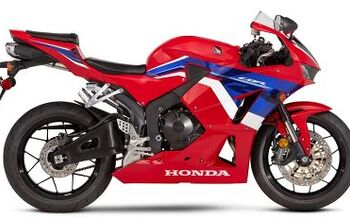
Honda's CBR900RR (Fireblade in some markets) returned for 1998 with what seemed like redesigns too minor to hang with this buffed out crowd. Ah, but all is not as it seems, and this year the 'RR matches up to the marketing hype that sold so many of the (ex-) wobbly machines in years past. Notably, a stiffer chassis, 5mm more trail (trail, not steering head angle, is what provides front-end "stability"), 10mm more fork span to enhance handling and torsional rigidity, improved suspension valving and selected weight savings added up to a quantum leap forward from the previous model. In fact, it was argued that with more power the RR might have won this test: That is, despite its 114 horsepower motor being a little under par in this group, the RR proved to be a such a flickable, stable mount with predictable power delivery, it afforded all riders instant confidence to go fast in the twisties. Bottom line: the 'RR is the easiest bike to jump on and go fast.
One of the surprises of this test is that most of these mongo dong-swingin' hyper-bikes are also great street bikes with tractable power and livable ergonomics. Not so with the GSX-R750. As resident Willow Springs Motorcycle Club king-pin big-fish Chuck Graves -- who won seven out of seven classes this past season at Willow -- pointed out, "the GSX-R750 sure likes to be ridden hard, but it's a miserable street bike." Point the GSX-R750 at a track or a set of curves that you've scouted for dirt and cop officers and hang on for one awesome ride: The Gixxer captured the only other first place vote in the test, from AMA Dirt Tracker Brett Landes: "The harder I rode, the better it handled. I was very impressed with its racetrack prowess."
Page2
Despite the Gixxer's impressive racetrack performance, the brutal power of Kawasaki's redesigned ZX-9R relegated it to fourth place. Despite taking the final podium spot in our test, the new Ninja didn't fare well in our racetrack testing. Hard compound Bridgestone radials, abrupt throttle transitions and unsorted suspension conspired to make the ZX a marginal track bike as set up from the factory. AMA 250 GP'er Roland Sands commented, "You could feel the bike start to come around when you got back on the gas -- there's little traction out there -- but the gear box was good and the motor was smack-you-in-the-face powerful."
In the end, the savior of the odd-handling Ninja was its awesome motor and excellent -- dare we mention it! -- ergonomics. It's a toss-up between the Kawasaki and Triumph as to which is most comfortable, suffice it to say that both make top-notch sport tourers with all-day comfort and amble wind protection.
![]() |
![]() |
![]() |
A general rule of thumb if comfort is important: If you're over 180 pounds, go for the firmly sprung ZX-9R, if you're a midget, get the ultra-soft Triumph. Despite spotting the shootout-winning R1 100cc's displacement, the ZX-9R pulled 10.26 seconds in the 1/4 mile at 133.81 mph, only .01 seconds and 2.32 mph behind the Yamaha. In the canyons, the ZX's torquey motor also excelled, put plan on shelling out an extra 500 or so dollars on a set of race-spec tires if you don't want to land on your head: "I did a half a lap on the ZX-9R," quipped Editor-in-Chief Plummer, "and pulled in to wipe all the oil off the rear tire -- it came almost all the way around on me twice, and I was sure it was leaking fluids. Sure enough, it wasn't, so I checked tire pressure, which was fine, too. The forward weight bias and stiff rear spring, coupled with the hard tire prevent weight from transferring back, so there's little traction available for sporting situations." If you get a 9R, be careful on the stock tires! It is also possible that Kawasaki needs further development on their K-TRIK throttle position sensor -- we noticed the same on-off throttle jumps on a similarly equipped Vulcan 1500 Classic.
Which brings us to the Triumph T595. Most of us had a great deal of affection for the pretty red Brit, but in this slugfest it simply received a hammering. The gearbox, while smooth around town or in the hands of our lead-footed non-racers, was overwhelmed when hammered by the racers. It also turned in the least impressive dyno performance with 112 ponies at the rear. But the triple was a blast on the streets, with a healthy growl from the exhaust and solid handling. A little less weight and a little more power would have brought the attractive T595 into the league that the Japanese established and still own. In all, though, we were extremely impressed with the Triumph -- that they're even considered in the same league with Yamaha's R1 is impressive, and it's nice to see the Brits willing to kick some ass after 30 years or so of relative inactivity.
![]() |
![]() |
Impressions: 1. Brent Plummer, Editor-in-Chief
If you want the best sportbike made today, go get an R1. But you'll have to get in line behind me, 'cause I'm pulling industry strings to get one ASAP. Ha ha!
2.Chuck Graves, Contributing Editor Racer
The R1 is incredible, state-of-the-art through and through. The neatest thing about it was that while it still had suspension plush enough to give a smooth ride on the highway, the chassis still gave the razor-sharp feeling of a racebike when ridden at its limits. It's as stable as a rock. The other thing that made it leaps and bounds beyond everyone else's motorcycle is the smoothness of the throttle control -- the exact same thing that I was raving about on the old YZF1000. Rolling on the throttle was always smooth, always predictable, and that goes a long way towards instilling confidence when driving off a turn.
The Honda moved around a lot, but never gave you the feeling of getting out of control, even though it didn't have great control and wasn't smooth over the bumps, there was always confidence that the bike was going to stick when you turned it in. Suzuki's GSXR750 -- which got my vote for third place -- is better than last year's 750, which was an awesome bike. It's a great machine.
I was alone in liking the Triumph at the racetrack. While we agreed it looks great and that its tractable motor made for excellent streetability, I felt that its superior throttle response made it easy to achieve smoothness when ridden hard.
I thought the ZX-9R felt too vague. You couldn't tell what it was going to do when you tried to change direction quickly, and you couldn't turn it in really fast because you weren't sure what the front end was going to do because it was too soft and moved around so much. It had good brakes and a really comfortable riding position, but the off-to-on throttle transition was so abrupt that you really couldn't control the bike coming off the corners.
3. Billy Bartels, Associate Editor
I really wanted to pick the CBR900RR to win: Sure, it wasn't fastest, but it was so much fun to ride. I suppose it all depends on how much testosterone is in your riding diet. If you want to live to a ripe old age and have plenty of fun sweeping through the countryside at speeds double the legal limit get the CBR, if not then there's the R1.
In fact, if you belong to the Anthony Gobert win-or-wad school of racing, you will probably want to get the R1, but I hear you'll be waiting until next year, as they are already selling out in most locales.
The ZX-9R was a distant third, yet still an excellent bike, after all this is the Best of the Best. That motor is awesome. Give the Triumph the benefit of the doubt, it's a killer street bike, but in this company its only fourth. I don't get the GSX-R, its racing credentials are second to none, but on the street it's almost impossible to ride that bike the way it is designed.
4. Brett Landes
AMA Grand National #41 The Honda was the first bike I rode. I was very impressed with everything about the bike. The bike felt real stable through the middle of the corner. The power was good and it stopped real well. The CBR really lets you build confidence in yourself. Going from the CBR to the Triumph is a let-down ... it's a fun bike to ride but does not compare to the other bikes in the test. I was impressed with the way the bike handled, but the transmission does not have a close enough gear ratio to be a race bike ... Also, I have a hard time riding a bike that leaks oil.
I was not very impressed with the Kawasaki. It felt like the bike moved around a lot in the corners and did not stop as well as the other bikes. I think the tires had a lot to do with that. The bike wanted to break loose exiting the corners. I spent a lot more time riding the GSX-R. At first I had to fight it in the middle of the corner in order to be where I wanted to be on the race track, but the harder I rode, the better the GSX-R handled. This bike has great brakes, accelerates well, steers well. And the Yamaha is an absolute ball to ride. It's very smooth doesn't do anything radical at all. I had a little trouble steering it in the middle of the corner, but I don't think it would take much to fix than perhaps a little stiffer spring in the back. In my opinion, I think it is the best looking bike at the test. The R1 is one great street bike!
I don't feel that there are any losers in this test. The bottom line is simple. If you want to go racing, the GSX-R is definitely the best bike to buy. If you want a great street bike that is extremely fast and comfortable, I would go with the R1 followed by the CBR.
5. Roland Sands
AMA 250 GP #10 I love motorcycles more than most things and riding the Yamaha R1 made me realize that. Fast as all git out, the kind of fast that leaves you thinking about what would happen if it got away from you, but it never did. It greeted full-throttle slides with a smile. The only problem was a slight lag when getting back on the throttle, but most people wouldn't notice it. Good gear box, and good suspension, though a bit soft for me, but that's fixed easily enough.
The RR was the friendliest bike, I was immediately comfortable on it and ran like stink. (In Roland-speak, "like stink" translates into "very good" or "great.") The CBR is the best complete package if I were going to get a street bike, but I'm a little biased by the sheer, undeniable power of the R1. The very racy Suzuki was the closest thing of the bunch to my TZ, I ran it the hardest in the corners and it always felt like it wanted more. You have to rev the snot out of it to get it to do anything, but if you get it where it wants to be, it'll scream like a chick in a Hitchcock flick. Not so great if you want to run to the pub for some suds, but great if you want to win races.
I loved the ZX-9R, more so than anyone else here. It's lighter and faster than the old one. Smokey rear tire fast. Good brakes and sharp steering made it easy to pitch in, but there was a noticeable lack of mid-corner grip once there. The lack of traction might just have been the year-old lay-away rubber on the thing, and as we all know if you ain't got rubber, you ain't gonna get none. The Triumph is beautiful, I was in love. But on the track, I was always looking for more revs past the 10k red-line. It missed gears and leaked oil. Well, the chassis felt strong and the steering was good, and it sounded cool as hell, but its just a little out of league with this group.
Riding all these bikes is fun and anybody could ride one fast.
Page3

Triumph's T595 Daytona
|
|
|
Chuck Graves really liked the big Triumph. He found it reminiscent of his old GSX-R1100 racers. |
|
|---|---|
![]() |
The Daytona was slowest at the strip (10.75 @ 128.48 mph), but posted a competitive launch time of 1.795. |
|
In our unofficial Best of the Best Beauty Contest the T595 was runner-up to the radical R1. |
|
![]() |
Comfortable ergonomics didn't hamper the fun when the pace kicked up. |
|
Specifications: Manufacturer: Triumph Model: 1998 Daytona T595 Price: $10,695 Engine: liquid-cooled inline DOHC Triple Bore and Stroke: 79mm x 65mm Displacement: 955cc Carburetion: Sagem Fuel Injection Transmission: 6 speed wet, multi-plate gear Wheelbase: 56.7" (1440mm) Seat Height: 31.5" (800mm) Fuel Capacity: 4.0 gallons (15.L) Claimed Dry Weight: 436 lbs (198kg) Measured Wet Weight: 499 lbs (226kg) Peak Horsepower: 112.67 bhp at 9,250 rpm Peak Torque: 69.93 ft-lbs at 7,250 rpm Quarter Mile: 10.75 at 128.48 mph |
Suzuki's GSX-R750
![]() |
The GSX-R is a demon on the racetrack, but the tight and technical Streets of Willow didn't let it open up and have its head. |
|---|---|
|
The primary change to the '98 engine is fuel injection, replacing the 39mm Mikuni carbs. The 46mm throttle bodies, two-stage system is similar to the FI used on the TL1000. |
![]() |
![]() |
Also new for '98 is a larger ram air box with 50% more intake that increases airflow and decreases intake resistance along with a stronger generator and digital-direct ignition system that produces hotter sparks. Intake valve lift is increased from 8.5mm to 8.7mm and exhaust valve cam lift was reduced .4 mm with more duration on the intake cam and less on the exhaust cam. |
|
Know your enemy, this is the smiling face that'll kill you. "I don't get how this bike is so popular," quipped Associate Editor Billy Bartels, "it's painful to ride on the street." |
![]() |
![]() |
At LACR the peaky GSX-R ripped of a 10.64 @ 131.44mph (60ft reaction 1.806) to come in fourth behind the more tractable CBR... |
|
...However it fried its slightly weak clutch doing so. We toasted the last GSX-R750 clutch we had too. |
![]() |
![]() |
It may only be fourth in this shootout, but you won't see any 750cc bikes stepping up to bat against the Gixxer. |
|
Specifications: Manufacturer: Suzuki Model: 1998 GSX-R750 Price: $9,299 Engine: liquid-cooled inline DOHC Bore and Stroke: 72 x 46mm Displacement: 749cc Carburetion: Fuel Injection Transmission: 6 speed, constant mesh Wheelbase: 55.1" (1395mm) Seat Height: 32.7" (830mm) Fuel Capacity: 4.8 gallons (18L) Claimed Dry Weight: 395 lbs (179kg) Measured Wet Weight: 466 lbs (216kg) Peak Horsepower: 120.23 bhp at 12,000 rpm Peak Torque: 58.49 ft-lbs at 10,000 rpm Quarter Mile: 10.64 at 131.44 mph |
Page 4
Kawasaki's ZX-9R
|
Kawasaki's ZX-9R has about a 20lb bias towards the front wheel, evidenced by the minimalist tail section and titanium muffler. Those residing in California and countries with restrictive emissions standards will have to settle for a stainless steel can and a catalytic converter that adds a few pounds. |
|
|---|---|
![]() |
The dash, while not esthetically inspiring, is almost as thin as the dash on the CBR. |
|
Suspension is harsh, yet complaint enough on the street. |
![]() |
![]() |
The devilish grin that has come to define the 90's Ninja. You'd smile as well if you lost 77 pounds from your once porky frame. Still, at 468 lbs measured, it was the second heaviest bike in our test. |
|
Roland Sands' impersonation of Gary Rothwell. |
![]() |
![]() |
It's claimed wheelbase is 25mm shorter than last year. A 24 degree rake and 94mm trail make the 9R easy to pitch into corners, although some testers commented that it felt twitchy. |
|
Six-pot binders good enough to stand it on its nose... and beyond. |
![]() |
|
Specifications: Manufacturer: Kawasaki Model: 1998 Ninja ZX-9R Price: $ 9,999 Engine: liquid-cooled inline DOHC Bore and Stroke: 75 x 51mm Displacement: 899cc Carburetion: Four Keihin 40mm CVKD Transmission: 6 speed w/ positive neutral finder Wheelbase: 55.7" (1415mm) Seat Height: 31.9" (810mm) Fuel Capacity: 5.0 gallons (19L) Claimed Dry Weight: 403.5 lbs (183kg) Measured Wet Weight: 468 lbs (212kg) Peak Horsepower: 129.57 bhp at 10,750 rpm Peak Torque: 68.46 ft-lbs at 9,250 rpm Quarter Mile: 10.26 at 133.81 mph |
Honda's CBR900RR
![]() |
Chuck Graves set the second fastest time of the day on the CBR900RR, despite a large horsepower deficit. |
|---|---|
| The CBR had a "stealth" redesign this year, keeping the same basic profile despite significant chassis changes. | ![]() |
![]() |
One of the ways Honda saved weight on the RR is the tiny new electronic instrument package by Kansei. Photo by Honda |
| One of the ways Honda spent the weight savings: A beefier, more rigid swingarm. Photo by Honda |
![]() |
![]() |
It didn't launch well (1.808 60ft time), but its tractable power and smooth tranny made for a respectable 10.61 @ 130.11 mph. |
| Frame tubing thickness was increased for greater lateral and torsional rigidity, increasing overall rigidity by nine percent. Add stronger swingarm pivot plates, modified steering geometry and a beefier, stronger swingarm and the difference in handling between the old RR and this model is like night and day. | ![]() |
|
Specifications: Manufacturer: Honda Model: 1998 CBR900RR Price: $ 9,999 Engine: liquid-cooled inline DOHC four Bore and Stroke: 71 x 58mm Displacement: 919cc Carburetion: Four Keihin 38mm CV Transmission: 6 speed constant mesh Wheelbase: 55.1" (1400mm) Seat Height: 32.2" (818mm) Fuel Capacity: 4.8 gallons (18L) Claimed Dry Weight: 396.8 lbs (180kg) Measured Wet Weight: 453 lbs (206kg) Peak Horsepower: 113.5 bhp at 10,250 rpm Peak Torque: 60.8 ft-lbs at 8,250 rpm Quarter Mile: 10.61 at 130.11 mph |
Yamaha's YZF-R1
![]() |
Upside-down forks, magnesium parts, and the coolest Japanimation-inspired front-end ever... Oops, gotta change the sheets. |
|---|---|
| Most everyone set their fastest time on the R1, including CEO Brent Plummer. | ![]() |
![]() |
A large digital speedometer lets you know when you break the sound barrier. The electronic tachometer houses a digital water temp gauge. |
| The rear cowling is now a one-piece design. Racers commented on how cool the bike would look in race trim minus the license plate and passenger pegs. | ![]() |
![]() |
Yamaha carries on their recent tradition of killer brakes, and the bike weighs 60 or so pounds less. |
| The R1 likes to lean -- 56 degrees from vertical. Chuck liked sliding the R1 out of corners, admiring its ability to stand up on corner exits. | ![]() |
![]() |
Launches were not the YZF's forte, but the 130+ horse motor took care of the rest, posting a best time of 10.25 @136.13 mph, just .05 slower than Honda's CBR1100XX. |
| YZF-R1: Best of the Best | ![]() |
|
Specifications: Manufacturer: Yamaha Model: 1998 YZF-R1 Price: $ 10,199 Engine: liquid-cooled inline DOHC Bore and Stroke: 74 x 58mm Displacement: 998cc Carburetion: Four 40mm Mikuni BSDR 40 CV Transmission: 6 speed, constant mesh Wheelbase: 54.9" (1395mm) Seat Height: 32.1" (815mm) Fuel Capacity: 4.7 gallons (18 L) Claimed Dry Weight: 390 lbs (177kg) Measured Wet Weight: 445 lbs (202kg) Peak Horsepower: 130.73 bhp at 10,250 rpm Peak Torque: 74.03 ft-lbs at 8,500 rpm Quarter Mile: 10.25 at 136.13 mph |
Best of the Best Venue: Los Angeles County Raceway
| Notice Chuck Graves' intense concentration on the tach, this is how you set fast time on every single bike in a test. | ![]() |
|---|---|
![]() |
This is not how to set fast time. |
| Welcome to the Antelope Valley. | ![]() |
Best 1/4 mile times: Bike Best Time Speed 60ft Time YZF-R1 10.25 136.13 1.737 ZX-9R 10.26 133.81 1.725 CBR900RR 10.61 130.11 1.808 GSX-R750 10.64 131.44 1.806 T595 10.75 128.48 1.795 |
Best of the BestVenue: Streets of Willow
![]() |
Standing around waiting for the boss to stop talking about safe riding. Gee, guess who wadded the CBR900RR this day? |
|---|---|
| The dressing room. | ![]() |
![]() |
Hey Mark, where'd you find the girl? Tell her I'm cool. |
|
How many MO staffers does it take to mount our high-tech camera system? Huh, huh, huh. We said "mount." |
![]() |
![]() |
CEO Brent Plummer warning Associate Editor Billy Bartels not to wad... |
|
...the CBR900RR after Brent slid it across the skid-pad. At least it crashes well. |
![]() |
![]() |
Billy about to get passed by Brett Landes on the T595. |
|
Race team manager Rick Hutchins checking tire pressure. You were wondering who does all the real work here at MO? Certainly not the wussies in the Editorial Department! |
![]() |