It Ain't The Tool Shootout

The Canyon Carving Shootout

story by Gabe Ets-Hokin, Photograph by Fonzie, Created Jun. 14, 2005
BACK TO THE ARTICLE PRINT
Has this happened to you? I know it's happened to me. I have this recurring nightmare: I'm riding the fastest, most powerful, best-handling sportbike I've ever owned up a gnarly, twisted mountain road. I'm braking late and getting on the gas early. I'm wearing leathers and my kneepucks are lightly tapping the ground in the corners. My wrists ache and my knees are straining, but it's worth it because I'm going fast as heck. I'm on a vehicle that is purpose-built to do one thing and one thing only -- go as fast as possible on pavement.

I'm not looking in my mirrors, because there's nothing in them but blurry elbows, but if I did, I would see a crusty old guy wearing moto-cross boots and an even crustier old Bell helmet with goggles, astride a monstrosity of a motorcycle, a dirty, banged-up dual sport, rolling on skinny tires and making all of 32 bhp. He's gaining on me, and then, with almost no warning aside from a whirring sound not unlike a Huey helicopter, he is past me, pushing the bike into the next bend as he disappears from view. The guy looks like he's barely awake, much less breaking a sweat.
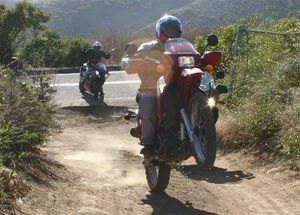
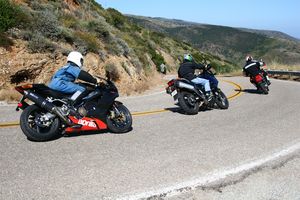
Lascivious thinking gets you everywhere @MO: With bragging rights at stake in a dash from points A to B, who says you have to stay on the blacktop?Awakening, I think: 'This is just another urban legend.' Or is it? If it is reality, then what's the good of having a hard-core, dedicated sportbike if a cheap old dualsport will go just as fast, in addition to being cheaper to maintain, more comfortable to ride, and fun in the dirt? Can anybody go faster on a dualsport than a sportbike, or do you need to be the aforementioned crusty old dirtbike guy who descends out of the hills on fine, sunny mornings to haunt my life and dreams? What about the intangibles about motorcycling: The sounds, the feel of the clip-ons, the joy of owning and taming a highly strung exotic stallion? Would owning a dual-sport or quasi-dualsport satisfy the urges we motorcyclists feel every day?

Which one of these will best satisfy your urges?One thing we do here at MO is ponder such questions so you, the loyal MO subscriber, can quickly read our conclusions and get back to your busy work day. However, this present question fomented a lot more debate than usual. It's something many motorcyclists desire: a fast, comfortable, great-handling and lightweight bike that has as much ability off-road as on, a do-it-all companion on any kind of moto-adventure. Is this practical? Does such a bike exist? Or are we doomed to perpetual ownership of a stable of bikes to keep us truly happy?

In April, contributor Fred Rau wrote an insightful essay putting into words what few motorcycle publications like to discuss: a skilled rider on a slow bike can go much faster, in the real world, than a less-skilled rider on better machinery. But what kind of bike suits which riders, on which roads, and why?

There's only one way to figure it out: get a few totally unrelated motorcycles, break out the MO charge card and ride around some of the sweetest roads in the LA area to find out what happens when an old dual sport, an exotic Italian, and a goofy-looking I-Don't Know-What-the-Hell-That-Is walk into a bar.
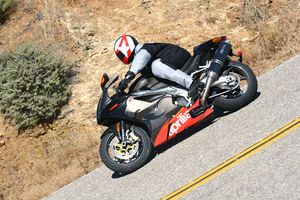
Looks good. Goes Better.Part One: Meet the Trio

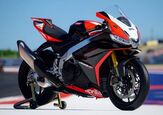
First up on our reality show is the hot Italian supermodel, the 2004 RSV 1000 R. First introduced in 2003, the Mille R is a focused and hardcore sportbike. The ergonomics are compact, with low clip-ons and extremely high footpegs. The seat is hard and flat, with a vestigial passenger seat.

This thoroughly modern Mille is equipped with all the best hardware you'd expect on a $14,000 Italian race replica. Up front is a pair of four-piston, radial-mounted calipers bolted to a 43mm inverted Showa fork. On the other end of the beautifully welded aluminum frame is a "banana" style swingarm that looks like it could have been lifted off of Aprilia's Moto GP bike. Like everything Aprilia builds, the RSV 1000 R has slick and flawless build quality, reminiscent of ordering a cheeseburger at a high-end restaurant: it's the same basic recipe as a diner's, but the preparation, presentation, and execution are so good that the lowly cheeseburger is elevated to a memorable affair.
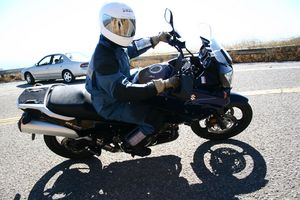
I don't care what 'Strom' means in German...I call it 'fun' Of course, all this deliciousness is just wrapping for the best part, the 60 degree, eight-valve, liquid-cooled "magnesium" motor. Producing 136 HP at the crank and 117.7 (2004 model) at the rear wheel on MO's Dynojet, this powerplant promises smooth and easy-to-access power everywhere. Remember Gabe's requirement for a motorcycle priced north of $10,000: it should have more power than you could ever use in any situation.

Our next contestant is also visiting us for our upcoming Adventure Tour shootout, and is another motorcycle that wouldn't have existed 10 years ago, at least not in this country. Introduced in 2002, our own John Burns reviewed the Suzuki V Strom for us and told us all about what makes Lil' Suzy Wee Strom tick. To spare you Burnsie's stream-of-consciousness musings, I can recap the highlights.

The V-Strom uses a pair of old-tech, two-piston, sliding-pin calipers bolted to a pair of 43 mm cartridge forks with plenty of travel. It's all led on its merry way by a 19-inch front wheel riding on a 110/80-19 Bridgestone Trailwing. This connects to the back 150/70-17 rear Trailwing via an aluminum frame and swingarm suspiciously reminiscent of the SV 1000.

The motor is a 996cc 90-degree "L" twin derived from the TL 1000 S, but with smaller valves and different fuel injection... the good ol' "tuned for torque" routine. It's still good for 91 HP and 60 foot-pounds of torque (2002 model): good enough to get you going as fast as you could want.

All bolted together, we come up with a vehicle that looks bigger and heavier than it is: the V-Storm has a *claimed* dry weight of just 458 pounds, and even though the little windscreen is way out in front of the rider, the V-Strom still doesn't seem overly ponderous or big once you're in the saddle.
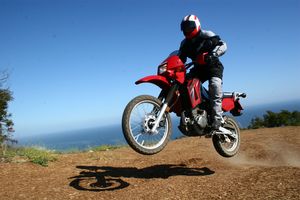
Sean was surprised to find the KLR wasn't half bad off-road as long as you keep the weight and chassis limitations in mind.Next to the big, glamorous V-Twins, we have placed a little old lady of a thumper. Kawasaki's KLR is one of the oldest motorcycles in continuous production from a Japanese manufacturer. First sold in the USA in 1987, the KLR was an upgraded KL 600, which was first sold here in 1985! We here at MO reviewed it in 1999, and the technical details are all still the same. If a production cycle for a motocrosser or hard-core sport bike is three years, than the KLR is over 160 years old in motorcycle years, and yet it's still a strong seller for Kawasaki.

What makes it so good? If first impressions are lasting, the KLR is in trouble. Build quality and styling are more Mainland China than the swoopy V-Strom's Euro-looks, with clunky plastic, silver-painted steel and a very industrial-looking powerplant suspended under the Reagan-era bodywork. There's a tiny front brake with a single-piston caliper bolted to a 38mm air-adjustable fork.

Air-adjustable? Yes, my boy, back in the old days we used to have little valve caps on top of our forks to adjust preload. It sort of works, too. Just don't hook up the air line at the gas station to them to see what will happen, unless you want to hear your fork seals go "pow". Don't ask me how I know this.

The rear Unitrak shock is adjustable (with a ramped collar, thanks) for both preload and even rebound damping. It holds up a steel swingarm and 130/80-17 rear tire on a spoked wheel, matching the front 90/90-21-shod wheel. But the advantage to all this low tech is a light 337 pound *claimed* dry weight.

The motor is a buzzy, thumpy history lesson in liquid-cooled four-stroke singles. There's no fancy fuel injection or automatic fast idle here: a 40mm carburetor does all the work of feeding the four-valve, dual overhead cam 651cc single. At least there's electric start as a concession to modernity. A small windscreen, spacious saddle and large luggage rack are included for your comfort and convenience
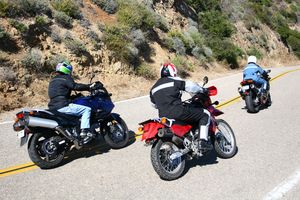
Which is the best on this road, and why?Part Two: Why are We Here?

So I've described three dissimilar motorcycles we have here in the MO garage: so what? We chose these three bikes because they represent two totally opposite approaches to having fun while riding fast on a twisty road.

The first approach is what I will term the "holistic" one. "Holistic Sportbiking" is an almost ceremonial affair, with image and appearance being paramount. On our ride up the Angeles Crest highway, we saw a couple of acolytes of the Holistic Church of the Sportbike. They were both riding the preferred vessel, the GSX-R, with rear fenders ceremonially chopped, and dressed in baggy, spotless one-piece leathers and pristine, unscuffed knee sliders.

Holistic sportbiking is an activity performed infrequently and often in large groups. Only the most high-tech, class-leading motorcycles are acceptable. Great amounts of thought, time, energy and money are placed into improving power, brakes, suspension and appearance. In practice, these motorcycles rarely see the racetrack, but instead are ridden on carefully selected two-lane roads somewhere near the speed limit. Much time is spent at rest stops comparing tires, suspension and other esoterica.
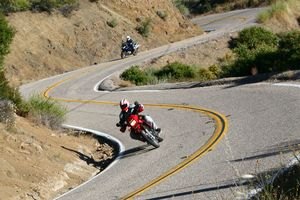
Forget about keeping up with Sean if he has both hands on the bar, regardless of what he rides. The other approach is a more practical one. It's usually practiced by older guys who have been riding a long time. They love to ride and ride long miles. They demand comfort before almost everything else, yet they blaze through even the bumpiest of turns without even slowing down.

Practical sportbiking involves long, 250 mile or longer Sundays spent on a variety of roads. Any line on the map is acceptable, as long as it's not an interstate. When the pavement disappears or is impossibly broken these practical riders don't even flinch.

Therefore, a practical bike must have a comfortable seating position, decent wind protection, good fuel range and suspension with sufficient travel to handle a wide variety of pavement. In the last five years, a number of bikes have appeared to satisfy these requirements, with the famous BMW GS series spearheading.

The V Strom and the KLR represent two different ways to get this combination of features. The V Strom has a lot more heft than the stone-axe KLR, but compensates with a burlier engine and much more sophisticated suspension. The KLR offers its light weight and flexible, un-intimidating engine to get from point A to B the fastest.

We all know the Mille makes the most power and would doubtless be fastest on the racetrack. But for the kind of riding most of our readers here in the Land of the Free (that is, free except for riding as fast as you want), which bike gets you from here to there with the least effort, regardless of the type of road? Is the old cliché about dual-sports and an upright seating position accurate, or is it hype from broken old men justifying their purchase of dowdy equipment?
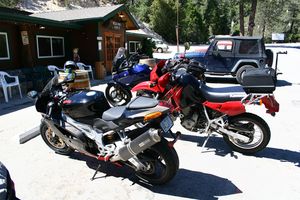
Here we are, back at the Ranch. Part Three: On the Road with the Three Sisters.

We spent two days riding these three bikes. On the first day we rode among the canyons of the Santa Monica Mountains. Here, the roads are characteristically tight and twisty, with limited sight lines, large elevation changes, and bumpy pavement. On the second day we rode in the Angeles National Forest, with roads that are also bumpy, but with greater sightlines and gentler, higher speed curves.

How many times have you read something like, "this (insert hard-core sportbike here) would be a great bike to have if you lived at the base of a twisty canyon road" in a sportbike review? We read as many magazines as anybody, so we put the theory to the test. We had perfect weather, great road conditions, light mid-week traffic, and a wonderful, Italian V-Twin sportbike to ride.

We switched bikes frequently during the days, so we could be sure we experienced each bike in all kinds of road surfaces and corner types. After a long traffic jam on the Pacific Coast Highway, we turned up one of the canyon roads towards Mulholland drive.
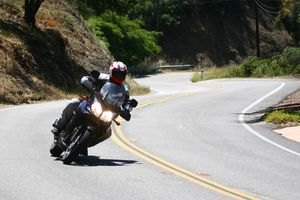
Dirty loved railing through the sweepers on this thing. I got to start out on the V-Strom. I had heard plenty about riding this mantis-like monstrosity, and had been passed by one or two on my regular Sunday Ride (which has evolved into a more holistic event over the years), but I hadn't experienced it for myself.

It was worth the wait. With wide, high bars, low footpegs and a very soft seat, the V-Strom greets you like a 90 HP easy chair. "The V-Strom combines the Aprilia's grunt with the KLR's ergonomics and wraps it all together in a smooth and refined package that's well suited to long days of terrorizing your favorite back road", says Publisher "Dirty" Alexander.

Page2I felt instantly comfortable on the thing. I was able to lean it as far as I dared with total confidence and comfort, trying out my newly-learned dirt-riding technique of pushing the bike away from the rider in turns. The 110-section front tire provided as much grip as I needed at street speeds, and I could keep up a good clip following Dirty as he humiliated us riding one-handed, no matter what he rode or how gnarly the road surface. "I do it to keep me from riding too fast on the street." Humble, he's not.

Managing Editor Pete Brissette liked the V-Strom as well, although it took a bit of time for him to get used to the unconventional beast: "Throw in the ability to do some fire road riding and this bike is as close to perfect as a bike can be. It took me longer than any of the others to get used to, but once I became at ease the V-Strom easily consumed the paved twisties."

Pete loved the wide handlebars on the KLR.Of course, the V-Strom isn't perfect: no bike is. It feels a bit ungainly and top-heavy: as Pete says, "With a relatively high center of gravity the bike gives the sensation of falling into a turn once you're more than forty percent into the lean, giving me the feeling that I'm going to run out of tire." It's also heavy, especially after you hop off the KLR. But with that smooth, flexible, and powerful motor, the rider can just select one gear in the buttery, precise gearbox and roll on and off the throttle, using the motor to slow into corners. This is a good thing, as the brakes don't really shine. The rotors are a bit undersized, and the two-piston calipers require a good tug to slow the bike down.

We were still on some tight roads, so I whined and cried until I got to ride the KLR. The KLR is the motorcycle equivalent of having a battered old pickup truck. It's not very fast, has more rattles than the Tito Puente orchestra, and it makes a weird whistling sound as you accelerate. But it also has a huge luggage rack, a very soft seat (too soft, according to Dirty, a man who knows about soft seats, as he possesses a very large and plush one of his own), low pegs and a wide, high-leverage handlebar. "One of the most useful aspects of the KLR is the amount of leverage offered from the dirt bike style bars" commends Pete.

Now this is what an Italian Sportbike is good at! Just as you don't mind when somebody uses your old pickup to haul greasy engine blocks and 600 pounds of empty beer bottles to the dump, the KLR seems happiest when it's being tossed around like a chopped salad on twisty bumpy roads, or being bounced over ruts and bumps: "The KLR feels light and nimble and encourages its rider to throw caution to the wind and just have fun", according to resident fun-magnet Dirty. Nobody is going to respect you for abusing your $13,000 Mille, but big lean angles, dirt-road excursions and long wheelies feel natural on a low-budget bike like the KLR.

Of course the KLR isn't all sunshine and lollypops. "The KLR's front brake is nearly worthless and could be replaced with a single-leading shoe drum for more stopping power" is Sean's main gripe about the 18-year old machine. We all noted the engine's buzziness, especially Pete, who made his 100-mile round-trip commute on it daily for several weeks. "The KLR could be good but not without spending additional money" writes Pete, and we all agreed. Brake, suspension and counterbalancer technology have progressed such that Kawasaki wouldn't kill its golden goose by spending a bit of money smoothing out the KLR's rough edges, rewarding the KLR's loyal and numerous following.

Now we switch one last time to the RSV 1000 R. After riding the roomier KLR and V-Strom all morning, I'm rudely re-introduced to sportbike ergonomics...but I still don't remember ever being on a more cramped streetbike. With GP-bike dimensions, even a short 5'6" rider like myself or Pete winds up with his ass in the air and knees seemingly in his armpits. It's a great position for attacking a wide, smooth racetrack or making pornography, but a poor one for trying to negotiate a serpentine canyon road. The bars are stubby, sharply angled inward and below the beautifully cast and machined triple-clamps, and the pegs are so high and forward it would be funny if somebody else had to ride it.

The basic riding position of the RSV has "you hunched forward and looking down, instead of through the corner", according to Sean. Pete felt similarly frustrated: "If a motorcycle can be both a pleasure and a nightmare to ride at the same time it would be the Aprilia. The bike begs you to ride it to its limits by virtue of the torquey yet seamless motor, but then physically punishes you for having such thoughts. It has clip-ons that place far too much weight on the heel of your hands and a seat to bar relationship that nearly has you sitting on the gas tank. When they sell that bike, it should come with 10 free chiropractic visits."

I felt very much the same way as Pete. Riding a tight road on a sportbike like the Mille can be an exercise in frustration. You can never carry enough corner speeds to take advantage of the Mille's reserve of cornering clearance, and the sub-50mph speeds of roads like Latigo Canyon mean the triple-digit horsepower numbers have no meaning as the bike just sputters through the bottom third of the rev range in the bottom two gears. In the meantime, your friends on the upright, user-friendly bikes are slowly inching away, corner after corner as they take advantage of greater visibility and leverage to muster valuable confidence and process that into higher corner and exit speeds.

It doesn't help, either, when your so-called friends abandon you at the gate to a fire trail and go gallivanting in the hills for a half hour, leaving you by the side of the road while Sean practices hill-climbs and jumps with the KLR. The V-Strom, though not sold or marketed as a dual-purpose bike, can also handle a smooth dirt road with its big front wheel and long-travel suspension. The RSV 1000 R has to sit by the road forlornly while its two sisters have fun getting dirty with the other boys.

Insuring our Odd Trio
Kirk Harrington is a motorcycle enthusiast who just happens to also sell motorcycle insurance. I asked him for an insurance professional's take on insuring these three oddly matched beasts, and this thoughtful insight is the result. We'd like to make Kirk's take on insurance a regular feature, and hope to be able to give more specific information on premiums in the future.- Gabe Ets-Hokin

First up is the Mille. Being a "true" liter-class sportbike is the Mille's only downfall. The insurance industry, as a whole, prefers not to underwrite liter-class sport motorcycles with comprehensive (theft and fire) and collision (physical damage) coverage. Basically, the cost of repairing a sportbike is far greater than repairing a cruiser or standard motorcycle.

The insurers will tend to give better rates for riders that are over 30; rates are based on a simple formula that makes age a key factor. So, a 25 year old rider would undoubtedly pay higher premiums than a 40 year old rider. Even if the 25 year old rider were married (some companies will give a married discount as high as 20%), the single 40 year old would still fare better than the 25 year old. In my home state of Georgia, the average 1000cc sportbike would be anywhere from $1900 to $3200 annually to insure for a 25 year old single male, but the same bike for a 40 year old would come in around $900 to $1500 for a single male. That may seem high, but when you consider that there are few companies that rate bikes based solely on engine displacement, your options become rather limited.

On to the KLR. This is an interesting machine. It would be in an insurance class that was once described as the "standard" class. Since there are no real "standards" any longer, insurance companies tend to lump a whole collection of bikes together for this class. However, there are a couple of companies that tuck these bikes away into their own class (dual purpose), making them inexpensive to insure. Whether you're 20 or 60, the rates for these bikes will usually be under $400 annually no matter where you live. I just insured a guy that has a Suzuki DR 650 with comp and collision coverage for the low, low price of $130 annually. He is 29, single and has a clean driving record. No too bad for an insurance policy that runs a full year.

The DL is the kicker in this comparo. I have a couple of companies that actually give this bike "dual purpose" status. Do you think a liter-class DP bike should be cheap to insure? You're right! I've got six or seven V-Strom customers of varying ages and driving records and not one of them pay more than $500 annually for their policies (the average is about $275). Suzuki played a nice little marketing game with this bike: they marketed it as an adventure/sport-tour motorcycle. Some companies put it straight into the sport-tour category for rating because it draws a bigger premium. Not upsettingly high, mind you, but higher than the standard/DP category. Basically, the insurance companies just wanted to rake the V-Strom owners for a few more dollars and most people don't even realize it.

Insurance is a fact of life and we cannot ride without it. Insurance companies play favorites with riders that play by the rules. So, if your motorcycle class endorsement is valid and you have no tickets your premiums will reflect that. If you take a MSF or other safety course and/or join a motorcycle association you will get discounts (these vary widely from company to company).

In the end, you control your own destiny in the insurance market. If you want a true and comparative way to find insurance rates for your state ask your local bike shop if they work with an independent insurance agency. I've had my agency for five years and work with around 20 different bike shops. Basically, I'm an anomaly in this business. I've been riding around 23 years and read everything that can be read about bikes. There are guys out there like me. Find them and you'll be just fine. 

Kirk Harrington
A.C.E. Specialty Insurance Agency, Inc
http://www.acecycleins.com/
877-571-RIDE (7433)


When I die, I want to be rolled in bread crumbs and deep-fried. But that's OK: the next day is time for the glorious open sections of Angeles Crest and Big Tujunga, which have more increasing and constant-radius corners, and less vegetation to obscure views of rockslides, sand-filled apexes, and law-enforcement types sent from Mordor to save us from ourselves.

These kinds of roads seem much more suited to the Aprilia's character, so I ride it first. And indeed, it's a little more fun up here. Even with the stock mufflers the exhaust and intake sounds are pure heaven, steering is linear, precise and light, and the engine...oh that engine is truly fine. Why anybody builds or buys anything other than V-twins is a mystery to me. Pete calls it "bottomless power"; I'm inclined to agree.

Don't forget: the nice weather brings cops as well as flowers. But it's still not really ideal for this kind of street riding: "The Aprilia's suspension feels out of sorts on rough pavement, bouncing its rider out of the seat over bumps and transmitting too much force back to the contact patch when skittering over frost heaves and road patches" writes Dirty. Unless the bike is coming out of a corner at full throttle, or accelerating through the gears at 100+ mph, it just doesn't seem to make sense on the street.

It used to be you would tolerate riding an uncomfortable Italian V-Twin as the price you had to pay to get one of those marvelous engines. But the V-Strom makes paying that price unnecessary. Hopping on the V-Strom after a dozen miles on the RSV is like getting into a warm bathtub at the end of a hard day of work. The long wheelbase, high center of gravity and wide bars don't make the V-Strom any less enjoyable at higher speeds. The V-Strom is a nicely engineered motorcycle that feels as stable and neutral in 90 MPH sweepers as it does at 60 MPH. "Its riding position keeps your head up and allows you to maximize your leverage over the bike, while remaining relaxed. This enables the rider to maintain a higher pace for a longer period, while flinging the bike back-n-forth through the twisties", sayeth Sean about what would turn out to be his favorite bike.

Archival photo of 'Operation Dumbo Drop'We didn't go completely ga-ga over the big Suzuki: I didn't like the extreme buffeting from the small windscreen over 75 MPH that made my head shake like Katherine Hepburn after drinking AM/PM coffee. Ironically, only big bad Sean noted that the tall seat height could be an issue for us little people: "those under six feet tall are out of luck if they like to flat-foot a bike at a stop."

The KLR was last on my list to ride, and I used it for the 4,000 foot descent back to the LA Basin. Where the RSV had been a chore to ride on twisty downhill roads, the KLR was just as fun in the wider, more open turns as it had been in the tight stuff. Although it lacked the stability and nice suspension of the V-Strom and Aprilia, the KLR provided just enough stability and brakes to nicely augment the low weight and wide bars. It was easy to blast down the mountain and chase Sean on his favorite mount, the V-Strom, as long as he wasn't trying too hard. Sometimes he would even put both hands on the bar.

Luckily for KLR owners, Loctite comes in 250ml bottles.The motor, of course, with its 36 horsepower doesn't overwhelm. If HP were IQ, the KLR could barely work for the Caltrans planning office. But blasting downhill through hairpin after hairpin, triple-digit power isn't what's needed: grip, stability and a comfortable, confidence-inspiring riding position are. The KLR delivers, and is more fun to ride, in an "I don't care if I do crash" kind of way, than the other two bikes.

This old nail isn't perfect, especially when you put the modern bike yardstick up to it. Build quality has a Unicor feel to it, the brakes do little but activate the "Dial-a-Dive" system, (Sean's term for how the KLR's forks dive when braking, with good and bad effects on cornering) and vibration is bad enough to shake the screws holding the windscreen on loose. This isn't a bad thing, really, as there's actually smoother airflow and less turbulence without the screen

Luckily for KLR owners, Loctite comes in 250ml bottles.Part Four: Putting it all Together

You have waded through line after line of turgid prose waiting for the pay-off. So what's the conclusion? Which bike was favored by our intrepid crew on the sorts of roads that most of our readers are blessed with for their weekend fun?

The Aprilia is just miscast in this role. With an uncomfortable riding position, even the best chassis, suspension and motor aren't enough to compensate for multiple hours in the saddle. The Aprilia puts the rider in a state of real bliss when everything is just right, but how often, on a six-hour ride, do you have those moments? When just the right mix of experiences- the perfect apex, gaining on your buddy, the sun on the back of your neck and the roar of exhaust in your ears- sends the serotonin into your pleasure centers? Not that often, really, though we keep riding for those intermittent pulses of pleasure. But most of our leisure riding is spent connecting the twisty spots with straight-aways. The RSV 1000 is not intended for straight-aways: "The RSV simply isn't any fun droning down the freeway for more than twenty minutes", says Pete about his favorite bike. And the problem with using such a bike for street riding is that if you are uncomfortable and cranky when you get to the corners, you won't enjoy it as much as you would if you were in a better mood, negating the advantages the built-for-speed RSV holds.

Still, we were all wowed by the RSV's beautiful build quality, excellent brakes, sweet handling manners and wonderful motor. But I think our decision is unanimous: please find somebody else to ride this bike in a straight line for any length of time. That's why only Pete picked it as the best bike for twisty roads: "It is after all a narrowly focused race bred motorcycle", so it does come with the best motor, brakes and suspension to go into corners fast and leave them faster. It just takes a high level of rider skill and discomfort to get that equipment into your favorite turns. Unless you do more than 10 or 15 trackdays a year, your ticket to moto-happiness might not have "RSV" stamped on it.

Having a delicious, expensive, finely-crafted Northern Italian gourmet five-course meal is wonderful, but sometimes you get just as much pleasure from Weinerschnitzel's dollar chilli-dogs as well. The KLR is the tastiest thing on the motorcycle value menu short of a $500 pickup truck. Pete once again tells it like it is: "In the hands of a skilled rider it can compete in the twisties with bikes of a much narrower focus, perform as a near perfect commuter and then, quite literally, carry you over the mountains and through the woods." Sean was charmed by the old girl as well: "The KLR allows me to "play" all the time and with its ultra-inexpensive asking price, I can afford to upgrade the brakes, tires and suspension to make it even more fun and still have the cheapest bike in this group."

I was enthralled by the KLR's mix of versatility, fun and value. Both Pete and I, novice dirt riders that we are, felt confident puttering around on dirt roads on the KLR, and Dirty entertained us with displays of jumping and hill-climbing prowess on tires and suspension that can also handle pavement with a surprising amount of grip. We also spent a great deal of time plying LA's freeways on our KLR with no ill effect. And when premium gas costs more than light beer, getting 45+ mpg is a nice bonus. You get all this for $5,149 brand new? And with 19 years of production, there are plenty of nice examples available used for well under $3,000.

The best thing about the V-Strom may just be the price: $8,999. But it's not perfect. None of us were impressed with the soggy suspension, buzzy, noisy motor, or flaccid front brake. The seat hurts after a while, and fasteners tend to shake loose: we lost our windscreen the second day. The tires never give the rider much confidence to really whip the bike into corners: even Sean claimed he was fearful of the front knobbie washing in a turn, although we all loved the ease with which the rear brake locks the back tire, producing impressive squeals and clouds of smoke.

The KLR 650 is fun, versatile and easy to ride briskly, and it's the pick of all three of us cheapskates if we had to shell out our own non-existent cash to buy a motorcycle. Still, it's not the ultimate weapon against the curvy lines on the map. In this company, we preferred its larger offspring.

Offspring? "The VStrom combines the Aprilia's Grunt with the KLR's ergonomics and wraps it all together in a smooth and refined package that's well suited to long days of terrorizing your favorite backroad" says Sean. It's as if the grizzled old KLR took the svelte and sexy young RSV as its mistress and had a mutant love child. The V-Strom combines the seductive sound, feel and power of the V-twin RSV with the comfortable ergonomics and user-friendly details of the KLR, finished off with decent brakes and suspension.

"With an upright riding position, comfortable seating for two and a torque loaded, user friendly V-twin, the V-Strom is the bike most people should own" opines budding Stalinist Pete Brissette. It makes going fast fun, not just with its predictable, easy handling and powerful, sonorous engine, but because you can get to your favorite curves happy and relaxed. And if relaxing is why we ride, the Suzuki is the most relaxing and fun machine of our trio.

copyright (c) 2008 Verticalscope Inc. Story from http://www.motorcycle.com/shoot-outs/it-aint-the-tool-shootout-14733.html