

Los Angeles, February 15, 2000 -- The Honda Valkyrie Interstate and the Yamaha Royal Star Venture are recent entries into the "Chrome Tourer" niche that, until recently, Japanese manufacturers ceded to Harley-Davidson. Both motorcycles are big and fat and replete with chrome, certainly on the hoggish side of the scale, but in many ways decidedly un-hoggish.
They are elemental in design yet they don't cut corners when it comes to amenities like full-range audio. The Valkyrie and the Venture pack plenty of motor, particularly the Interstate.
Even better, both of these bikes take you down the long and winding road in comfort and style.
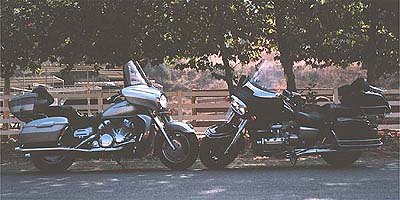
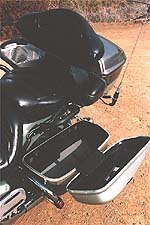
We felt that the Yamaha Venture possessed a better integrated design. In some ways, it seems almost as though Honda rushed the Interstate to market to counter the Venture. For example, except for the top case, the Valkyrie's bag system was awkward to access while the Venture's was easy to use. The Interstate's CB/Audio system offered a lot of functionality, but it gave us flashbacks of Windows NT -- overdesigned and complex to operate. Even worse, it wasn't loud enough.
On the other hand, the Venture's audio system, in our opinion, offered the same core functionality -- radio, CB, on-board intercom -- while sounding better. Well, at least it was louder. We also liked the Venture's retro-styled digital ruler speedometer -- a small but inspired slice of design. The Valkyrie's analog speedo and tach were functional but a bit lacking in imagination.
2000 Models?
However, the Valkyrie Interstate offers a stronger motor, better brakes and superb night-time visibility. The Venture is still a Royal Star and while the V-four engine has been re-tuned for a bit more grunt, compared to the Interstate, it feels underpowered, particularly when riding up inclines or traveling with a passenger. But then perhaps the Venture's less powerful motor this isn't such a bad thing considering that the Venture's brakes often felt overwhelmed and were prone to fade.
Mechanically, the MM Limited is no different than the 1999 Venture and offers, instead, special color schemes and badges. The MM limited comes in Pearl White/Ivory with saddlebag hinge emblems, a brass serial number plate and a commemorative key. The MM Limited is a little pricer than the standard Venture with an MSRP of $16,099 USD.
"Both the Valkyrie Interstate and the Yamaha Venture tested were 1999 models. For the 2000 model year, the Valkyrie Interstate received a blue/pearl paint scheme and no mechanical upgrades while Yamaha released the Venture MM Limited Edition."
While both motorcycles handled surprising well -- with the edge to the the Interstate at higher speeds -- although, quite obviously, neither motorcycle can be classified as light-handling or "flickable." The Venture's front end had a tendency to swim a bit on higher speed sweepers and we felt that that the very tall and not particularly aerodynamic windscreen contributed to this. On the other hand, even though the Valkyrie's front end was a bit undersprung, it still felt a little more stable at higher speeds. Perhaps the fork-mounted fairing was more aerodynamic. In any case our evaluators gave the edge to the Interstate when we rode faster. In short, we liked both motorcycles, but when we sat down to make a preference, the staff chose motor over design. Both motorcycles take take you where you want to go and do so in style, but the Valkyrie does it with more grunt.
The Yamaha Royal Star VentureYamaha calls the Venture the flagship of their Star Motorcycle line-up. It certainly lives up to its billing, with goodies such as air-adjustable suspension, cruise control and full audio with front and rear speakers. The Venture also offers over 130 liters of cargo space and comes with a five-year, unlimited mileage warranty and 24-hour roadside assistance program that is one of the strongest support packages in the motorcycle industry. The 1294cc, V-four, liquid-cooled powerplant is inherited from the Royal Star but has been tweaked with a larger capacity airbox (increased from 3.2 liters to 9.7 liters), larger carburetors (four 32mm Mikunis compared to 28mm Royal Star carbs) and new cam timing to help give the Venture a little more oomph. What we liked best about the engine was its pleasant, unique pulse, a sensation that doesn't feel as raw as a V-twin Harley but not as smooth as the flat-six Valkyrie. It's a vibration that reminds you that you are on a motorcycle, yet it never feels so overwhelming that after one hundred or so body-numbing miles you being to wonder why you ever decided to ride motorcycles in the first place.
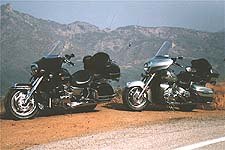
Horsepower tops out at 79.2 hp at 6250 rpm and torque peaks at 76.7 foot-pounds at 3850 rpm, not bad but significantly less that the 90-plus rear wheel horsepower and torque produced by the Interstate.
Still, while Venture's engine produces adequate power, it needs very one of those ponies to haul its well-over 800-pound body across America's highways. In some situations, such as in heavy freeway traffic where a quick hit of power is often appreciated, a little more torque and top end would have been welcome.
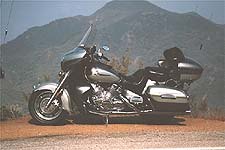
Where the Venture shines is in its esthetics. A tastefully designed chassis surrounds the engine and offers enough chrome to highlight the motorcycle's lines, yet not too much as to overwhelm it.
Both the front and rear suspension are air-adjustable and the Venture offers a plush and comfortable ride. Ground clearance, an issue on Royal Stars, is good but not as much as the Valkyrie's. The long, 67.1-inch wheelbase provides a stable platform for spirited highway touring, and we found low and cruising speed handling characteristics better than we expected.
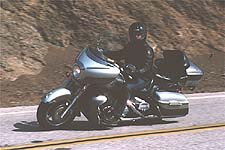
Compared to the Valkyrie, the bike is a little top heavy and two-up riding, while pleasant, was a bit more of a challenge than on the Interstate. Still, both these bikes were designed for passengers and so if we seem to be critical, it is because we are splitting hairs for the purposes of this comparo.
Two-up or solo, the front end does have a tendency to swim ever so slightly in high speed sweepers, but we attribute this more to the extremely tall and flat windscreen.
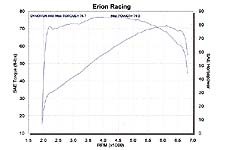
Max horsepower = 79.2 hp @ 6250 rpm.
Max torque = 76.7 lbs/ft @ 3850 rpm.
Ah yes, that tall windscreen. It offers excellent wind protection, but because it is so tall, flat and upright, it seems as though it was not designed with drag coefficients in mind and, as a result, it creates wind resistance that makes the Venture's front end feel like it's swimming through the turns.
However, we must add that the particular staffer who noticed this admitted he sped through a freeway exit ramp sweeper at about 85 miles per hour. Of course, the Venture is not a sport bike, and because the speed limit in most American jurisdictions is 75 mph, take this observation as valid but one that many riders may never experience. However, we do have one complaint about the windscreen that is relevant for almost all riders. Moisture tends to collect and bead, limiting visibility in wet weather. Again, due to its tall and upright design, the wind hits the screen at almost right angles rather than a more sloped angle where the airflow assists in pushing the moisture off and over the windscreen.
While a good rain wax or an anti-fog cloth helps, there are times when the wax has faded and you can't find the cloth, and it is then that the fog and misty rain are particularly vexing. Caught during a recent storm, we had to pull off the road a few times and wipe the screen. In dry weather the windscreen performed as designed, offering excellent wind protection. The floorboards are a nice touch and we preferred them over the Valkyrie's foot pegs.

Motorcycle.com presents an unrivaled combination of bike reviews and news written by industry experts
More by Motorcycle.com Staff






Comments
Join the conversation