Heavyweight Cruisers, 1996

Five Fat Uglies on Five Fat Bikes

story by Andy Saunders, Fat Guy Number One , Created Apr. 25, 1997
BACK TO THE ARTICLE PRINT
Take five motorcycles. All but one are V-Twins (10 years ago an endangered species, now one of the dominant motorcycle engines). All sized from 1100 to 1500cc, all weighing 550 or more. All with four or five gears, none with seat heights above 29 inches. They're painted different colors, but if you think that we can't tell them apart by anything other than the paint -- well, you're pleasantly wrong. How different can they be? That's the question non-cruiser aficionados always ask, and it's usually answered one way "If you have to ask, you don't understand."

Even if you've never sat on a cruiser in your life, it's actually easy to understand their appeal. They are motorcycles for the dietetically challenged. No thin people need apply. The svelte look silly in the ample tractor-based seat of an American style cruiser. Fat guys own cruisers. It's fair enough: Fat guys look ridiculous in full leathers, especially after shoe-horning their beerguts behind sculpted gas tanks of sportbikes so their arms wave in the air like beetles. And as the keep-fit fad dies among baby boomers (Who can face a two hour workout every day for the rest of their lives?) potential cruiser owners will soon become the majority of the motorcycle riding population.
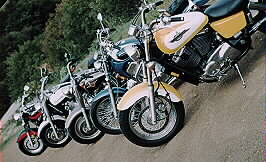
So we took a bunch of the biggest fellows we could find around the Redondo Beach offices of Motorcycle Online. Muscle Beach is just a five minute rollerblade away, but we didn't need to go that far. Sure enough we found some substantial bodies, right here in the office. True, most of the strength in some of these specimens was concentrated in the arm muscles, exercised by constant lifting of hamburgers, cheeseburgers, 256 oz. mugs of Diet Coke and 12 oz. tins of Budweiser. Not to forget serious butt muscles, built by weeks of constant attention to the computer screen.

Ah well, weight is weight. And after all, every cruiser motorcycle sells by image, not reality. These five heavyweight heroes (total tonnage, 1.5) plunked their substantial selves on the widely spreading seats of the our five heavyweight cruisers, one each from Harley-Davidson, Honda, Kawasaki, Suzuki, and Yamaha, then took off for a romantic cruise. To the burger joint, for a heart attack special. Over three burgers and two fluffy vegetarian things, we rated the bikes. Then we ate more burgers, and tested the suspension. Here's what we found.


1: Kawasaki Vulcan 1500 Classic
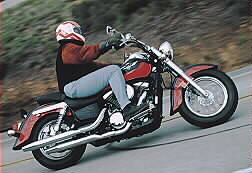
Kawasaki's and the world's biggest cruiser is now available in three versions. From the original super-chunky Vulcan 1500 to the new Norman Rockwell-styled Vulcan 1500 Classic. Every year brings cruisers closer to the American original, and the Vulcan Classic is the closest yet, in looks at least. What is different from the real McCoy is the twin-shock rear end, shaft drive and the smooth performance.

It's taken some reworking to make this cruiser so smooth. Kawasaki's engineers retained the four-speed transmission from the original Vulcan, but upped the gear ratio for the top three. Now, although you wouldn't know it from the tachometer (especially since there is no tach), the engine loafs over at a low 2,500 rpm at 60mph. At this point in the engine's power curve, vibration is minimal. Yet torque is there in plenty, thanks again to Kawasaki's re-engineering of the big motor's power curve.

Swinging a leg over the well-shaped saddle, the rider's first impression is of size. The gas tank may only hold a teacupful over four gallons, but it feels like a 55 gallon drum between your knees. Substantial is the word. The handlebars, too, are high, wide, and buckhorned. Seat height is low enough that almost anyone can feel in control, instantly. Despite the huge size, manageability is good. The bike has good balance and feel, and can be hustled through corners at a reasonable pace. When something does touch down, it's usually a footboard first. The brakes are confidence-inspiring, and well up to stopping this wide load. Suspension is a problem on a long, low bike, and the Kawasaki's twin shocks are wooden and unresponsive, until you put even more weight, in the shape of a passenger, on them. Then they start to smooth out the bumps more.

What you need on the Kawasaki to appreciate the control placement, is an open face helmet. Most of us wussies feel naked without the protection of a full face, but the tank-mounted speedometer and all idiot lights are invisible in front of the protective chinbar on a full face lid. This malady is common on cruisers, and since only the Fat Boy has self-canceling turn signals, flashers left on was the most common symptom of the lack of feedback. On the positive side, moving the gadgets to the tank did give enough room for Kawasaki to plant an effective fuel gauge under the speedo, and the view of the uncluttered triple clamps and clasically shaped headlamp shell is elegant in the extreme.

If you like chrome, you'll love the Vulcan. Acres of chrome plate cover the wide forks, the huge headlamp, and both air cleaners. (There's one of the round chrome pieces on each side, although only one 40mm carburetor sits between the Vee. Style wins out over function, yet again.)

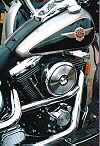
2: Harley-Davidson Fat Boy
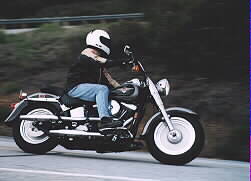
It's the most expensive in the test (especially since few Harley buyers ever pay less than retail, most pay lots more), it's the most primitive to ride, and it shakes like an overloaded laundromat dryer, but there's still something about a Harley that nobody else can clone, no matter how close they come. And since cruisers are style more than substance, the Fat Boy couldn't possibly place any lower than second in this comparo. It has more style in one tank badge than most manufacturers print in their whole brochure. 

That name on the tank means more to many people than any feature (or lack of them) that the Harley possesses. To be sure, the rigid mount 1340cc engine transmits a higher level of vibration to the rider than any of the other cruisers in this class, and the hand and foot controls lack the silky-smooth operation of the others. To some people, that's a plus. If God had created motorcycles for sissies, they say, he would have given them four wheels and windshield wipers.

More importantly, to our bunch of overweight weenies anyway, is the power level, which is on the low side. There may well be a stump-pulling, 80 inch V-twin under those svelte silver tanks, but modern pollution patrols and emissions tests have emasculated it. You can get serious power out of a Harley big twin: It takes about $1000 to get another 15-20 horsepower out of it.

Handling, however, is good. The rigid mount motor and disc wheels contribute to the absolutely solid feel of this machine, and compared to some of the knuckle-draggers in this test, ground clearance is ample. It takes a fairly serious effort into a corner before draggage occurs. The single front disc lacks the authority of some of the other machines, unsurprisingly, given the Harley's second-highest weight of the test (only the Royal Star is heavier), but give it a good hard yank, and you'll stop in plenty of time for breakfast. 
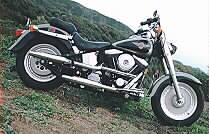
More important than performance to many riders is the seat height. Here, the Fat Boy is unbeatable. The sub-26 inch seat height means even your grandmother could swing a leg over with ease. You'll have to use Harley's padlock style steering lock, secured with an ace key, to keep her from stealing away on the Fat Boy, since the ignition key is a simple, tank mounted switch. Or should we say tanks, because there are two. Two gas tanks means twin gas tank filler caps. Both have to be removed to fill the tanks (unless you want to wait an awful long time for the gas to drain through via the petcock hose), but each cap is threaded differently, so they cannot be misplaced. Things are different on a Harley.


3: Suzuki 1400 Intruder:
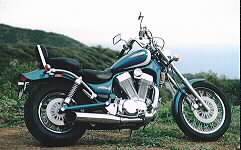
One of the longest in the teeth of the cruiser steeds, the Suzuki 1400 Intruder has been produced for the best part of a decade, with few apparent changes to the mix. The 1400cc twin was a sensation when launched: Here was a manufacturer that wanted to make a bigger bike to outgun Harley. Now, ten years later the 1400 seems small against the competition, an impression confirmed by the numbers. It is the smallest, lightest and narrowest of this blatantly corpulent bunch, and the easiest by far on the wallet. It's the bargain of the bunch. Go to a Harley or a Yamaha dealer, pay full price and specify a handful of add-on extras, and you could easily part with twice the price of an Intruder, and you'd get a bike that was heavier, slower, and didn't handle as well.

But aren't we missing the point here? The Intruder just doesn't exude the kind of style our two higher-placed cruisers command. The smaller size of the 'zuki is accentuated by the narrow bars: stepping off one of the other behemoths, your hands extend forward without meeting the grips, because they seem so close together.
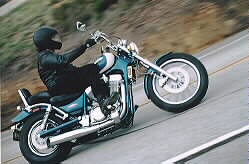
Ergonomics are not helped by the position of the tank, the wedge-shaped rear of which ends just above the rider's knees. The other bikes have substantial metal gas tanks to lean the knees against: the Suzuki's lack of such a credential makes it feel more like a Harley Sportster than a big twin. And while we're into off-test comparisons, the paint scheme that does so much to narrow the tank comes straight off a 1970s era Triumph, with scalloped cream flashes blending into pinstripes. 

Odd that Suzuki would try to reduce the apparent size of the bike with optical tricks like this, when everyone else is adding pounds faster than a Georgian powerlifter. Get on the gas, though, and the lack of weight means the bike will take off fast. It's got great throttle and roll-on response, just like a real V-twin should (helped by its low weight, of course). At the traffic light Grands Prix, its the Suzuki that will always come out in front. At constant speed on the freeway, though, the carburetion feels on the lean side, and this lean surge (familiar to riders of mid-eighties bikes) is annoying. It feels like the bike is constantly just about to run out of gas. Cruising around town, on a constantly changing throttle, and the feel is not discernible. You can just see the grin on the rider's face, as he passes bikes that cost twice as much.

PAGE 24: Honda Shadow ACE

Honda's ACE (American Classic Edition) has been with us for a couple of years now, apparently long enough to build up a following amongst cruiser fans. It happens to be the only motorcycle in the test (except for the Fat Boy) to be built in America. Paradoxically, it is the least American in many ways. The headlight is decidedly Japanese curved, and the rider's eye view is peppered by seemingly randomly-placed instruments and idiot lights. It's odd that, compared to the other machines in the test, the Honda should seem like a parts bin special, since Honda went to an awful lot of trouble with paint finishes. No less than ten solid and two-tone color schemes are available. We got the white and yellow one (Pearl Yellow and Pearl White, according to Honda). To our jaundiced editorial eyes, the best looker has got to be the ACE in basic black. 

There are fewer complaints in the engine department: Although this is the smallest engined V-twin in the test, the 1099cc, three valve per cylinder liquid cooled motor punches out torquey performance, at medium speeds in the rev range. Like the Kawasaki and the Harley, the Honda uses hydraulic valve-lash adjusters that do away with the expensive task of routine valve adjustment.

The seat, though, isn't in the same comfort class as the best. The padding is on the soft side, and doesn't allow the rider to feel planted. The seat was an acquired taste for most editorial behinds. Handling is occasionally erratic in bumpy turns and rough roads, but then, as many enthusiasts will no doubt remind us, it's not a sport bike. The 41mm conventional forks do possess a large helping of trail, however, helping the all-important freeway stability. Rear tire is a 170 section 15 incher, exactly the same size as the Suzuki, while the front is shod with a currently fashionable 16-inch balloon. Another characteristic it shares with the Intruder is the provision of footpegs, rather than boards, for the rider's feet. Brakes are good, a single disc on each wheel capable of stopping the plot in a reasonable distance.

The Shadow, in common with most other of the cruisers here (except, of course, for the domestic model) uses a fair degree of fakery in its makeup. The engine is liquid cooled, despite the prominent cooling fins. The exhaust pipes really don't follow such a simple path as it appears: Instead they are routed in and out of the chrome covers. Black paint hides the details. To be fair, the Kawasaki has an even more convoluted exhaust system. What are we saying here? Price has its importance, and the Honda joins the Suzuki in the sub $10,000 bracket, but style is the most important thing to cruiser owners. And the ACE isn't keeping up with the leader.

5: Yamaha Royal Star

Someone had to come last: and if it wasn't for the price tag, it may not have been the Yamaha. But at $13,500, we felt that the motorcycle must offer outstanding value. And we're not yet convinced.

Okay. The Yamaha Royal Star has had the most press ever of any motorcycle tested at Motorcycle Online. We've tested it on its own and compared it to the domestic competition. We were getting so sick of the damn thing, we asked Yamaha for an 1100 Virago to test for this comparo. But their response, reasonably enough, was that the Royal Star is competing in the market place against these bikes, so why shouldn't it run with them? And besides, we could have one with a different color scheme, and more virgin floorboards to scrape. How could we resist?

Actually, comparing the Yamaha against the other cruisers in their intended environment, the subtly twisting canyons of downtown, and the road to the beach, showed us the strengths and the weaknesses of this still-new cruiser. It's built for a new generation of cruiser riders, and it's built to be big. In fact, if they make motorbikes any bigger than this, they're going to have to breed a new generation of Schwarzenegger clone riders to control them.

It's engine wasn't the biggest, but it was the only four cylinder in the test (the others were all V-twins), meaning that it gave good throttle response but had a distinct lack of torque down in the rpm basement, which is where most cruiser riders keep their beasts. You gotta give it one thing though: It does exude that cruiser style. But not one of the Motorcycle Online fat guys is yet fat enough.

Specifications:

Cruiser Specificatons

Manufacturer:  Honda
Model: 1996 VT1100C2 Shadow American Classic Edition
Price:  $9,499
Engine: sohc, 3-valve, V-Twin
Bore x stroke: 87.5mm x 91.4mm
Displacement: 1099cc
Carburetion:  36mm CV
Transmission:  5-speed
Wheelbase: 65.0 in.
Seat height: 28.7 in.
Fuel capacity: 4.2 gal.
Claimed dry weight: 573 lbs.


Manufacturer: Kawasaki
Model: 1996 Vulcan 1500
Price:  $na
Engine: sohc, 4-valve, V-Twin
Bore x stroke: 102.0mm x 90.0mm
Displacement: 1470cc
Carburetion:  36mm Keihin CVK
Transmission:  4-speed
Wheelbase: 63.2 in.
Seat height: 28.3 in.
Fuel capacity: 4.2 gal.
Claimed dry weight: 557 lbs.


Manufacturer:  Harley-Davidson
Model: 1996 FLSTF Fat Boy
Price:  $13930
Engine: ohv, 2-valve, V-Twin
Bore x stroke: 88.8 x 108.0
Displacement: 1340cc
Carburetion:  40mm Keihin CV
Transmission:  5-speed
Wheelbase: 63.89 in.
Seat height: 25.75 in.
Fuel capacity: 4.2 gal.
Claimed dry weight: 631 lbs.


Manufacturer:  Suzuki
Model:  1996 VS1400GLPT
Price:  $8,399
Engine:  ohc, 3-valve, V-twin
Bore x stroke:   94mm x 98mm
Displacement:   1360cc
Carburetion:  36mm Mikuni BDS front, 36mm Mikuni BS rear
Transmission:   4-speed
Wheelbase:  63.8 in.
Seat height:  28.9 in.
Fuel capacity:  3.4 gal.
Claimed dry weight:  533 lbs.


Manufacturer:  Yamaha
Model:  1996 Royal Star
Price:  $13,500     
Engine:  dohc, 4-valve, V-Four
Bore x stroke:   79mm x 66mm
Displacement:   1294cc
Carburetion:  Four 28mm Mikuni BDS
Transmission:   5-speed
Wheelbase:  66.7 in.
Seat height:  28.2 in.
Fuel capacity:  4.8 gal.
Claimed dry weight:  673 lbs.
 

Impressions:    

1. Andy Saunders, Editor

You have to be in the right mood to ride cruisers. I get impatient, desperate to get going. I'm a terrible cruiser rider. Just watching that needle hover around the 55mph mark, mile after mile, eats away at my impatient soul. Okay, some people like that, and how can I argue. Sometimes I can get in that relaxed mood of not having to be anywhere at any specific time, just taking the time to enjoy the ride, enjoy the view, feel the thud-thud heartbeat of the big loafing pistons a few inches away from my most sensitive parts. It's like fishing, I suppose. I've never yet heard a fisherman satisfactorily explain the fascination of the sport. Same with cruisers. If you want to ride slow, the best one to get is the one with the slowest engine. And right now, that's the Kawasaki. If you want resale value and street credibility, you know which one to buy. If you want economy, perfomance and light handling, what are you reading this for?

2. Brent Plummer Editor-in-Chief "    

Arf arf, Motorcycle Online has gone to the dogs." Someone wrote that in a recent story we published, and I have to agree. So let me be the first to flame Editor Saunders: What's the matter with you! How could you pick a clone over the Real Deal. A clone is a clone is a clone, no matter how much it looks like the original. When it came time to vote, the Harley was tied dead even with the Kawasaki. Saunders exercised Editorial Priviledge, breaking the gridlock and giving the number one spot to the Vulcan. The new Kawasaki is a total and complete rip-off of a Harley, right down to the tank emblem that's a spitting image of H-D's. Ick. I liked the old one better.

Sure, I'll concede that the Kawasaki is far superior to the Harley in stock form. Much smoother, it stops better and goes better. Heck, it even turns better. But so what? Who rides a stock cruiser? The Harley aftermarket has more stuff available than all other brands combined. Isn't that what cruisin' is all about -- standing apart from the crowd, forging your own identity and doing your own thing? "If you have to ask, you don't understand." Back when I was a sportbike weenie, that phrase annoyed me to no end. But then, one day, I understood. Walking out to a Harley testbike, I asked my girlfriend to come with me. "What are we riding," she asked.

"A Harley."

I was preparing for the usual tirade of whining -- you know, 'this sportbike is too uncomfortable, it takes too long to get to the canyons, and once there the fun is oh so short. Then it's grind back through traffic, butt perched high, back and knees aching.' Instead, all she said was "okay," and hopped right on. In that instant, it dawned on me: Once you throw a leg over a Harley, you're where you want to be. It didn't matter where you're riding or how fast or if there is traffic, you're cruising on a Hog and happy as could be. Get it? A Harley is the destination, so the destination is Harley. Fully understanding all the circular logic and rhetoric, I was suddenly in the know.

3. Tom Fortune, Managing Editor    

I would've picked the Suzuki Intruder to win this comparison hands down -- if it weren't so damn ugly. It was the best performer overall for me, but falls to second place because of lack of style. Big-bore cruisers' talents aren't just going slowly and comfortably, they must look cool doing it. The Fat Boy certainly has the looks, but vibration and mediocre performance relegated it to third on my list. Only the Kawasaki did everything an open-class cruiser should and do it well enough to make it my top choice. And I guess if it's got to look like a Harley, the Vulcan Classic does it better than any of the others. 4. Billy Bartels, Graphic Designer

This story should be called: "A Fat Boy, and some bikes that want to be one." It exemplifies why Harley riders (mostly) don't read mixed- brand magazines. A cruiser is about style more than anything else, and when Harley took a bold step in 1989 and introduced a very different motorcycle into the world -- the Fat Boy -- the rest of the manufacturers (except Suzuki) waited to see if it would sell, then duplicated Harley when it did. Now I must admit that, in bone stock form, I liked the Intruder the best, but then I like the H-D Softail Custom that it emulates better than the Fat Boy anyhow. The Suzuki handles great, has monster power, and they put some very nice finishing touches on it. Would I buy it? No, but I have my prejudices. Next the Fatboy. The lack of chrome, spit and polish make it a perfect canvas for the customizer, and for less than $1500 you can get 15-20 horses and a completely different look out of it. It has better resale value than anything here, and most importantly, babes dig Harleys. After this the distinguishing characteristics disappear. The Vulcan is big and heavy and the most blatant ripoff, but is smooth and torquey, so I give it third. The Shadow ACE had more irritating vibration than any stock bike I have ever ridden, and handles rather poorly, so it is fourth. Lastly the Royal Star. What can I say that hasn't already been said? I wish we could have gotten a Honda Valkyrie for the test, it's not a ripoff and supposedly has a hundred horsepower.

5. Pat Russell, Pat the Mechanic

I guess I just don't have a cruisin' kind of spirit. Every time I ride one of these bikes anywhere -- except around town -- they just don't deliver what I'm looking for. So it's hard to pick a clear winner, but it would be either the ACE or the Fat Boy. They are both good around town, but the Fat Boy has a more visceral feel that seems to take you back in time a bit. On the other hand the Honda out-performs the Harley quite easily.

The others? They either don't have the feel or the performance or both. The Intruder is fast, but is a bit clumsy at lower speeds and the rear suspension is too mushy. The Vulcan almost seems too smooth, and is not as easy to maneuver. Then there's the Royal Star; nice feel, good motor and outriggers for floor boards.


copyright (c) 2008 Verticalscope Inc. Story from http://www.motorcycle.com/shoot-outs/heavyweight-cruisers-1996-2592.html