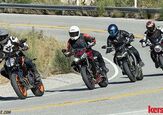
2013 Sport-Touring Shootout 1.0 - Video

Yamaha FJR1300 vs. Honda ST1300 vs. Kawasaki Concours 14
Kawasaki Concours 14
Based on the world’s fastest production motorcycle and our choice for 2012’s bike of the year (ZX-14R), the Kawi Concours 14 emphasizes the sport of its sport-touring designation. Powered by a 1352cc inline-Four with variable valve timing, the Connie posts the biggest dyno figures of the group and accelerates to a top speed in excess of 150 mph with its saddlebags full.
|
What the Connie fails to do is deliver its power in a user-friendly, sport-touring kind of way. At the low end the Kawasaki is outgunned by the FJR (and for a little while the Honda) and while the Connie’s motor spins up quickly like an inline-Four sportbike engine, its power is peaky compared to the others here.
|
“Its revvy engine responds as if it has the lightest flywheel effect of this group,” says Duke. “This contributes to its less-tractable nature compared to the always-ready-to-rock Yamaha.”
|
The Kawi is the sole motorcycle of the group to boast a sixth gear — a true overdrive cog that brings engine revs down significantly — and this certainly affects its performance against the Honda and Yamaha. The Connie got smoked by the FJR in top-gear roll-ons, and even the mild ST13 pulled a small gap until speeds got supra-legal. Dropping down to fifth gear, the Kawasaki performed like the bike with the most power should, being in the meat of its powerband to edge the Yamaha and dust the Honda.
| Suspension | ||
| Front | Rear | |
| Concours 14 | 43mm inverted fork; adjustable rebound damping and spring preload, 4.4 inches of travel | Tetra-Lever shock with stepless rebound damping adjustment and remote spring preload adjuster, 5.4 in. of travel |
| FJR1300 | 48mm traditional fork; fully adjustable, 5.3 inches of travel | Single shock; adjustable preload and rebound damping, 4.9 inches of travel |
| ST1300 | 45mm cartridge fork; non-adjustable, 4.6 inches of travel | Single shock with five-position spring-preload adjustability, 4.8 inches travel |
Although the Kawi came second in overall scoring on our ScoreCard, garnering a 79.6% score, there were two shortcomings that lowered the Kawi’s results. The first category was Handling, as it feels mass-uncentralized when ridden aggressively.
“Part of the blame for the C-14’s clumsy handling can be pinned on its 190/50-17 rear tire,” Duke says. “I once rode two C-14s back to back, with one fitted with a 190/55 tire. Its taller profile dramatically improved its cornering responses, being easier to turn at low speeds and more linear when bent into a corner. If you own a Connie, you definitely should buy 55-series meat when it’s time for a replacement.”
|
The other issue, the Connie’s terribly calibrated linked brakes, earned Team Green a grade of just 50% in the Braking category on the ScoreCard.
Applying even small amounts of rear brake pressure, the Kawasaki Advanced Coactive-braking Technology (K-ACT) directs way too much braking influence to the front calipers. The effect is abrupt and unsettling, especially when riding dirty, tight switchbacks. And it can’t be blamed on a general failure of linked braking as the Honda’s linked brakes function without any detrimental effects. “It’s the Connie’s worst feature,” laments Duke.
The C-14’s best feature, where it scored a perfect 100%, is in the Transmission/Clutch category. All testers applauded the Kawi’s slick-shifting capabilities while its slipper clutch is a technology the other bikes lack.
| Highs: | Sighs: | |
|
|