2006 Open Superbike Shootout - Motorcycle.com

Get the Flash Player to see this player.
However, here we are, testing two 2006s that are virtually the same as the 2005s, and two bikes that have supposedly been heavily revised by their manufacturers, but which look substantially the same. Maybe we could get away with not testing them this year? Maybe we could just change a few words around from last year's shootout and go have lunch? In the end, our interest in journalistic integrity won out, and we
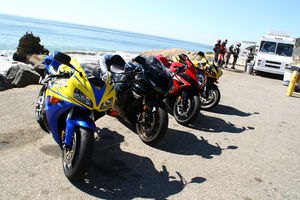
MO's Publisher Sean "Dirty" Alexander, who had recently returned from the Kawasaki ZX-10R introduction, was convinced the Ninja would win. "It's as user-friendly as the Honda was last year, but with all the power and speed from last year's ZX-10R." It sounded like a winning combination to us, and since the Honda sounded like it had changed for the worse, according to Sean's intro report, and the other two models reported just a few changes, we figured the ZX-10R would emerge as the winner. As outstanding as the GSX-R was in our 2005 Shootout, it sounded like the bar had been raised -- once again -- by Kawasaki's engineers.
The reality surprised us a bit. We're back from two days on the road, a long trackday where we put over 200 miles on each bike, multiple dyno runs and some healthy arguments about which bike is best. We've come up with some pretty interesting results that anybody who either presently owns or is considering the purchase of an open-class sportbike should read. Although it looks like this is "2005 Open Sportbike Shootout: The Rematch", two of these bikes have been significantly revised to have another shot at the crown. The effects of those revisions made this a fun test to do and should prove illuminating to you, the MO reader. Feel better about spending an hour away from work? Read on, MOridian!
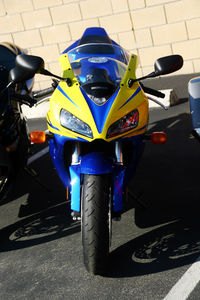
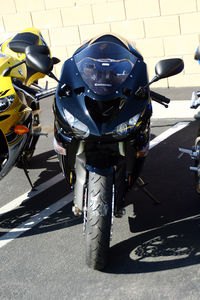
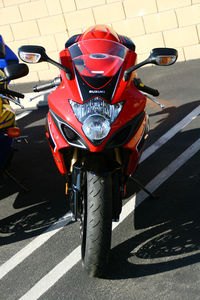
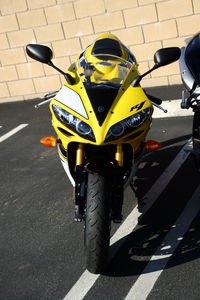
The Contenders
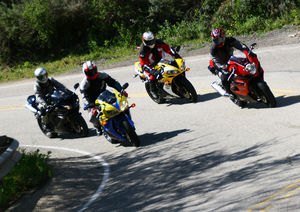
Suzuki's GSX-R 1000 is the only one of the four bikes to be unchanged (except for graphics) for 2006. The Yamaha had just a few revisions, while the Kawasaki ZX-10R and the Honda CBR1000RR were almost completely revamped. Would these improvements be enough to rival the Suzuki? Or would they just alienate their fan base by altering their characters? Let's look at each bike a little closer so we know what we're dealing with.

Last Year's Winner: Suzuki GSX-R 1000
We've gone over the tech of the GSX-R in some detail in both the 2005 Open Super Sport Shootout and our 2005 Best of the Best Shootout, where we pitted it against our 2005 600cc winner, the Yamaha YZF-R6. For those of you who can't get enough technical information in your life, here's what makes this bike one of the greatest ever built.
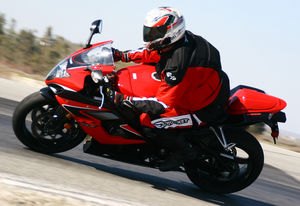
The frame needed to be roughly the same dimensions as the 600 and 750 models that inevitably follow a GSX-R 1000's redesign, so the cast and extruded twin-beam unit is extremely compact. It uses a heavily-braced swingarm and a linkage rear suspension to hold the rear 190/50-17 Bridgestone tire just 55.3 inches from the front wheel, which is suspended from the massive steering head by a pair of fully-adjustable upside down forks.
A superbike is all about motor, and the Suzuki doesn't disappoint. It uses a liquid-cooled, inline-four powerplant with four valves per cylinder opened and shut by dual overhead camshafts. Bore and stroke figures are heavily over-square at 73.4 by 59 mm, compressing fuel and air from the eight 52 mm fuel injectors (two per throttle body) to a 12.5:1 ratio. There's no changes evident from the outside, but something happened inside that motor this year; our dyno run revealed a bike making 161 hp and 81 foot-pounds of torque, compared to last year's bike, which made a mere 158 hp and 78 foot-pounds. How did we stand it?
Top-of-the-line components and build quality complete this 365 pounds (claimed dry weight) ...here's what makes this bike one of the greatest ever built.package. Radial-mount four-piston calipers clamp 310mm front brake discs, powered by a radially-actuated master cylinder. A bleed screw on top is a nice touch that will be appreciated by those who do their own maintenance. The sleek bodywork includes a sexy solo seat cover, all for the paltry asking price of $10,999.
Deflation and the Big-Bore Sportbike
"Paltry asking price?"
I have a nerve writing that, huh? After all, $11,000 for a motorcycle is an awful lot of money. Since the average age of an American motorcycle consumer is somewhere well north of 45, there are many of you reading this that can remember buying perfectly good, top-of-the-line sportbikes for three, four or five thousand bucks.
Friends, each one of the bikes we're testing here makes over 150 hp at the rear wheel, a figure unobtainable in anything except a full-blown Grand Prix race bike just 20 years ago. In fact, the Kawasaki ZX-10R makes 166 hp, which is more than any AMA superbike made until pretty recently. And it comes with a warranty, runs on pump gas, and is smooth and tractable enough to cruise around town on.
Oh, and there's fuel injection, computerized digital ignition, a passenger seat, a built-in lap timer and a valve adjustment interval longer than the life span of your average 1970s UJM cylinder head. The tires have more grip (and much longer life) than the most expensive road racing slicks from the early 1990s, and the clutch pull is as feathery-light and sensitive as a 125 cc motocross bike. Ten years ago a lavishly-built custom sportbike with those kinds of specifications would cost many tens of thousands of dollars; now you can walk into a motorcycle showroom and haggle the price under 10 grand if you're happy with last year's model. You'll probably get a free helmet, too.
Also, 11 large now isn't what 11 large was a decade ago. Correcting for inflation, we can see what a big-bore sportbike cost in real dollars back in the mid-Nineties:
1998 Kawasaki ZX-9R: $12,164
1998 Honda CBR900RR: $12,164
1998 Yamaha YZF-R1: $11,818
1997 Suzuki GSX-R 1100: $12,254
I'm no economist, so I don't have any coherent theories as to why this is. I do know that wages for working-class Americans has declined, while prices for many things, like insurance, education, and housing, have increased in relation to the value of current dollars even while the relative prices of durable goods like computers, TVs and cars have declined. Whether this is the result of Democrats, Republicans, the IMF, the Tri-Lateral commission, Zoroastrianism, or Mel Torme is a matter I'll leave to our cast of know-it-all blowhards in the discussion forum.
I'd rather start saving my money for a 2016 ZX-10R. If things keep going the same way, it'll weigh 325 pounds dry, make 210 hp at the back wheel and still only cost $11,000. -- Gabe
Last year, we found the GSX-R to be light, powerful, easy to manage and comfortable for everyday riding, not to mention the fastest bike on the track. Is that standard high enough to keep it on top? It's a tough one to beat.

Back From the Fat Farm: Honda CBR1000RR
Last year's Honda CBR1000RR was typical Honda sportbike: competent, friendly to novice riders, fantastically well-built, but a bit heavy and bland to capture the imaginations and votes of jaded magazine road-test editors.
"Oh yeah?" said Honda's collected corporate consciousness, "let's see what they say when we hand it over for Doug Toland and his merry band of development riders to spice up."
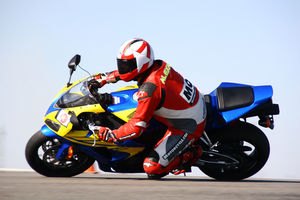
The frame is basically the same aluminum twin-spar job as the 2005's, but with a 20mm shorter swingarm and differences in steering geometry aimed at giving the bike a more exciting ride. The wheelbase is now down to 55.2 inches from 55.6, rake is 23.45 degrees instead of the 23.75 degrees of the 2005, and trail was reduced by 1/10th of an inch, to 3.9 inches. A 190/50-17 rear tire is held up by an HMAS cartridge-style, fully-adjustable rear shock, and the front hoop is pointed down the road by a 43 mm upside-down cartridge fork. Like a watchful bureaucrat, an HSED speed-reactive steering damper crouches atop the triple clamp to save us from ourselves.
The CBR's motor is a four valve per cylinder liquid-cooled 998 cc mill with a 76 mm bore and 56.5 mm stroke. Lighter dual overhead camshafts, a higher, 12.2:1 compression ratio and a 12,200 rpm redline account for the power increase. It's fed by dual-stage fuel injection and sends power to the road via a six-speed cartridge-type gearbox that can be removed from the motor without the motor being pulled from the frame, just like a true race bike.
It's finished with radial-mount four-piston calipers gripping 320 mm brake discs in front; 10 mm larger than last year's. The bodywork is also thinner and lighter than last year's, and the new blue-and-yellow paint scheme gives the bike an aggressive, sporty edge.
The 2006 CBR1000RR is lighter, faster and promises quicker handling. Will these changes make the Honda the best liter sporting weapon? Or will they just detract from the user-friendliness and refined feel that Honda fans love?

Since Obedience School, He Doesn't Pee on the Carpet Anymore: 2006 Kawasaki ZX-10R
If real estate is all about location, location, location, then a Superbike comparison is all about motor, motor, motor. Kawasaki is a company well-equipped in this field; from the fearsome H1 three-cylinder two-stroke and 903cc Z-1 four-stroke, to the 1985 Ninja 900 that made the word "Ninja" synonymous with a hyper-powered, widow-making sportbike, Team Green has always put big horsepower as a goal.
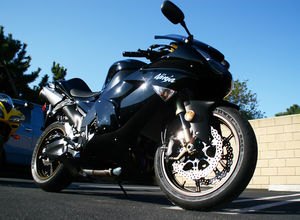
Unfortunately, it also earned a reputation for being a bit too rambunctious. A 54.7 inch wheelbase, steep geometry and lack of a steering damper, combined with all that power meant a bike that didn't quite feel as stable and planted at speed as some other sportbikes do. We always liked the ZX-10R in the two shootouts it participated in; just not enough to name it the best.
So Kawasaki hit the drawing board, and not too long ago revealed a heavily revised ZX-10R for 2006. The most noticeable change was a big, shiny Ohlins steering damper mounted crosswise behind the top triple clamp, but the changes are much deeper than that.
The chassis receives the most changes, starting with the steering head being moved forward in the frame and strengthened. Next, the engineers moved the motor mounts forward and up, as well as rotating the engine back a few degrees. The swingarm pivot was also raised. These changes result in a higher center of gravity for better "roll response", according to the Kawasaki website. This required an oddball rear tire size, a 190/55-17, with a roughly nine mm higher profile to help keep the swingarm and chassis at acceptable angles. After all this revision, the wheelbase remains unchanged at 54.7 inches.
The motor got a few changes to improve power, feel and throttle response. The flywheel weight was increased to make things smoother, the 43 mm Mikuni throttle bodies were revised to improve fuel atomization, but the rest of the liquid-cooled, dual overhead cam, four valve per cylinder 998 cc mill is basically the same fire-breather that has kept insurance actuaries awake for the If real estate is all about location, location, location, then a Superbike comparison is all about motor, motor, motor. past two years. It's a short-stroke design, with a 76 mm bore and 55 mm stroke that makes its peak torque at 9,600 rpm.
The new styling is edgy and aggressive, with big headlamps flanking a big ram-air duct
Braking is handled up front by a pair of comparatively small 300 mm floating "petal" rotors and four-piston, radial-mount calipers that use separate pads for each piston: Kawasaki claims better wear characteristics and less overheating and warping that way. The front forks are 43 mm cartridge units; fully adjustable, of course.
Some changes are for style and convenience. Gone is the wacky LCD tachometer, replaced with a very cool-looking analog tach sitting underneath a wafer-thin LCD screen with the speedometer on it. There's also a lap timer with handy bar-mounted controls. The exhaust has been moved under the seat, with two separate cans like the Yamaha R1. We inquired why Kawasaki didn't put them under the bike like the Ninja 650; apparently there's not enough room under a modern 1000cc sportbike to fit the big exhaust volume and catalytic converters to damp the sound and emissions to EPA or Euro III-friendly levels. What happened to freedom of speech?
The new styling is edgy and aggressive, with big headlamps flanking a big ram-air duct. The bike's important dimensions -- weight, wheelbase, seat height -- remain basically the same as before, but the significant changes should make this bike both easy to ride for novices and a wicked enough powerhouse to thrill the most jaded moto-journo on our staff. You get all this for an unchanged MSRP of a mere $11,199. But it's not the only bike that's been in training over the winter.

More by MO Staff



Comments
Join the conversation