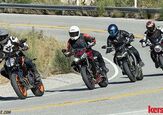
We here at MO have a great love for 600cc machines, as well as a great love of free tracktime, tires and crispy fried foods. So every
year we call up the manufacturers, procure trackday tires, and poach some tracktime from a cooperative trackday organizer. We've done it so many times now it practically runs itself.
The fly in the ointment was Triumph announcing the potential Jim Thorpe of middleweight sportbikes, the Daytona 675 triple. We figured we could ignore it and do our usual Honda-Kawasaki-Yamaha-Suzuki thing like we've been doing since 1997, but the feedback and buzz on the message boards indicated we would have to somehow get the Triumph to maintain even a shred of dignity and credibility with our attractive and discerning readership.
Triumph wouldn't have one available for us until 2009, and Publisher Sean Alexander had just spent our last $8,999 bailing his manservant Abdul out of county jail yet again, so we couldn't buy one. We put out a frantic call to our readers, and by some miracle, a bike materialized.
We have the 675. We have the new Suzuki GSXR 600. We have the new Yamaha YZF- R6. We also have the Honda CBR600RR and Kawasaki Ninja ZX-6R. They have fresh tires, there's a trackday scheduled, and we have enough gas, snacks, lap timers and other implements of destruction to get the job done. Good MOridian, set your phone to "out of office" and hang the "Back In 15 Minutes" sign on your cubicle. It's Supersport Shootout time once again.
![]() |
![]() |
![]() |
![]() |
![]() |
Picking contenders for this annual comparison is easy; since the mid-90s, each of the Japanese factories has offered a cutting-edge middleweight sportbike. In 1999, Yamaha upped the ante with their YZF-R6, which offered uncompromising, track-oriented performance and handling. In 2003, Kawasaki fired back with a 636cc machine with very focused ergonomics, and even Honda -- long known for building slightly softer bikes that offered friendly, balanced performance with a broad appeal -- presented their CBR600RR, based on their hi-tech MotoGP racer. This year is as exciting as 2003, with the addition of two all-new machines. The Triumph is the big news, as it signals the abandonment of the English company's strategy of attempting to compete with the Japanese on their terms. Instead, the 102 year-old marque uses their signature engine configuration --the inline-triple -- to offer consumers a lighter, slimmer machine with the same top-end hit as a 600cc inline-four and the grunty torque of a middleweight twin.
The other big news is an all-new Yamaha YZF-R6. Lighter, faster and with aggressive styling, the new Yammie boasted a 17,500 rpm redline -- at least until it was discovered that the tachometer was optimistic, reading over 1,000 rpm higher than actual crank speeds. Still, it's a light, fast and potent sporting machine that has some of the most amazing looks we've seen in any sportbike.
![]() |
![]() |
![]() |
![]() |
![]() |
As if these two new missiles weren't enough, Suzuki snuck in an all-new GSXR 600 for 2006. It's based on their incredibly versatile and dominating GSXR 1000, which is a blend of speed, comfort and incredible handling prowess. We also can't ignore the Honda and the Kawasaki, which we tested last year. They return for 2006 mostly unchanged, but they are still very good and looking for trouble. It's a motojournalism cliché to say they are all excellent bikes, but the level of competition in this class makes this a true statement. How do we determine which one is best?
| MO Dyno Results | |
![]() All Torque |
![]() All Power |
Who Ordered Rain? The Test
To figure out which bike is best, we have to actually ride all the bikes. Poor us. Lining up the four Japanese bikes was fairly easy, but Triumph wasn't as forthcoming about pooping a 675 on command. "We'll put your name on the list and let you know when it's available" they said, and judging by the 14-month wait we had for the Rocket III, we'd rather not hold our breath.
So we put out an all-points bulletin for a MO reader with a 675 we could flog. We got many responses from all over the country, but we settled on loyal MO reader Ole (say "ol'-ee") Holter of Long Beach, CA, a piston's throw away from MO's Torrance headquarters. In exchange for the use of his shiny new 675 for a couple of days, we gave him a measly two sets of $300 tires, lodging, meals, a trackday, free racetrack coaching, two dyno runs and all the gas he could burn. What a sucker!
|
Pirelli launches the Diablo Corsa, the first tire with the revolutionary MIRS™ technology | ||||||||||||||||||
|
Pirelli creates their latest tire without the use of those bothersome "humans."
Tread pattern plays an important role, with the front tire being "assigned the task to 'attack' water layers to clean the asphalt", thereby leaving what water is left in the path of the rear tire to be dispersed even further by way of transversal grooves between the center and shoulder sections of the tire with the remaining area being slick so as to be tractable and stable. Man, those robots sure know how to make one heck of a tire.
|
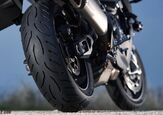
With five bikes procured, we needed to level the playing field by putting equal, track-ready tires on them. A call to Pirelli sent a couple of pallets of Diablo Corsas to spoon on. The Corsa is a step up from the regular Diablo, offering more grip and a carcass better suited to track use, yet that is still suitable for street riding in all kinds of weather conditions; this last feature was to be useful later in the test.
Ole himself turned out to also be a useful resource, because not only did he provide a spare rider to help with the test (motojournalist and author of 101 Sportbike Performance Projects Evans Brasfield had to cancel), but he also mapped a route for us to Buttonwillow Raceway for the racetrack testing. The route went through some of the most spectacular roads in Southern California, with almost no Interstate involved. We started near Glendale at the Angeles Crest Highway and worked our way over to Lancaster, where we took flat, empty and wind-blown Highway 138 to I-5.
After watching Publisher Sean "Editor Emeritus" Alexander consume a 1.5 pound chimichanga in a horrifying, anaconda-like manner at a very tasty Mexican restaurant, we headed in a top-secret direction on one of the most excellent roads we've seen to do our photo passes and enjoy the handling and motor of the best sportbikes made. The road is so good, MOridians, that we will not reveal, even under torture, the name or location of the road.
Sadly, the weather Gods did not smile on us, lightly sprinkling us with rain for the remainder of the test. We stayed dry enough to enjoy some more high-speed hijinks on another top-secret road near the racetrack, and then retired to the palatial (compared to some other Buttonwillow area motels) Buttonwillow Inn and Suites after a traditional charred large-mammal dinner at the Willow Ranch barbecue.
The next morning it was off to Buttonwillow Raceway for the racetrack evaluation. Composed of 14 twists and turns, Buttonwillow is already a technical challenge that highlights a machine's suspension and responsiveness. Trackday organizer Ti2TT decided, after getting strong customer demand, to run the full course backwards, in a counter-clockwise direction for more fun and challenge. Now exits would become entrances, increasing radii turns would be decreasing ones, and apex would be in the wrong place. If there was a place that flexible, easy-to-ride and forgiving characteristics of a bike would shine, this was it.
Did I forget to mention the forecast for rain?
Fortunately, we did not have to go it alone. Honda, Yamaha and Kawasaki all sent their tech support staff to keep their bikes clean, fueled and perfectly tuned for each rider's preferences, and the Suzuki and Triumph had their suspenders dialed in by the very competent hands of Dave Moss of Catalyst Reaction suspension.
|
The Riders |
|
Ole Holton An electrical engineer for a large corporation that builds expensive and destructive machines for the government, Ole (say "Ol-ee") was a natural to test expensive and destructive motorcycles for us. He has been riding motorcycles for 16 years and is the proud owner of the grey 675 we used in the test. He stood up to Sean's withering torrent of foul jokes and alpha-male posturing with flying colors and rode a passel of unfamiliar motorcycles with confidence and verve on our test. He is currently building a death-ray to attach to Ashley's RV.
We also enlisted the throttle-twisting services of Eric Putter, a 20-year veteran motojournalist. He's a former 600 owner and racer who is now an unabashed open-class streetbike devotee. He currently rides a lightly modded Yamaha FZ1 and is in the market for a middleweight track-day steed to offset his diminutive Honda NSR50 race bike. He attended the R6's press introduction and recently spent a day riding all of this year's open-class sportbikes. Mike Goff Remarkable for not eating land animals and being married to a former Mouseketeer, (Mary) Mike (also an engineer for an aerospace firm) proved his mettle by riding in wet leathers over the 4100-foot Tejon Pass in the rain and then eating a large and greasy In-n-Out cheeseburger at Sean's urging. He's a true enthusiast with 18 years of riding under his belt and over 60,000 miles on his 1998 CBR 900RR as well as odd tastes in motorcycling footwear. Sean "Editor Emeritus" Alexander
Sean is also wicked fast on the track or street and can go faster then most mortals while riding one-handed. He will be sorely missed by all of us here at MO who don't offend easily. Editor Ets-Hokin has spent the last four days sitting outside Sean's office, waiting for him to take him to lunch. We don't have the heart to tell him he's not coming back. Gabe "Are We There Yet" Ets-Hokin Woody Allen once said, "90% of success is just showing up." To prove that true, Gabe stuck through 14 months of almost daily abuse from MO's executive power structure to move to the front of the line and become the Editor when Dirty left the building. More than qualified to plan, execute and write content for MO, Gabe is an AFM expert roadracer and former trackday coach who still can't wheelie on command. He is, however, furry, warm and easy to subdue, characteristics that make him popular on long road trips. |
After a trackday that was disrupted by an afternoon rainshower, we packed up MOvan, connected electric vests, and got on I-5 for a chilly, rain-soaked 150-mile trip back to the office. The next day, we commenced to put the bikes on the MO DynoJet Dynamometer and hash out our votes.
As always, votes are based on the 100 percent subjective impressions of our five testers. We ask ourselves which of these bikes we'd want to own if we happened upon the necessary cash for the asking price of each one. We then tallied the votes and turned in our notes and impressions. One week later, the finished story is presented for your enlightenment.

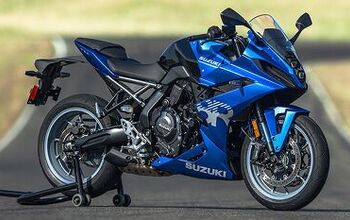
If you're looking for a ride to show off on, the GSXR shows itself off pretty well. The styling is aggressive and balanced, with some futuristic touches like the exposed engine cases, built-in turnsignals in the rear and tucked-in rear fender. We all liked the electric-blue treatment on the wheels; Ole called it "absolutely gorgeous" and liked the way it made the wheels stand out. Sean
said the bike was "an absolute stunner in direct sunlight." Mike was a little less appreciative, saying that the instrument display "just looked exceptionally cheap" and that the long shift linkage looked like an afterthought. However, nobody could deny the bike has a compact, aggressive look that sums up what a 600-class sportbike should be.
Slipping aboard, we all noticed a very tight riding position. The bars seem lower than the larger GSXR's, and the pegs a bit higher, too, although they are adjustable for three positions over a 14 mm range, a classy and welcome touch. Eric noted that even if it did feel "like it had a "sit-in" (instead of "sit on top" feel), the short-tanked GSX-R felt best... [it's] the most oddly comfortable of the lot." Gabe also liked the cramped quarters, noting it felt comfortable and familiar on the track, the way GSXRs often do. Tall guys might not agree with our more dainty testers; Ole complained that "for riding long distances, the GSXR6 is the worst of this bunch". However, nobody buys these things to tour on (unless they are masochistic or jockeys, or both) and we mostly agreed that the difference in comfort levels between the bikes was negligible.
What we do buy middleweight sportbikes for is that precision-engineered, high-rpm kick-in-the-ass we love from these little screamers, and the GSXR has it. We all noticed the soft low- and top-end power from this motor, with Sean calling it "a bit lacking" in the power department and Eric noting he was "dropping down into first and second on the Suzuki where I was in second and third on the Triumph." The rest of the testers found the power delivery somewhat bland, contributing to the overall average feel of the bike.
The gearbox is typical Suzuki-good, with a short throw and positive, smooth action; Eric stated "as always, the GSX-R wins the slick-tranny award". Only Mike noted slight difficulties getting into first or neutral without feeding a bit of throttle. Overall, as a street motor, the GSXR is probably the weakest, even if it is tied for most horsepower with the Yamaha R6 at 111.3. Unfortunately, it makes that power at rpms that most riders never use at a street-riding pace.
We might not have been too impressed by the motor, but we liked the handling. The GSXR, although it might have a "screaming, head-banging, mosh-pit kind of" reputation, according to Ole, is a pussycat in the handling department. Even though Sean found it "not as plush" as the other bikes, the suspension and chassis are very well set up, making everyone confident and comfortable in most sorts of turning situations, whether making U-turns for photo passes or 100 mph, knee-down racetrack turns. The brakes are great, too, with all the power and sensitivity you'd expect from this kind of brake arrangementut.
Like the motor, where the chassis on the GSXR really shines is on the racetrack. The harder you push it, the better it feels, which some of our testers liked and others didn't. Ole said that "it felt like I had to work at it a bit more to get the best out of it", but Gabe and Eric turned in some of their best times on the GSXR; it seems to reward aggressive, wild antics on the track. "You can just rail on that thing" said Eric, breathless and wild-eyed after his first session on it, and Sean relished how it allowed him to "dance around the apex while carrying excellent corner speed." It's a well-engineered bike that allows a good rider to become better the faster he goes but lacks the character a less experienced rider might notice on the track. The GSXR finishing last illuminates what a tightly-contested class this is. It's really outstanding in its own right and would make any owner ecstatic, especially if they lived at the base of Latigo Canyon or right outside Mid-Ohio Sportscar Track. The GSXR is an incredible bike but is probably too track-oriented to really be considered better overall than the other machines here. The 675 and 636 have better motors, the R6 is sharper handling, and the 600RR edges out the Suzuki with its refinement and balance. However, a racer or serious trackday rider -- especially if she's a Suzuki fan -- would be foolish to discount this bike on the basis of its position in some magazine shootout written by five idiots. We think this is a winning bike, Suzuki, just not in this test.
|
2006 Suzuki GSXR 600 Tech Briefing |
|
Suzuki must have been busy for the 20th anniversary of the US introduction of their mind-bending, earth-shattering GSXR sportbikes. They revamped their 1000 last year, and blew the minds of motojournalists everywhere with what might be the best sportbike ever made. Unfortunately, their 600cc tool was getting a bit long in the tooth and wasn't getting the attention and respect they felt it deserved.
Hanging out in that frame is an all-new motor, smaller and more powerful than before. The crankshaft and transmission is designed to be smaller and more compact, (although the crank is 16 percent heavier to "add traction during cornering") and the whole assembly is rotated forward in the frame for better mass centralization. An all-new back-torque limiting clutch is also new for 2006. Brakes are still twin four-piston, radial-mounted calipers, but they now grip 310 mm discs. The rear caliper is now lighter as well. Forks are 41 mm and adjustable for preload, damping and rebound, and the rear shock sports a "16mm larger rod", according to Suzuki's website. It must be getting the same spam we are. Other features include a new instrument cluster with a gear position indicator, all-new aerodynamic bodywork, super-light aluminum alloy wheels, a bigger, trapezoidal radiator and some very cool, adjustable footpegs that every sportbike should have. The whole package weighs in the same as last year's bike at 355 pounds and sells for $500 at $8,799. It's available in four colors: red, blue, black and grey. |

How can a bike this refined, this well-balanced, this exquisitely well-crafted come in fourth place in this shootout? The competition is really tough, but how can Honda, with R and D resources like the Pentagon's not beat the smaller upstarts?
This is a bike that is nearing the end of a four-year life cycle, eons in middleweight sportbike years. However, we've always really liked it. Gabe and Sean both picked it as their favorite track bike in our 2005 comparison test, so it doesn't lack in handling prowess. So why didn't it win?
None of us had any complaints about the styling. The aggressive, RC-211V- inspired bodywork looks great, and the center-up exhaust set the standard for trick, even if it does reduce under-seat stowage to almost zero. Overall, the styling is as polished and finished as the rest of the bike is.
On board, the bike fires up smoothly and easily, with an electric-smooth feel from blipping the throttle. The motor is eerily smooth on this thing, as is its bigger brother, the 1000RR. The gearbox is also faultless, with a feeling like you are clicking the knobs on an expensive piece of medical equipment as you row through the gearbox. The fuel injection is the best, "combining great accuracy with smooth delivery", according to Dirty, who knows a thing or two about injection.
Comfort and day-to-day living with this bike is pretty run-of-the-mill for a middleweight sportbike. The bars are low, the pegs are high, and the seat is hard. "No part of the Honda's ergonomic layout stood out", according to Eric, but Gabe didn't find the comfort level as objectionable as he thought he would. Around town, the push-up body position can be painful for extended periods if you're not going fast enough for the wind to prop you up; again, that's to be expected in this company. We're not on sport tourers here.
What this bike is built to do is deliver confident, effortless handling under all kinds of riding conditions, and it has that in spades. Every one of us noted how easy the Honda is to ride fast, and how well-built it feels. Whether Ole was on the street or track, he reported it was "totally effortless and easy to go very fast" on the little red bike. Eric said the Honda spoke to him "in all the right ways. It has an electric-smooth powerband, flicks easily, is super-stable and the chassis gives great feedback." Even Sean, demanding an expert that he is, praised the RR for feeling like it was "carved from billet."
Braking and suspension action are top-notch as well. The big brakes deliver outstanding feel and response from one or two fingers, and the unit pro-link rear suspension is as precise and well-balanced as the rest of the bike is. It all adds up to what Mike called a "well balanced, almost reassuring" feeling.
The brilliance of the CBR is the way it can inspire confidence on the track, and we all liked its racetrack performance. Ole said "on the track, the 600RR was totally effortless and easy to go very fast on", and Sean maintains that it "plasters a grin across your face as soon as you roll it out of pit lane. No other machine can combine this much racetrack prowess with a friendly a nature like the CBR." Like the GSXR, this is a good choice for those who want an incredibly competent chassis to build their cornering skills in a controlled environment.
However, that competence is marginalized by what we all thought was a soft or characterless motor. Gabe loved the smoothness, but even Mike, with the least track experience, complained of having to downshift more often to pass or gather a head of steam. On the dyno, the RR puts seven less hp on the ground than the top middleweights, with not much on tap below 8,000 rpm. Eric Putter wryly complained of having to ride the "low-power version" of the Honda and was reminded that "these damn 600s are weaklings; the CBR the weakest of the weaklings", but was happy to spend his first two track sessions on the "mellowest bike of the group". It seems tough to nit-pick the Honda over seven horsepower, but in this kind of competition, that's a large gap, especially compared to the R6's monster top-end rush and the Triumph and Kawasaki's mid-range stomp. Anybody who buys a Honda will not be disappointed, for sure. It's an incredible-handling, balanced bike that has enough power to win races with a competent rider aboard, but on the street, most riders will notice a comparable lack of power. Great handling and quality feel isn't enough alone to get top billing in this test; the Honda was close to tying the next two bikes, but close only counts for horseshoes and hand grenades. For $8,999, the same price as the much more-exciting 675 and just $200 less than the explosive and dripping-with-technology R6, Big Red doesn't offer enough of a value to top the list here. To quote the Soup Nazi: Next!

Two-way Tie for Second: Yamaha YZF-R6 and Kawasaki ZX-6R
What is interesting about this two-way tie (and we rarely tie here at MO; a first-place tie will result in the senior editor casting a tie-breaking special vote) is how different these two bikes are. Both machines make similar horsepower and weigh almost the same, but they take different approaches to how they get deliver riding goodness.
We covered the Kawasaki 636 in last year's shootout, and it took second place last year as well. It's a balanced, comfortable bike that has a stomping mid-range hit; whether you think adding 36 cc of displacement to get that stomp is cheating is beside the point.
Styling is just OK; we don't think it has the same visual impact of the 2003-2004 ZX-6R. It's more bulky and burly than the other bikes, with little to distinguish it visually from the ZX-10R. The tail-mounted exhaust looks great but reduces underseat storage. In the cockpit waits that same crazy bar-graph tachometer that has been replaced in the ZX-10R. Eric complained "with all the ZX-6R's horsepower fighting for my attention, that tach is a terrible joke." Almost everybody griped about it, and all we can say is that the 636 has enough midrange so you don't really need to look at your tach. However, there's also a lap timer and a programmable shift light, which classes up the instruments package to an acceptable level.
Once in the saddle, you can notice how comfortable and plush it is, which belies the less-comfortable low bars and high pegs. Sean declared that "on the street, the Kawasaki's cushy seat is compromised by what seems like too long of a reach to the bars." Gabe spent a few days cruising around the LA basin on the 636 and thought the comfort was totally acceptable, as long as you don't spend too many hours in the seat and you keep moving fast enough to keep the weight off your wrists and lower back with the wind blast. Mike noted the 636 "felt bulky and heavy compared to the other 600s, even though I know it weighs about the same", and Eric agreed; "With its wide tank, the Kawasaki felt like the biggest of the group -- and this wasn't a bad thing on the street." Some of us don't want a bike so tiny it disappears; the Kawi has a substantial, comfortable presence, making it a good street ride. Ole even went so far as to say that "If I was choosing a middleweight with the expectation of doing repeated 500-1000 mile days, I'd choose the 636."
What helps is that motor. With 108.6 hp and as much torque as the Triumph's 675 cc triple, this is the bike for the lazy middleweight pilots among us. The midrange -- fatter on the dyno chart than the 675's -- lets you leave it in a higher gear than some of the more peaky bikes. Gabe noticed carrying two gears higher in some turns at Buttonwillow, and Eric liked the "killer midrange pull". Still, how that midrange feels is subjective, and Ole thought it still felt "like just another 600cc (or so) inline four." 675 ownership makes one jaded, apparently.
You can't hide from that famous Kawasaki intake shriek. Dirty said "this new bike seems a bit louder than last year and there's a mischievous note to it throughout the mid range." It sounds so good you want to ride in that higher rev range all the time, but the "vibration in the tank and seat from 7,000 to 10,000 rpm" was noticeable to Eric, which might put a damper on listening to that music as much as you'd like.
We don't buy bikes to listen to (or do we?), so how is the 636 in the handling department? Like the Honda, the Kawasaki makes the rider feel at home much of the time with precise, yet stable handling. Mike noted the bike felt stable leaned over, yet quick to steer. Sean thinks he might have set his fastest times on the green machine if our track day hadn't been rained out. Gabe appreciated the balanced and neutral feel the bike had; that high comfort factor goes a long way towards making you faster in the twisties as well as making long commutes tolerable.
On the track, the meaty powerband, balanced handling and comfortable feel made it a favorite bike for many of our testers, although Eric said it "offers less chassis feedback than some of the sharper tools in this pack", even though it was setup well for trackdays. This could be a perception caused by the larger, wider feel this bike has. Brakes and suspension are top notch, and the slightly shorter front tire profile (a 120/65-17 rather than the 120/70-17 the other bikes use) didn't cause any noticeable handling issues.
That's the Kawi; a solid, dependable, comfortable bike that also has pretensions of being a "headbanging rocker which would make you want to grab the shotgun and a couple of Molotov Cocktails and have a little fun", according to Ole. However, it's anything but. Instead, you get a good all-around mount that can still carve it up at a trackday or win a club race or two. And even if it does have all the power and torque the 675 does on paper -- and much more midrange than the R6 -- it still doesn't stand out enough to overcome that big, heavy feel. What do you expect from a company that calls itself "Heavy Industries"? Still, the 636 is a terrific bike that would make most riders happy for a long time, as long as they haven't ridden a 675 or an R6. "I was just about to sign the check for a 636" said Ole. "Now, I'm glad I didn't."
For $8,699, this bike is a value compared to some of the other bikes and a solid performer. Second place two years in a row is impressive in this company; well done Kawasaki.

It's nice to see a love it or hate it kind of bike in a class dominated by carefully engineered machines with differences measured in tenths. This newest R6, the third total redesign since 1999, is an extreme bike, one that elicits strong reactions.
Styling-wise we think the Yamaha people have hit it out of the park, maybe even the parking lot outside the park as well. Every part on this bike was designed to be aggressive-looking and purposeful, from the big aerodynamic wings on the fairing to the teeny little tail section that will frustrate racers looking for real estate for their numbers or sponsorship stickers. The little stub
of an exhaust pipe is very MotoGP, and kudos to the stylists for not jumping on the done-to-death undertail exhaust bandwagon. Our test unit was dressed to kill in its Yamaha 50th anniversary gold and black paint scheme, which makes grown men weep with joy when viewed in sunlight.
On board, our riders noted a very compact seating position, with bars and pegs close to the seat. Surprisingly, it wasn't too uncomfortable; Sean called it "quite comfortable on the street", but Gabe found the seat's comfort lacking after he rode it back to Torrance after our trackday was done. He made it in one (tired) piece, but not without some judicious complaining; "my ass hasn't been this sore since my first night at MO!" It's no tourer, but there are less comfortable bikes out there.
What makes the R6 exceptional, aside from its cutting-edge styling, is an incredible motor. It makes 111 hp at the rear wheel, with a genuine 600 cc of displacement and no tuning tricks. What's the catch? This power comes on like a light switch; Sean described it as "almost two-stroke like with its distaste for low revs and an explosive upper-RPM hit." Gabe almost pooped himself when he went to pass a pesky B group slowpoke on the racetrack by clicking down two gears in the smooth, flawless gearbox and twisting the throttle hard exciting a turn. The bike jumped forward and shot past a clump of riders so fast he thought he was crashing. "It leaps out of corners and screams its way downrange just like a real race bike" according to Sean, all the while making delicious high-rpm wailing sounds that cause sterility in migrating birds and make property values plummet 15 miles away.
Maybe 17,500 rpm was a figment of Yamaha's PR hacks, but our MO Dynojet Dyno did record power at 16,000 rpm, although peak power comes on at just a little over 14,000. Still, at 10,500 rpm it's pumping out close to 90 hp and keeps it up until Mr. Rev Limiter growls "lights out!" and shuts it down at 16,000. That's a 5,500 rpm-wide powerband, hardly what we'd call "peaky" if it was any other bike. "I felt comfortable keeping the engine revving above 10,000 rpm" said Mike. "In doing so, the bike felt fast and the engine just shrieked." That's the idea; keep it over 10 grand and let the fun begin. On the street, that means Mr. Toad's wild ride, wheelieing off the corners and accelerating the 357 pound (claimed) critter like a cinder block dropped off an overpass. "When ridden in its sweet spot, the R6 flat-out ripped!" gushes Eric.
Handling is similar to the motor's character; manic yet precise and effective when utilized correctly. The forward-biased chassis and lack of a steering damper made the bike feel a little unsettled when pushed a bit; Eric claimed he could get the R6 to "wag its tail easily" on the track, and Mike thought the handling was "very sharp, maybe sharper than the Triumph." Gabe noted headshake under even mild racetrack conditions, and a chassis very sensitive to input or suspension tuning. If this is your first sportbike, we just hope you know what you're doing. If you have any doubts about your tuning or riding abilities, get the lower-spec R6S: it's a fantastic bike that is forgiving and a lot less expensive, yet almost as fast.
The new R6 is as ground-breaking and controversial as the original. It's a unique bike with incredible charisma and presence. It "makes the greatest sounds in all of sportbiking", according to Eric, and Ole liked the "delicious and sublime" handling and chassis. However, it is clearly harder to ride than the other bikes and designed for hard-core trackday enthusiasts and racers; "If you're a racer looking for a middleweight track weapon, look no further" says Sean.
The Pink One also said "it's a hell of a bike... and it should be, considering how much Yamaha charges for it." $9,199 ($9,299 for Raven and $9,499 for the 50th anniversary paint) is a lot of money for a 600, but it's a lot of 600 for your money, and one that should safely stay on the leading edge for several years. Will Honda or Kawasaki be able to top it next year?
|
Yamaha YZF R6 Tech Brief |
|
Yamaha entered 2006 with guns blazing. The all-new 2006 YZF-R6 offers sharpened power, handling and boasts a 17,500 rpm redline. Yes, we know the 17,500 claim is bogus, the result of someone not checking their voicemail frequently enough. It still has an incredible motor and great chassis. The motor is completely redesigned, with several firsts for Yamaha. The 16-valve, liquid cooled motor uses titanium valves and 67 mm pistons working in a 42.5 mm bore compressing fuel and air to a 12.8:1 mixture. The clutch and gearbox is all new as well, with a super-tall, 80 mph first gear and slipper clutch for maximum racetrack performance. Fuel injection (with digital engine management, of course) is controlled by an all-new fly-by-wire system for precise control. The result is 111 hp on our Dynojet Dyno at just under 14,500 rpm. The chassis is also new, of course. The GP-inspired Deltabox frame and swingarm are much more rigid in all directions than the old frame, and it's constructed of a combo of plates and castings to create what Yamaha calls a "straight connection layout." The swingarm pivot is also moved 20mm, and all the changes result in a 5 mm shorter wheelbase and sharper, steeper steering geometry. However, there's still no steering damper. The suspension is as serious as the rest of the bike. The 41 mm inverted forks have separate high and low-speed damping circuits, as does the rear shock. Since most sportriders don't know enough to even set their spring sag, Yamaha's message is clear: they are catering to very serious racers and trackday enthusiasts. Brakes are similarly serious, with radial-mounted, monoblock calipers grabbing 310 mm floating discs. The whole package weighs in at 357 pounds dry, (claimed) just a couple of pounds lighter than last year's model. However, those two pounds come at a steep price; the 2006 YZF-R6 rings up at an MSRP of $9,199, a cool grand more than the old bike. That might be immaterial; Yamaha is going to bring in a limited number of these bikes anyway. However, the old model will still be available as the YZF-R6S, with standard forks and brakes (instead of the inverted forks and radial-mount claipers on the 2005) for just $8,199. |

The Winner: Triumph Daytona 675
Do you remember all the hype for the Jerry Bruckheimer production of "Pearl Harbor"? It seems the more something is hyped, the more it actually sucks. Fortunately, motorcycles frequently measure up to the hyperbole, and here's a good example. Triumph's sportbikes, especially 600-size, tend to be overweight and underpowered, if excellent handling. So when they announced this three-cylinder 675cc wunderkind, we were skeptical. Would they really offer class-leading power and be able to wrap it in a sweet-handling, lightweight chassis? And sell it all for a reasonable price? We braced ourselves for another Triumph-sized disappointment, but we were spared.
Instead, we started hearing from the early ride and introduction reports that this thing really was all that. This was good and bad. Good because a good motorcycle is always a good thing in general, but bad because we knew there was no way we would get one to test against the other middleweights, and no amount of intellectualizing would explain away the lack of this bike in our test to our fiendishly discerning and demanding readership. Fortunately for us, reader Ole Colton came through with a lightly-used, bone stock (we had to switch the off-road canister--which adds exactly one horsepower--for the stock exhaust) example for us to use, so we can tell you how it measures up.
One glance at the bike tells you it's something different. The styling is a combination of 80's sharp lines and 90's curves that results in a mature yet aggressive look that stands out in this pack. Eric said it had "more gorgeous, swoopy lines than a Lotus Elise", and Mike just called it "beautiful to look at." The high tailsection looks a bit insectoid, but that high seat helps taller riders with comfort, too.
The bike is dripping with sweet details. There's a cast, bolt-on subframe, gold-anodized forks, solo seat cowl, easily-detachable license plate bracket, and a cool three-outlet exhaust can. The instruments, housed in what Eric called a "beautiful and elegant" dash are as comprehensive as it gets, with a gear indicator (ironic, as this is the bike that least needs an indicator), lap timer, shift light (that flashes a series of three blue LEDs at you as you near the limit) and MPG calculator. Gabe and Eric complained about the MPH readout being too small, but you can set the clock to display the time in Big Ben-sized numbers in case you leave your glasses at home, grandpa.
Hopping on, shorter riders like Gabe, Eric and Mike can still just about get their feet flat, thanks to an incredibly narrow cross section. It's so slim at the waist you can practically touch your heels together under the bike. The frontal profile is noticeably smaller than the other bikes, and the low bars and cut-outs on the top triple clamp contribute to the feeling of compact lightness. It "felt a little weird because of its tall, stinkbug stance" to Eric, but Sean thought "it was perfectly comfortable for the couple hundred of street miles we covered." Gabe and Mike loved the narrow tank; this is a tiny-feeling, yet comfortable bike.
The motor fires up easily, and aside from a fuel injection stumble at about 1,500 rpm, pulls easily and cleanly to the 13,000 rpm rev limit we saw on our Dynojet Dyno. The torque curve is remarkable, getting near 40 foot-pounds at just 4,000 rpm and staying ironing board-flat all the way to redline. This flexible, torquey, free-revving and powerful mill is the heart of this bike's appeal, and we think it's one of the best middleweight motors we've experienced. Eric noted a slightly notchy gearbox, but he thinks it will improve with time, like other Hinkley-produced transmissions.
Possibly the best part of it all is the incredible sound the 675 makes when it's wound out. Here's what the peanut gallery had to say:
Ole: "Oh my God I love triples. The sound that this bike makes between 6000 and 12000 rpms is one of the sweetest sounds I've ever heard."
Sean: "That beautiful howl makes me ride like even more of an idiot than usual -- good bye license."
Mike: "The engine is just awesome; awesome torque, awesome sound, awesome pull -- I want one!"
Gabe: "The sound is so incredible that I was actually caught myself singing along with it in my helmet; does Triumph make a disc of triple music for my Karaoke machine?"
Hey, the Rocket III has a great motor, too, but we didn't like the bike overall. How good is the chassis? Does it measure up to a great motor?
You bet. The 675 doesn't handle like the other boys, but it neatly matches the triple's quick-revving, nimble character. With its forward weight bias and that ass-high back end, the bike feels like it has "unbelievably light steering", according to Mike. Eric had no trouble getting accustomed to the bike quickly on the track and set his fastest laps on it. Ole likes the way it's "totally effortless and highly comfortable to go very fast [on] while feeling like you have a huge amount in reserve."
As a package, track or street, the Triumph is fun, exciting and effortless to ride. It has light steering, a free-revving, powerful-feeling motor, outstanding brakes, and supple, well-controlled suspension. Expert and not-so-expert riders alike loved the bike, and in fact we all picked it as the bike we'd like to own. Sean made serious sounds towards owning one, and Gabe swears he'll buy the naked version if (when!) it comes out. Ole and Sean noticed vibration; the rear motor mount is very close to the rider's footpeg, but because you can keep the bike on the boil at much lower rpm, the rest of the crew didn't really notice (or shut up about it if they did). The other little nit pick is the way the high tail section slopes the seat into the tank; Ole recommends gripping the tank tightly with your knees at low speeds.
What's the catch? We don't think there is one. Triumph has pulled off a real coup here. The 675 is great-looking, sweet-handling, and very fast for a middleweight. It's also surprisingly novice-friendly and easy to ride, with the flexible motor and forgiving, yet precise chassis letting you focus on your riding, whether you are on the street or on the track. It's even priced reasonably at just $8,999, cheap compared to an MV Agusta Brutale or Ducati 749. After years of struggling to compete with the Japanese factories following the rules, Triumph wrote their own so they could win. The result works well and will be a strong contender for Bike of the Year. Congraulations, Triumph.
|
Triumph Daytona 675 Tech Briefing |
|
The bike we've been wishing Triumph would make for a long time, the 675 uses a lot of cutting-edge technology to give us a bike that will beat the giant Japanese factories.
The chassis is also innovative, with the extruded aluminum frame spars arching over the motor to give it a slender, compact feel. The wheelbase is a stubby 54.8 inches and the chassis geometry is fashionably aggressive with 23.5 degrees of rake and 86.8 mm of trail. Suspension is handled by a pair of gold-anodized 41 mm inverted forks, adjustable for preload, rebound and compression damping. The rear shock works through a linkage and is also three-way adjustable. It also has a ride-height adjuster, if you can scrounge the right sized washers and don't mind taking the shock out to adjust it. Brakes are radial-mount four-piston calipers and 308 mm free-floating discs. The bike is topped off with swoopy, modern-looking bodywork and an all-steel tank, a welcome thing if you've got a tankbag. The instrument panel is loaded with features, but there is no anti-theft system built into the ignition. With a price of just $8,999, the Triumph is priced right in line with its Asian competitors. Will Triumph devastate the Japanese automotive industry, leaving Japan as deserted and depressed as England's Industrial Midlands in the 1970s and '80s? We doubt it, but this is an exciting product from a company that has enjoyed more success than failure in recent years, and should boost their fortunes even more. |
PAGE 4Conclusion: The Junior High School Track Meet
Oftentimes when we do a comparison test, at least one bike is a real stinker, but no bike stands out as a clear winner. Here, it's even tougher. Although the 675 was the clear winner, all the other bikes were incredibly good and we really liked them all; Sean said if he picked a random key out of a hat he'd be happy with whatever he got.
So, in the spirit of the Junior High School Track Meet, where nobody goes home without a ribbon, we present five first prizes.
Best bike for Serious Racers: The GSXR. It's got serious features and great contingency support from Suzuki, and is well supported by the aftermarket and shares DNA with two other Suzuki models, making bodywork and other parts easier to find used. The top-weighted powerband and durable design is suited for heavy track use, as is the compact, focused riding position.
|
Notes from the Test |
|
Observed Fuel Economy on Street ride: Honda 33.3 MPG, Suzuki 36.1 MPG, Kawasaki 36.9 MPG, Yamaha 32.8 MPG, Triumph 34.4 MPG ![]() Preload Adjusters: Yamaha and Honda use convenient stepped adjusting collars on the rear shocks, while Triumph, Suzuki and Kawasaki use harder-to-adjust but more precise threaded adjusters with locking collars.
Yamaha boasts high and low-speed compression damping in the front fork, affording squids yet another opportunity to degrade their bikes handling.
Mike was impressed by the Kawasaki's decent wind protection, but Ole (who is much taller than his Stepfather-in-law) complained that it needed a taller windscreen.
Although three bikes had built-in laptimers, they only work via the rider hitting the "lap" button at the exact same place every lap. We don't think that's either a safe or reliable way to record laptimes, and urge the manufacturers to use a magnetic or infra-red trigger like AIM or Ducati uses, as most racetracks have a magnetic trigger or IR beacon set up for trackdays and racing.
Slipper clutches on the Kawasaki, Suzuki and Yamaha are pretty nice insurance policies to have on the racetrack against engine damage caused by overreving or rider damage caused by highsiding.
It used to be you could tell a manufacturer by build quality, now everyone meets very high standards. The Honda is still the nicest, though, with Yamaha and Triumph close behind. The Kawasaki and Suzuki are very nice, although Mike Goff complained about cheap-looking plastic panels on the GSXR.
Most of the mirrors on these bikes are too short and don't reveal much view to the rear.
Our 675 test unit has the Triumph accessory tall windscreen mounted.
|
Best Built: The Honda is such a classy, quality ride that we weep to see it take fourth place. It's also a hoot to ride, and whodda thunk that 105 hp would ever be a "slow" 600? We never thought they'd break the 100 hp barrier. It makes those 105 horses in a smooth, flawless manner, something that counts more than outright top speed.
Best Street-Only Bike: The Kawasaki's monster midrange, sensible wind protection and comfy seat make it a good choice for urban commuting. It's also a good handler and not-too-shabby with a passenger. When you're ready to get nutty, that unique intake shriek and fat midrange power hit will gather all the wanted -- and unwanted -- attention you need.
Best (Bad) Boy: The R6 has an Impala SS, a tattoo with your mom's name on it and a three-legged pitbull. It is a serious bad-ass that will change the reputation of the R6 from that of a forgiving, comfortable puppy into a tough-to-tame, wild stallion. It needs a steering damper and won't suffer fools gladly but in the right hands can run rings around anybody on anything at the track. On the street it's comfortable enough and is fantastically nimble through traffic. Stunters will probably like it too, but let's not encourage them.
I hope that makes everybody feel good about the other machines, but let's face it; this test was all about the Triumph. Is the 675 really that good? Does it really set a new standard? Yes. There is something undeniably right about this three-cylinder motor, and Triumph should be praised for waiting to get everything, not just that wicked powerplant, right before going to market. If you're in the market for a middleweight sportbike, slap down a deposit on a 675. You might even be able to get one before you're too old to ride.
|
What We'd Buy |
|
Eric Putter: Picking a winner in this shootout was simple.
Although I'm not interested in a middleweight streetbike, if I were gonna lay down my not-so-hard-earned money on a new 600-or-so-cc track tool, I'd have to gather $9000 worth of sterling pounds and trot on over to my local Triumph dealer. The 675 is so sexy, so competent and carries such a tremendous buzz factor that it's the no-brainer pick of this fine litter. Hell, the thing's so good, I'd even take it on a few street sorties. The best of the Fours for me was the ZX-6R. It has a big-bike feel without the big-bike weight, great midrange power, a seamless slipper clutch, the best fuel injection in this comparison and is comfortable, to boot. Even though I felt more comfortably enveloped by the GSX-R's ergonomics and appreciate its top-end rush and excellent slipper clutch, the Suzuki's weaker and somewhat less balanced chassis made it a bit tougher to ride than the Kawi. The CBR600RR is a tremendous all-around performer, but, simply put, its motor's lack of steam negates all of the wonderful things its chassis translates and delivers. This final spot is the toughest pick. As much as I wanted to love the beautiful, high-tech, shrieking Yamaha, we're like lovers who haven't found that magic chemistry. All the components seem to be in place for a happily-ever-after ending: serious power, sharp handling, near-infinitely-adjustable suspension and great looks. Too bad I found the R6 hardest to ride due to its super-narrow powerband and chassis that wasn't even close to being properly set up for me. On top of that, the slipper clutch is the least effective one I've ever used. That said, I'd jump at the chance to spend another day at the track with the R6 to see if we can rekindle our unrequited love. Ole Holton:
After riding the R6, CBR600RR, ZX6R, GSXR600, and the 675, I have to say that the Triumph is in a class all it's own. These bikes are all within a fraction of an inch of each other in how fast and incredibly amazing they are, but the Triumph just exhibits all the right traits, and blows the other bikes out of the water in many ways. The sound .... oh my god I love triples. The sound that this bike makes between 6000 and 12000 rpms is one of the sweetest sounds I have ever heard. The riding experience is an absolute joy, just breath on the throttle, and you have a fistful of Torque in a nice, convenient 250 sized package. As this bike starts to sing at 6000 rpm you feel the huge torque advantage it has over it's competition. Splitting through traffic, idling along at around 6000 rpm, you always have plenty of pull to accelerate quickly and get away from potential trouble (where riding on a "normal" 600, you'd be dropping 2 or 3 gears to get the same acceleration). This bike is by far the best bike to use for everyday driving. The Triumph is also drop dead gorgeous and is one of those bikes which would thrill me every morning I'd see her parked in my garage. This bike has a suspension/frame/geometry which makes it totally effortless and amazingly comfortable to go very fast while feeling like you have a huge amount in reserve. The first time I rode the 675 relatively hard on a familiar road I got to see a little glimpse of sportbike Nirvana. I was able to go much faster than I'd ever gone on my Tuned/Tweaked/Well Adjusted Speed Triple, and I was really way more relaxed than I'd ever been before. If I was in the market to buy a middleweight sportbike (they all cost about the same), there is no doubt in my mind that I would buy the Triumph Daytona 675 before ever considering anything else. Mike Goff: For me this isn't a tough choice; it would be a Triumph. It's a beautiful bike; stunning looking, in my opinion. It's easy to ride, extremely nimble and light and that engine sounds phenomenal and pulls from wherever you're at -- it just has a lot of torque. It comes with a steering damper and slipper clutch. There was nothing about the bike I didn't like; probably the only reason I wouldn't buy one is that my son-in-law already has one and I can ride it any time I want to. Besides, he chose the best color and it would be boring to have two of the same. The tough decision is what would be my second choice. I would be happy with any of these bikes; I think it comes down to personal preference rather than which is a superior bike. That said, my second choice would be the Kawasaki, because of that great motor and the slipper clutch. I love the slipper clutch and the torque of the motor; I don't want to have to shift all the time. My next choice would be the Honda because it feels so comfortable and easy to ride. Then I would choose the Yamaha, leaving the Suzuki as my last choice. Those last three bikes were great, but felt so similar that it seemed a matter of "that was cool -- next". Gabe Ets-Hokin:
The problem is that intense competition in the showrooms and on the racetracks has harnessed the power of convergent evolution so thoroughly that the bikes have incredibly subtle differences. Four cylinders, about 420 pounds wet, with 56-57 inch wheelbases and around 110 hp. They even have almost identical bar-peg-seat relationships. They are all very, very good machines that will thrill however buys them. (Gong!) Enter the Triumph. It is stunning how good this bike is, and it does it with a simple concept; combine the performance and handling of a 600 with the torquey flexibility of a three-cylinder motor. Unlike a lot of good ideas, (like Ashlee Simpson or Boston Market) this one works very well, making the other bikes feel antiquated and hard-to-ride in comparison. Imagine an SV650 with racetrack suspension and 110 hp and you get the picture of how fantastic this thing is. I think it's the best bike of 2006, although I tremble to think how fun the Speed Triple 675 will be. That's why I gave the sympathy second-place spot to the R6. If the Brits hadn't shown up to a knife-fight with a .44 magnum, the R6 would be my favorite. It's a real racer with lights, a high-strung, nipple-pierced stallion that's the pure essence of what a 600 cc sportbike should be. The sound it makes at 14,000 rpm is so alluring you want to ride it to Nevada so you can legally perform an unnatural act with it. As a bonus, the styling is very fresh and original. I liked the 636 almost as much and would pick it if I was restricted to street riding. It's relatively comfortable and has a powerband I'd call user-friendly if I never rode the Triumph. That GSXR was great on the track, with enough balance and ease-of-use to probably be my track-only choice. The Honda is of course the benchmark in rideability and quality but doesn't stand out enough for me. Sean Alexander:
Triumph's press fleet may well be the hardest to work with in the industry and this fact wins them no points with MO. However, the basic goodness of this new 675 triple just can't be denied. It offers everything we love about middleweight supersports, plus more useable torque and a sound not unlike a Honda CBX or even a flat-twelve Ferrari. I think it may well be the perfect sport bike. Hey Buzz, instead of just teasing us about buying a 675 to loan for our shoot out, you actually should have bought one. The Daytona's riding position is quite sporty as you would expect from a bike in this class, but I found its taller seat height to offer more comfort and a cool aggressive stance. Though you won't go touring on it, it was perfectly comfortable for the couple hundreds street miles we covered. My only gripe is that the vibration can be a bit grating at certain engine speeds. And that the beautiful howl makes me ride like even more of an idiot than usual -- good bye license - The Triumph's power is truly impressive, in every roll-on test from 60 mph be it 2nd, 3rd, or 6th gear, the Triumph was able to pull away from Kawasaki's very quick 636. On the race track, the 675 pulled cleanly out of the corners though it didn't offer quite as much over-rev as the inline-fours. Its neutral chassis lets you hustle it through the turns in the same manner that makes middleweight supersports so much fun on the race track or in a canyon. |
|
"What We'd Buy" Table | ||||||
|
|
Sean "Rasva" Alexander |
Ole “Juusto Parta” Holter |
Eric “Isoisa” Putter |
Gabe "Karvainen" Ets-Hokin |
Mike “Hiiri Pouliso” Goff |
Totals |
|
Suzuki GSXR 600 |
5th |
5th |
3rd |
3rd |
5th |
9 |
|
Honda CBR 600RR |
2nd |
3rd |
4th |
5th |
3rd |
13 |
|
Yamaha YZF-R6 |
3rd |
2nd |
5th |
2nd |
4th |
14 |
|
Kawasaki ZX-6R |
4th |
4th |
2nd |
4th |
2nd |
14 |
|
Triumph Daytona 675 |
1st |
1st |
1st |
1st |
1st |
30 |