Whoa! You didn't quite want it that bad. How about a middleweight? More along the line of eight thousand dollars, you think to yourself. 
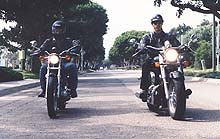
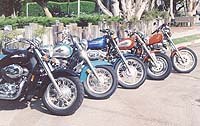
A middleweight cruiser is somewhat of an oxymoron. How to achieve that hefty cruiser feel, yet downsize the weight, displacement, and more importantly, price? To explore this enigma we gathered five of the finest little big bikes available: existing iron like Harley-Davidson's 883 Sportster, Kawasaki's Vulcan 800 Classic and Yamaha's Virago 750, along with Honda's all-new American Classic Edition 750 and Suzuki's new Marauder 800. Each one has its own answer to the middleweight dilemma.
Speaking of dilemmas, what the heck do you do to properly compare cruisers for a shootout? You can't just call up a racetrack and say, "Put us down for Tuesday, we're bringing up a bunch of cruisers to test!" They'd laugh us right off the phone. And when we called up our resident fast-guys Shawn Higbee and Chuck Graves to see if they wanted to help evaluate the assembled equipment, through barely stifled yawns they told us that they, um, oh yeah, they had to wash their dogs today. Clearly it takes a slightly more laid-back attitude toward life to truly appreciate the cruiser. So we decided to do the typical cruiser thing -- we followed the crowds. We motored up and down one of the world's most popular boulevards, the Pacific Coast Highway in Malibu, along with a mandatory jaunt up through the canyons to the Rock Store. We rode around town, down long stretches of freeway, and even took them on a several hundred mile trip. All the while looking for that perfect nothing, the transcendence from the physical, the ultimate vibe, and all that other metaphysical stuff.
So kick back, relax, and throw back a cold one. This time we'll do all the riding.
![]() |
![]() |
![]() |
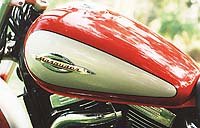
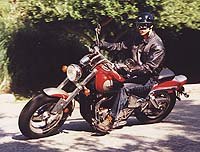
With motorcycles, as with life, things are not all that they seem. While it's true that the Marauder boasts some very cool features, its total package is in need of further refinement.
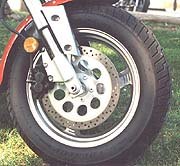
The Marauder is based loosely on Suzuki's Intruder 800, albeit with some important differences such as a switch to chain drive over the Intruder's shaft, for smoother power delivery. While switching to a chain Suzuki also made roomIf only it was any fun to ride.
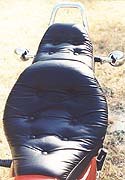
Starting with a wedge-shaped seat that begins to irritate in under five minutes and ending with the worst carburation of any bike we've recently tested, riding the Marauder is a bit of a trial. Its ergonomics are all wrong for a rider of even average size, with the drag-style bars too pulled back and the pegs not quite far enough forward. If you're tall, forget it. The flat, riserless handlebars gave poor feedback and lousy control when traveling down twisty roads. Ground clearance is a bit on the meager side too, although not as limiting as the Vulcan. Have we mentioned the seat sucks?
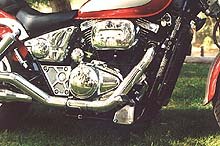
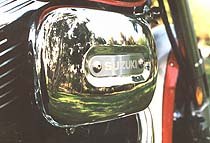
A quick twist of the throttle and you can tell this beast has nuts. Then you hit that stumble. You figure you can gas your way through it, but by the time it clears up you're already at the end of its powerband. What could be the best engine in this test is castrated by poor carburetion. Any first year engineering student could tell you that exhaust pipes of vastly different lengths are a tuner's nightmare, and such is the case with Suzuki's Marauder. Its left pipe wraps all the way over to the right to give an appearance of staggered dual pipes. Probably not helping any of this is the fact that its exhaust crossover tube is about one inch in diameter, bound to wreak all kinds of havoc with exhaust throughout.
What we're telling you is that with a little tinkering (new seat, bars, control extenders, pipes and a jet kit) this could be a nice motorcycle. However, this being the Marauder's first year in production, aftermarket support is not yet in existence, so it may be a while until you can upgrade this machine. If you've fallen in love with the Maurader's looks, try waiting around outside your Suzuki dealer for someone to trade one in -- we don't think you'll have to wait long.
Specifications
Manufacturer: Suzuki Model: 1997 VZ800V Marauder Price: $5,999 Engine: OHC, liquid cooled v-twin Bore and Stroke: 83 x 74.4mm Displacement: 805cc Carburetion: Dual Mikuni 36mm CV Transmission: 5-speed, constant mesh Wheelbase: 64.8 In. Seat Height: 27.6 in. Fuel Capacity: 3.4 gal. Claimed Dry Weight: 456 lbs.

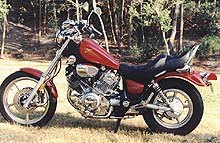
Yamaha caught on early, even before the advent of supersport bikes, that a sizeable percentage of people just want to kick back and ride. Behold the Virago 750. Functionally, it does everything a cruiser should. It's torquey, it stops well and it's mostly unobtrusive on a long ride.
During our ride up the coast the Virago got off to a good start, its torquey motor allowing gratuitous short-shifting, thus staying shy of its 5,000 rpm vibration point. Its ergos are relaxed, with the new, odd-looking flattened handlebars giving better comfort than the dreaded buckhorns. Taking a turn up the canyons, we found the Virago not to be a disappointment. Having second best ground clearance certainly helped in the fun. However, the Virago, like Suzuki's Marauder, has footpegs that are just a bit too short for comfort. On both machines the first thing to touch the ground in a tight turn is likely to be your boot. The Virago's shaft effect intruded upon the smooth roll of the terrain more than our other bikes (the rest being either chain or belt-driven), but never more than just a little. Altogether, it was solidly in the middle of the pack here, with Honda's ACE better at the slow stuff and Harley's Sportster superior during fast riding.
Out on the open road too, the Yamaha is certainly capable, but it's not a stunner. While miles ahead of the Marauder and Sportster comfort-wise, it trails the ACE and Vulcan in plushness. While it has the most raw horsepower (claimed) in this test, it vibrates. At speed, the vibration of its rigidly mounted motor becomes intrusive. The seat, while soft, is a bit too mushy, causing the rider to settle into one position and stay there. You sit low in the frame, giving you the advantage of having the tank protect you from windblast. The sloped pillion is good for passengers, but it tends to irritate the driver as passengers will tend to slide forward a bit.
Don't let the seat or any other silly tidbits get under your skin, though. After 17 years of production, and almost no with updates for the last nine, Yamaha's Virago has developed tremendous aftermarket support. With our $8000 target price in mind, its $6499 sticker leaves you with $1501 dollars to spend on the finer things. Still, despite the relatively light purchase tag, it came in as the second most pricey unit in this test.
If only it weren't so ugly.
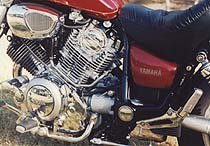
With the idea of cruisers being more about form than function, the Yamaha plummeted to fourth in our comparison, besting only the Marauder. Call us vain, call us fashion victims, whatever, but try not to point and stare while we ride the Virago 750, like so many others did. From its bulbous chrome extremities sticking out at all angles, to the squished buckhorn-style handlebars, Yamaha's Virago series is aesthetically challenged. Editor Plummer was our lone defender of the Virago 750, saying it "would have looked better in black."
While many other modern motorcycles may have been influenced by the fifties and sixties, Yamaha's Virago 750 is born, bred and remains solidly planted in the 1980s. Perhaps someday the '80s will return, values of the Virago will skyrocket, Virago knockoffs will appear from other Japanese manufacturers and Yamaha will have a hard time filling demand for this very capable bike. We're just not going to hold our breath.
Specifications:
Manufacturer: Yamaha
![]() |
![]() |
In all fairness, the Vulcan's suspension and handling manners (other than ground clearance) were second only to the Sportster. And its killer fit and finish were runner up only to the ACE. Of course, pound for pound nobody makes an engine like Kawasaki. Around town and on freeway commutes the Vulcan is entirely transparent, meaning very little thought must be redirected into riding the motorcycle. Its wide, comfortable bars give good leverage when styling around at low speeds down the boulevard, while the wide, flat seat pleasantly supported one's ever-widening posterior.
And to Kawasaki's credit, it's actually a good thing the suspension is just about spot-on from the factory, as the Vulcan's shock is deviously hard to adjust, actually requiring removal of the rear wheel.
Cruising up Pacific Coast Highway with the wind at your face, Kawasaki's Vulcan 800 is right at home. Purring its music softly on the ocean breeze, the torquey motor prods you slowly towards paradise. Take a turn onto a slightly twisty road though, and a small design flaw becomes immediately apparent -- no ground clearance. A small caution for the unwary: you will grind through the sidestand retaining spring before you get through the feelers on the pegs. This is not a case of sportbike weenines let loose on cruisers -- the Vulcan 800 drags even at a relaxed pace.
During freeway cruising, its high bars gave a bit of the "parachute effect," causing one's jacket to puff-up and catch a bunch of wind. Turning the bars down a bit may cure this if lots of highway riding is your thing.
When all was said and done, the Vulcan 800 Classic actually turned out to be a really good motorcycle. Our testers all agreed it was a rock solid mount -- comfy, torquey, fun and laid back. Our only real mechanical complaint was its lack of ground clearance. But we did all agree on one other point: lack of character. Kawasaki's Vulcan 800 Classic is a motorcycle in search of its own identity. After a year on the market there is reasonable aftermarket support; however, being priced right at our pre-set $8000 spending limit (the most expensive in this test by a whopping $1500), you won't have much spending money left after purchasing this one.
Specifications:
Manufacturer: Kawasaki Model: 1997 Vulcan 800 Classic Price: $7999 Engine: OHC, 8-valve, liquid-cooled v-twin Bore and Stroke: 88 by 66.2mm Displacement: 805cc Carburetion: Keihin CVK36 Transmission: 5-speed Wheelbase: 63 in. Seat Height: 27.8 in. Fuel Capacity: 4 gal. Claimed Dry Weight: 517 lbs.PAGE 21997 Harley-Davidson 883 Sportster
Harley-Davidson's 883 Sportster was picked for this field of more expensive equipment due to complaints received in our Frugal Flyers comparison. "You can't find an 883 at its suggested retail," complained our readers, along with "but there's a waiting list," and so on and so on.
Harley's 883 is not the most laid back. The seat is uncomfortable. It shakes like an epileptic. So how did it garner second place in this comparison? And furthermore, where is the chrome?
The 883 is not, unlike the others bikes in this shootout, a 90's version of, well, anything other than itself. It's not quite as laid back as the others, but it can be. It doesn't quite have the polish, but that
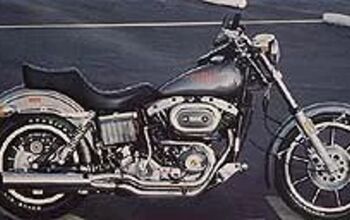
can be added. It is the most powerful, and it has the most potential. Bottom line is that the Sportster is not a complete motorcycle, it's a work in progress, waiting for your finishing touch. Versatility is the name of its game. The Sportster can be transformed into anything from a full-boat boulevard cruiser to a hot-rod canyon bullet (if you don't believe us, ask Jake Zemke, who recently beat out a field including 916s in Willow Springs' Unlimited Twins class on his de-restricted NASB Twin Sports racer). After eleven years in production, with just little improvements here and there, the Sportster has a larger aftermarket than anything without the word Softail in it.
At $5345 (ours came equipped with laced spoke wheels for $300 extra -- still leaving it $350 less than the Marauder) the Sporty leaves you with a bit of cash with which to play around. This is not to say Harley ignores this model in favor of their larger (read: more expensive) machines. Producing the little 883 is a lucrative trade, as it's the number one selling motorcycle in the USA and Harley intends to keep it that way.
The XL series Harley (one piece engine/tranny case) was born in 1958 and considered a "superbike" in its day. Made to go head to head with Triumphs and BSAs of that era, it was light, lean, and powerful. It hasn't changed much, but the definitions of these terms have.
For 1997 the slow, steady maturation of Harley's XL883 marches on. Its tank grew to match the 1200 Sporty at 3.25 gallons, taking the previous range of about 100 miles and extending it to around 160. The exhaust was also updated this year, turning the stock 883's exhaust note from its sewing machine-like burble of yesteryear to the growling beast we tested. Along the way it also picked up a couple horsepower.
This is not to say it's without flaws.
The footpegs, designed to quell the formidable engine vibration, are mushy and make you feel like your feet are falling off the pegs. The seat has you screaming for relief after a short trip, and the pillion accommodations -- well, it doesn't have any. Its tranny goes clunk, and requires a stiff push (although it never missed a shift). It lacks the flash of some of our other middleweights, but with better detail than all but the Honda, it screams: "Look at me, I'm naked!" Last, of course, is the vibration.
So you ask -- no scream -- again, "Second Place?"
To that we shout an unapologetic, "Yes!"
To back up these outrageous claims with a few facts we submit that it has the best rear brakes (actually the only one equipped with a disc) in the test. That, along with having the best ground clearance, handling, and being the most original, goes a long way. Further, the belt-drive system has a much longer service interval than a chain (80,000 miles).
All the aforementioned faults, save vibration, can be easily fixed through Harley's large aftermarket. Besides, if you can't get a Sportster for within $1000 of list, we'll give you a little insider information. Right now here's a bit of a glut in the southwest USA, so try a dealer there.
Specifications:
Manufacturer: Harley-Davidson Model: 1997 XLH Sportster 883 Price: $5,345 ($5645 for spoke wheels) Engine: V-twin OHV Evolution Bore and Stroke: 3.00 by 3.812 in. Displacement: 883cc Carburetion: Single 40mm CV Transmission: 5-speed constant mesh Wheelbase: 60.2 in. Seat Height: 28 in. Fuel Capacity: 3.3 gal. (including .5 gal. reserve) Claimed Dry Weight: 488 lbs
.
1998 Honda Shadow ACE 750
Stopped at a traffic light, a bus driver honks his really loud air horn -- nearly causing our tester to drop his bike -- and asks, "Hey, is that Honda's new Shadow?"
Yes, Honda seems to have figured out that magical combination of imitation, innovation, and guts that makes a great cruiser. One that's recognized for itself, not for what it duplicates.
![]() |
![]() |
![]() |
![]() |
![]() |
A couple of years back Honda stepped on what some considered sacred ground: they produced a single-crank-pin twin-cylinder, the Shadow American Classic Edition. This 1100cc twin finally had something the other Japanese cruisers lacked -- the feel of an American-built cruiser. It became an instant sales hit, despite some jeers from the press. In our eyes, they missed the mark a bit. The ACE still resembled a stock Milwaukee machine, not a custom cruising creation. That all changes with Honda's new Shadow American Classic Edition 750.
You look at it and try to figure out what's missing. Certainly not beauty. It flows from its rounded fenders around fat tires to its classic lines tastefully trimmed with chrome. Nothing missing here. Then you see it. It doesn't look like a Harley. Oh sure, it has the resemblance that cruisers have to one another, but from the curved fender rails to the stylized air cleaner, it has a look of its own.
Jumping on the long, low 750 first thing you'll notice is the width of its bars. You'll ask yourself, "These are stock?" Along with the banded aluminum footpegs and other custom touches, it would seem Honda has produced their first "factory custom." Harley coined the term, but they no longer have a patent on it. The equation is simple: Take the best the aftermarket has to offer and put it on a stock bike. Result? You'll sell many bikes.
Riding the ACE 750 is transcendent. The 750cc twin pulls smoothly off the bottom end and revs indecently high for a single-pin cruiser. The wide, low bars make up for the absence of a windshield, as they reduce the "parachute effect" of your jacket (the Vulcan and Sportster were especially bad at this). The firm seat was second only to the Vulcan's, but overall ergonomics were better on the ACE. Rumbling up the coast, the ACE's soft whirr of its overhead cams and the seductive exhaust note of the widely spaced power pulses will play beautiful music for you.
One cue Honda did take from Milwaukee with the ACE is ground clearance. Only the Sportster beats it in this department. It would scratch when pushed hard, but on a lazy loaf through some scenic twisties nothing so insignificant as the pavement need distract you.
Honda's ACE 750 takes top honors by satisfying all our conditions for a great little cruiser. It's a smaller, lighter version of the classic big cruiser. Unlike H-D's Sportster, that isn't a small version of anything, it is the best entry-level, full-boat cruiser available -- the only one to really succeed in this role. The fact that the Shadow is a new model is a bit of a drawback though, as there isn't an aftermarket developed for it yet. But with a machine this good, you'll have nothing but smiles while waiting.
Specifications:
Manufacturer: Honda Model: 1997 Shadow American Classic Edition 750 Price: $6299 (Deluxe $6499, Two-Tone $6899) Engine: SOHC three-valve 52 deg v-twin Bore and Stroke: 79 x 76mm Displacement: 745cc Carburetion: Two 34mm CV Transmission: Wide-ratio five speed Wheelbase: 63.6 in. Seat Height: 27.6 in. Fuel Capacity: 3.7 gal. (including .9 gal. reserve) Claimed Dry Weight: 504.9 lbs.
PAGE 3Our Conclusions
We traveled through hills, up the coast, cruised the drags, and rode across great deserts. At the end of our long and winding road we picked Honda's 1998 ACE 750 as our favorite mount. But what about our other worthy adversaries?
Suzuki's Marauder is a fairly original ride, with love-it-or-hate-it looks and a cool set of inverted forks. Low-slung, powerful, and second (or first, depending on where you live) cheapest in the test, it looked to be a strong contender for the win. However bad ergonomics and poor carburetion conspired to keep the Marauder at the bottom of the heap. With ample aftermarket support and 17 years
of development under its belt, one would think Yamaha's Virago 750 would claw its way up the stack a bit higher than fourth. Alas, humans are social animals and funny looks and jeers from our peers hurt even our most hardened magazine weenie. Before you pass judgment on us as a bunch of fashion conscious sissies consider that, not counting looks, Yamaha's Virago was not the smoothest, most comfortable, or the best handling (these being the Honda, Kawasaki, and Harley respectively). A facelift and a little refinement, and you might see this bike on top of the pile this time next year.
Hopefully Kawasaki will follow the lead of other manufacturers and develop a bike with a bit more of its own identity. Despite this glaring flaw, the Vulcan's strong engine, smooth ride, and great ergonomics catapulted this bike to third, edging the Virago by one vote. Who knows, with even just another inch of ground clearance. . . .
Harley's Sportster is as elemental as a bike gets, excepting perhaps its distant cousin the Buell Lightning. It's an engine with wheels and controls. With versatility that can make it anything from a canyon strafer to a full-boat boulevard cruiser to a seventies chopper, or just refined and kept in its original incarnation, plus its lowest sticker price, H-D's 883 Sporty almost wins this shootout. Just a bit too much character in stock form keeps it out of first.
Honda's ACE is, simply put, a complete package. Its unruffled power delivery, solid construction, smooth lines and knock-out looks won our hearts. If aftermarket support is lacking now, hold on tight, it won't be for long. At $6299 for the standard model and $6599 for the deluxe version, this bike should sell by the thousands.
Did we find that cruising nirvana, that ever-elusive nothing? Well, yes we did, but only on the ACE 750. H-D's 883 Sportster was a close second due to its potential as a platform for customization, but in stock form it lacks. The rest just didn't measure up. The best defense for our top picks were found in the squabbles we got into when it was time to head home, where the Honda and the Harley got nabbed first and everyone else got stuck with the others.
Impressions
1. Brent Plummer, Editor-in-Chief
The Harley rules 'cause you can modify it to suit your personal tastes. All the other bikes in this test combined can't match the aftermarket support for H-D's smallest machine. Further, our 883 was the only bike with a semblance of ground clearance; I actually milled the entire sidestand off the Kawasaki in an afternoon of lazy back road riding. Honda's ACE is surprisingly cool, they've modified it just like many finished Big Twins end up, but it's kinda slow and that's hard to fix because there's little aftermarket support. On everything else, I felt like a wussie -- the Kawasaki and Virago would've been okay if they'd come in "manly" colors, it seems to me that Big Twin Harleys are the only bikes that look cool in day-glow green or maroon.
2. Billy Bartels, Associate Editor
Half the fun of a cruiser is looking back after you park it and getting that knot in your throat that it's your bike back there. Walking away from the Vulcan and the Virago I just covered my face and strode quickly away. The Vulcan for its blatant cloneliness, the Virago for its rico suave 80's disco look.
I actually liked the Marauder, I just didn't like riding it. It's like the bikes of 20 (and more) years ago: It has potential, you just have to be willing to make parts to realize it. With a real set of pipes and some jetting the bike could be a rocket. Call it third.
I come from a unique position testing the 883 -- I own one. While the current model 883 is better than what I started with (a 1987 model), mine -- at 80 horsepower -- is clearly superior in its modified form. But I have to admit, neither is as good a cruiser as the stock ACE 750. While the 883 can go quite a way (with the right modifications) towards being a total cruiser and is more versatile, it would take more wrenching than I feel like doing to make it as good as the purpose-built Honda.
3. Gord Mounce, Associate Editor
To me, cruising is an emotional sensation. I dig the bikes that make me feel like riding, even if I have no particular destination in mind. These motorcycles all have lazy powerbands and mushy suspension, so you're left to choose the one that you have the most fun with.
Thus, for me, the Honda is it. It looks awesome and is really fun to ride. Second comes the Harley; it scores points for being the easiest to modify. Third is the Kawi, which has great looks, although its ground clearance is the worst of the bunch. Fourth is the Virago. Its styling is seriously dated, but it has a great ride and good performance. In the final spot is the Suzuki. Although it is cheaper than the competition (other than the Harley), its poor ride and cost-cutting details put it at the bottom of my list.