
Some of us are blessed enough to ride a big scooter or Sport Touring bike with large storage compartments. These sensible riders arrive at their destinations and can lock up their helmets, riding attire and take out a briefcase or gym bag containing their daily necessities. Maybe they even stashed some nice shoes in there, so they can change out their riding boots and look like a normal person at school, work or other activity.
And then there are the rest of us who choose a more minimal existence. We want high performance and a light feeling that a big commuting scooter can't provide, and saddlebags and a big, heavy sport-tourer cramp our style when we are lanesplitting or performing the other worthy activities that make outsiders question our transportation choices. How do we carry around our stuff?
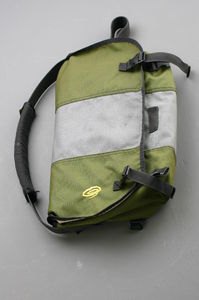
Luckily for motorcyclists, we don't have to re-invent the wheel. Over 20 years ago, there was a revolution in bicycle messenger bag design. New York City messengers had been using a bag made by the De Martini company since the 1970's, according to the history resource page at the International Federation of Bike Messenger Associations website. In 1980, an enterprising company called Manhattan Portage tried building a bag out of a newly available fabric, Cordura plus. They added some touches, like plastic quick-release buckles to replace the old-school double d-rings the De Martinis had and a one-handed buckle for the main strap so the bag would stay close to the rider's body. The hard-wearing, waterproof bags sold like blast walls in Baghdad, and within five years, many other companies were making similar bags all over the world, with regional variations and improvements. By the early 90's, companies like Roach, Chrome and Bailey Works had carved out regional niches - you could tell where a bike messenger was from just by looking at his bag. More recently, messenger bags have become the new icon of the Urban Hipster, and cheaper versions are available from Gap, Eddie Bower and other fashion-oriented retailers.
Over 20 years ago, there was a revolution in bicycle messenger bag design.
I've been using messenger bags for the last ten years or so. I like messenger bags because they don't bump into the back of your head the way backpacks do, are easier to get on and off when wearing riding gear, and hold bulky loads tighter and closer to your body so they don't shift around and affect your balance. You can also get into your bag while sitting on the bike with your helmet on by loosening up the strap and swinging the bag around to your front, where a backpack requires you to remove and unzip it, which usually means you have to remove your gloves, jacket and maybe even your helmet. I also like the tough, streetwise look the messenger bag embodies - you look like somebody who spends a lot of time riding, somebody committed enough to his riding to require specialized equipment.
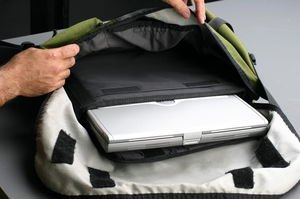
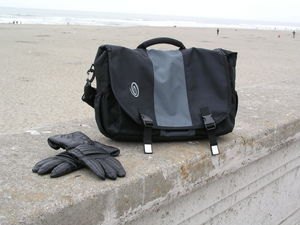
My own messenger bag is a medium-sized Timbuk2 Classic messenger bag. I've been using it for about five years and like its simple, strong design and practical features. But I had trouble carrying around a laptop in it: it's a bit too shallow to carry the laptop in a sleeve or other bag, and there's no provision for putting papers, files, CDs or the detritus that seem to accompany these new symbols of wage-slavery we must schlep from place to place.

So I called up the good folks at Timbuk2 to see if they had a messenger bag custom-designed to carry a laptop. They had me come down to the Timbuk2 factory/warehouse/headquarters in San Francisco's Mission District, where Timbuk2 has been producing and selling messenger bags since 1989. Recently, the factory moved a few blocks and outsourced about half of its production to China to save on labor costs. But unlike many companies who have done the same thing, Timbuk2 still makes some of their products (such as their custom designs) and all their repair work at the San Francisco facility.That should be enough pockets for anybody, at least those of us fortunate enough to be medicated...this bag has so many pockets I actually lost stuff in it.
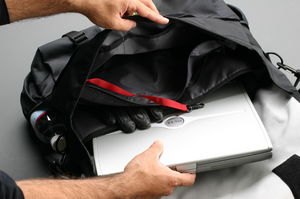
At Timbuk2, they gave me two of their messenger bags, a Commute XL messenger bag in black/grey, and a Laptop Messenger in black/red. They are very similar bags, with a few significant differences. The Commute XL (they also make the regular Commute, which is just two inches smaller lengthwise.) is more a briefcase, 18" by 11" by six inches, with a padded back wall and a detachable main strap. The Laptop Messenger is basically the standard-issue Timbuk2 medium messenger bag, but with a padded laptop compartment inside. It's a bit bigger than the XL Commute, although it's tapered towards the top, measuring 19" across at the opening and 14.5" at the base, and then 11" high and eight inches wide.
Both bags are very nice looking, well-built items. They are built out of heavy-duty Cordura and Ballistic Nylon with heavy nylon straps and hardware. The material is backed with vinyl waterproofing, and every structural seam is double-stitched. Picking them up reveals a hefty, solid feel many consumer products seem to lack these days.
The Commute has a bewildering array of pockets. On the front of the bag, there are two large side pockets flanking a small, central pouch with a zippered compartment for change or other small objects on the front and pen cubbies inside. There is a water-bottle holder on either side of the bag, and inside, in addition to the padded and corduroy-lined laptop sleeve, there is a huge zippered compartment with two big pockets inside and a long, red ribbon with a key hook on it. On the outside of this zippered pouch are more pen pockets, along with other pouches and pockets, one lined with soft corduroy material for sunglasses or cell phones. That should be enough pockets for anybody, at least those of us fortunate enough to be medicated. Perhaps you have some undiagnosed psychological problem? No sweat: this bag has so many pockets I actually lost stuff in it. Unzip the nice padded back (complete with channels to prevent sweaty-back syndrome), and you have access to a hidden compartment, complete with still more pen pockets, cell-phone pouches and yet another spot for sunglasses. It's actually an ideal size for papers or files. The wide pouches in front are good for your laptop accessories, like a mouse, power supplies or spare batteries.
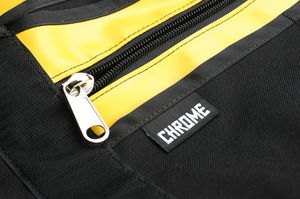
The Commute bag is very good as a briefcase or laptop bag for those of us who spend more time walking around. It looks nice and because of its briefcase-like design, can be set on end without falling over. Having the water bottle storage is nice, especially if you're using it as a carry-on bag. However, as a motorcycle or bicycle bag it has few advantages over any other shoulder bag or briefcase-with-a-strap. The bag won't conform to your body and shifts around too much as you move. The strap won't adjust small enough to hold the bag tightly to your back. Also, when the bag is full there is a gap between the flap and the bag interior, which could be a problem in the rain. This is an outstanding piece of luggage, and I adore it, but it's not 100% ideal for motorcycling.
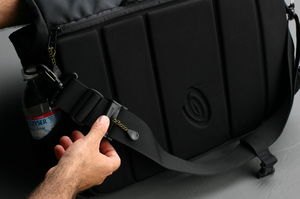
When it comes to two-wheeled use, I was much more excited and impressed by the Laptop Messenger. It's essentially the same as my six year old medium-sized Timbuk2 Messenger, but with the improved interior pockets and a laptop sleeve inside. This means it has the simple yet durable and reliable "quick-adjust" device for the 2" wide nylon strap, a paddle-like plastic cam-buckle that is incredibly easy to adjust, even if the bag is full of books and you've got your gloves and helmet on. You just pull the bag to your front, flip the adjuster lever up, pull the strap down until the bag is tight, and swing the bag around to your back. An optional (but recommended) stabilizer strap goes around your middle to keep the bag from swinging forward during stoppies or evasive maneuvers. A padded sleeve is another recommended option, which goes around the strap to prevent the kind of groove appearing on your shoulder that probably appears on both of Anna Nicole Smith's shoulders.
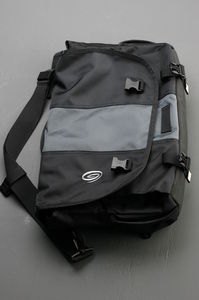
Speaking of both shoulders, the Timbuk2 messenger bags are designed to be used on either shoulder, which is good for southpaws and for those of us who have been repeatedly told by chiropractors to switch shoulders from time to time so we don't start walking like Quasimodo after 15 years of messenger bag usage. Some bags are setup so the sinister (Latin for "left-handed") among us can't use them.
Day-to-day living with a Timbuk2 bag is pretty sweet.
An empty or lightly-loaded Timbuk2 Messenger is unobtrusive, the tight feel of the straps giving a rider a secure feeling. With more than 10 pounds in it, though, I can feel the weight digging into my shoulder enough to make me uncomfortable, but it still doesn't effect my riding too much. More than 20 pounds and you definitely slow down. And for those short trips, say back from the grocery store where you have more than 30 pounds, wearing the strap loose and letting it rest on the seat behind you is recommended.
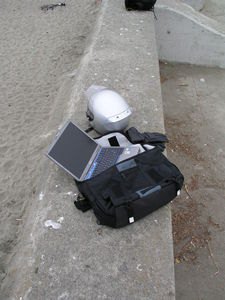
Rain stays out of a Timbuk2 bag for a while. The waterproof lining keeps your cargo dry in a light rain or drizzle, but a real drenching will soak through the liner because the stiching goes through the vinyl from the outside of the bag. It doesn't happen often, but if you ride in the rain a lot, carry a garbage bag with you. The Chinese construction seems just as solid and durable as the made-in-USA products, but it's still nice to buy American. This would keep me from spending the $90 on the Laptop Messenger or the $120 on the Commute XL.
For many years now, I've seen bicycle messenger carrying around large, stylish bags with cool airline-style buckles on the front. Closer examination of the buckles reveals the Chrome logo, so I headed over to the Chrome headquarters on Folsom Street to check them out. "When people buy Chrome, they know it's made to last a lifetime."
Chrome's marketing director Rob Reedy gave me a black and yellow "Citizen" bag. Chrome is a unique company, with a commitment to only using US labor. Their factory in Colorado makes all their bags. I asked Rob why Chrome didn't follow the parade of domestic manufacturers who have take advantage of overseas production to boost profits. "First, we've been in business for 11 years, manufacturing domestically. We're American-made, period. Second, we're able to oversee everything, compared to overseas, where you don't know what they're really doing in their factory and you're just hoping things will come out perfectly. We could save 60 or 70 percent on our labor costs, but we're not interested in that - it's just not us. When people buy Chrome, they know it's made to last a lifetime." says Rob. In fact, Chrome bags do include a lifetime warranty.
The company makes four different sizes of their messenger bags, from the 20" by 11.5" Mini Metro to the garage-sized 28" by 17" Kremlin. The Citizen bag I tested is considered "medium" by Chrome standards, but it can easily swallow both of my TimBuk2 bags and still have room for dessert.
The bag measures 22" by 11.5" by six inches and can hold over 1200 cubic inches of things. This is a very heavy-duty piece of equipment, designed for professional messengers who are very hard on their stuff. The shell is built of 1000 denier Cordura , double-stitched. Seams and hems are finished with tape and the entire bag is lined with a very thick and heavy 18 oz. waterproof "truck tarp" lining. The lining in the main compartment is "suspended" from the shell; it's a bag-within-a-bag, to keep the wet outer shell and seams from contacting the liner in the rain.
Page 2
The shoulder strap on the Chrome bag is a hell of a thing. The Chrome bags can be purchased in either right-handed or left handed versions. The strap joins the right (or left) shoulder in a thickly-padded triangle that sits very naturally and comfortably on your shoulder. The quick-release strap easily adjusts with one hand, securing the bag snugly even without a stabilizer strap, although the bag has one anyway. Once the strap is adjusted, the big metal buckle can be used to take the bag on and off with incredible ease. You just push the center button and it comes off, like the center lapbelt buckle in an old GM car. If that's not enough, the wide and nicely-padded strap also has a nice Velcro-secured panel to hold accessories like cell phone or radio holsters.
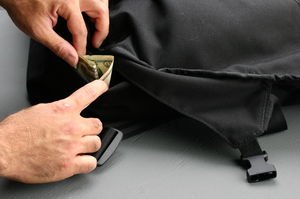
Wearing the bag is very comfortable, and it has plenty of features to keep you happy. There's a big front compartment secured by a heavy-duty zipper with a bigger pocket behind it. There's a slot for pens and other small objects in front. Under the large flap, there are extra clips and extra-long securing straps to secure a mailing tube, the better to get those blueprints across town by 5:30. Reflective threads are built into the small straps to make you more visible at night. There's even a small, secret "stash" compartment hidden in one of the seams that is very hard to find. Bicycle messengers like this feature, a lot. If you know any bicycle messengers you will know why.
I've worn this bag a lot, both around town and on some hour-plus trips, trips I usually wouldn't use a messenger bag on. It's incredibly practical and comfortable for a messenger bag. I didn't have a chance to test its waterproofing, but with the oversized, gap-free flap and heavy, separate liner, it seems like it would be pretty good, even in a heavy rain. It is a bit heavy, even when empty, and the size was a bit large for me. If I had to do it again, I probably would try a smaller bag, although having that much room is alluring. Also, the yellow vinyl liner and accent on the outside of the flap became scuffed and dirty very easily in everyday usage. But the Chrome bag is a distinctive, well-made and feature packed product that will last you approximately forever. The purchase price is a bit steep at $96 (add $15 for the laptop sleeve), but quality is expensive. And worth it.
I was eager to see how a company as commited to quality as Aerostich would do with a simple piece of gear like a messenger bag. I was not disappointed.
Next, I emailed Andy Goldfine at Aerostich, inventor and maker of the most excellent Roadcrafter one-piece riding suit. Andy sent me one of his Courier bags to check out, along with a shoulder pad ($17), stabilizing strap ($7) and an "Elastacord Spider"($18) doo-dad to go with it. I was eager to see how a company as commited to quality as Aerostich would do with a simple piece of gear like a messenger bag. I was not disappointed.

When I received the bag via FedEx, (Aerostich products are only available by mail-order), I was struck by both its simplicity and high-quality construction. Measuring 18" by 12" by 7", the Courier is similar in size and shape to the original DeMartini Messenger. But the construction seems a little more serious. For instance, the Cordura feels heavier and stiffer than what the other companies use. The seams are incredibly over-constructed, with the edges of the flap double-stitched, or "edge stitched", where the flap is turned inside-out, stitched, and then turned right-side out, much the same way the collars of men's dress shirts are made. It looks nicer than the binding strip the other bags use on their hems. It's also more labor-intensive, but it "looks nicer", according to Andy. He doesn't design them so they'll be cheap and easy to construct, but so they'll look "how I want them."
For just $87, Andy sells you a pretty remarkable bag. It's not exactly loaded with features, but if you appreciate simple, well-made things you should enjoy it. It only has a few interior pockets and no exterior ones (although a detachable interior pocket accessory will be available by Christmas), but the Velcro area is huge, there is a nice overlap between the flap and bag, and the waterproof liner is very thick. Andy based the design on the original De Martini messenger bag, except he added reflective tape, Velcro and plastic hardware. The result is classic, a purist's design that should survive just about any kind of abuse.
Andy designs the Courier to be worn a little differently than the other bags. He includes a tip s
heet on wearing the bag, and it instructs you to wear the bag loosely, resting it on the seat behind you. When I try to wear the bag tightly, like the other bags, it was a bit too long and stiff to be comfortable at first. Pete Brissette, Managing Editor, agreed. "The bag, as new, is too cumbersome... perhaps when and if it softens it may become more pliable and therefore easier to work with. As for everyday use I'd have to say it's a little bulky and large for my tastes. Something a little smaller would be more practical. Nevertheless, I like quality products that give you more than what you need or expect for your money. I'd say the Aerostich Courier bag fits that description, so ultimately I like it." After a few weeks of wear, the Aerostich bag has loosened, and I like it a lot more than I did when it was new.
For carrying a laptop, Andy also recommended using one of his laptop sleeves inside the bag. It was almost identical to the one Rob at Chrome gave me, so I used that one. Using the sleeve isn't such a huge inconvenience and leaves much more room inside the bag when you don't need to carry the laptop. Sewing some kind of Velcro retaining system inside the bag would give you the best of both worlds. With the increasing ubiquity of these "devil boxes", as Andy calls them, a neat way to carry laptops should be standard with every messenger bag. Even if you don't have a laptop, the padded slot is still handy for loose papers and files. Buy from a small, local maker and don't be afraid to be a bit extravagant; you'll have this piece of gear forever, and you might find it's your favorite.
Of the four bags I tested, I liked the Timbuk2 Laptop Messenger the best. It was the perfect size for me and felt the most comfortable and unobtrusive when riding around. It's simple but not too simple; there are enough pockets and features to keep me happy, but not so many I was losing stuff or felt it was too busy. I know the hardware will last for years, as my old Timbuk2 bag basically shows no signs of wear after many thousands of miles, other than worn Velcro¨ and some slight "pilling" around the edge of the straps. The Aerostich gets a close second place, and as Timbuk2 made me return their bag, Andy's Courier bag has become my new daily sack. I've added an accessory interior organizer pocket (available from Aerostich, $24) that has brought the bag up to 21st century standards, and I might even have the folks in Duluth "stich" the Velcro in to hold the sleeve.
Like most comparison tests, this one was designed to give you a taste of some different messenger bag products out there and tell you about some of the features and details you might need or want in a messenger bag, and how those work in the real world. If you think you want to give a messenger bag a try, do some research and browsing; find the bag that will really work for your needs, and spend a few extra bucks customizing it so it's perfect. Buy from a small, local maker and don't be afraid to be a bit extravagant; you'll have this piece of gear forever, and you might find it's your favorite.
What is Cordura ? And Who is This Denier Person?Better living through chemistry. We motorcyclists probably should embrace this mantra more than anybody. We couldn't live without that strong and useful stuff called "ballistic nylon" and Cordura , but where did it come from, anyway? And what is "denier"? I'm pretty sure that when I read "1000-denier fabric", it isn't referring to clothes worn by a conference room full of people who claim the Holocaust didn't happen.
In 1929, chemical giant DuPont's busy engineers figured out how to twist Rayon fibers into a super-strong fabric suitable for sewing thread and tire cords. Get it? "Cord-dura"? Engineers can be funny. After WWII, nylon took over as the tire cord material of choice, and Cordura was sent to the showers until 1977, when those engineers figured out how to dye the stuff different colors. Now it could be used as a tough and durable commercial fabric with abrasion resistance many times that of canvas. In just two years Cordura luggage dominated the entire luggage industry, with 40% of luggage sold being made with the fabric.
Ballistic Nylon and Cordura are actually different fabrics, although they are both used in similar applications and were both invented by DuPont. The ballistic stuff is a slightly different weave. It has slightly different properties but is still just as tough. Using such a fabric for motorcycle equipment and apparel is a no-brainer, as our stuff gets rubbed to death even if it never slides down the road. The long polymer chains of synthetic fabrics ensure a long, long life, as well as consistent weight, texture and density of the material. These factors are measured as "denier".
Denier is not how many threads the fabric contains per square inch, like I thought. That's thread count, which any man unfortunate enough to have had to trudge through the bridal registry process will know about.
No, denier is how much a single 9,000 meter-long filament of Cordura (or any other fabric) would weigh in grams. It's a useful measurement if you are comparing like fabrics, but it doesn't really tell you that much about the material. Is 500 denier Cordura half as protective as 1000 denier Cordura? No, it doesn't work that way, just as the thickness of cowhide tells you only a little bit about how much abrasion resistance that piece of leather has. In fact, Jandd Engineering claims on their website that 500-denier Cordura has 81% of the abrasion resistance that 1000-denier does. But it does give you a rough idea of how heavy and pliable an item might be.
This could possibly be the most trivial piece of information ever imparted on MO readers. Enjoy.
What's In the Bag, Dad?
A messenger bag is a serious piece of equipment for a working messenger or a rider who spends a lot of time on a motorcycle. Here's a list of features I think are must-haves on a bag:
2" or wider shoulder strap with padding and a one-handed adjuster:
A narrower strap will cut into your shoulder, even with a pad. The strap should be very solidly attached to the bag and have a strong, simple buckle that allows one-handed operation and that doesn't have any small or delicate parts. A retention strap - a smaller strap designed to circle your chest under your arm and keep the bag from sliding - is very handy, especially if you have narrower shoulders or are carrying something very bulky or heavy. The pad should be adjustable, if not completely removable, so it can be perfectly positioned for the load you're carrying, as the strap length changes with the size of your cargo.
Large, waterproof flap with Velcro and quick-release fasteners:
Waterproofing doesn't just mean vinyl: you also should make sure there is enough material on the sides to keep water from getting through gaps when the bag is overstuffed. The Velcro should be long enough to allow the flap to adjust for different loads.
Pockets: 
There should be plenty of them, and in a lot of different sizes to keep your stuff organized. Nothing sucks quite like missing a phone call because your stupid phone is ringing away in the depths of your bag while you frantically grope for it. If you have a laptop, the compartment should be lined with a soft material and be padded. Outside pockets are handy, too.
Materials:
Cordura is really great stuff. At the risk of sounding like a DuPont salesman, there are plenty of materials that look like Cordura , but they won't last like the DuPont product will. I don't know how hard you use your gear, but daily use of a cheaper bag or backpack will tear it up very quickly. The Cordura used in high-end bags will pretty much last forever, as it has many times the abrasion and wear resistance of nylon or cotton.
Country of origin:
I like a deal as much as the next guy, but to get the features, craftsmanship and high-quality materials of a decent messenger bag means it will probably be made in the USA or Canada. That's where you find the low-volume, post-industrial craftsmen who will make gear like this. Having a local company make your bag is very good, as you can easily go back to the factory for repairs or to purchase accessories. Plus, you're helping to keep jobs and money in your local economy, and it's not from drugs or hookers. Not that those are bad things.