Trail Test: 1996 Husqvarna 250 WXC/WXE - Motorcycle.com
This has to be one of the toughest bike tests we've completed in recent memory, for a handful of reasons. First problem, squeezing in a couple hundred miles of test riding between mid-Atlantic blizzards, deluges and other winter time fun proved formidable, to say the least. This dilemma was compounded by the fact that the Husky's stay in the Trail Rider stables would be short, only a month or so. Every snow-covered and/or flooded day that passed served to heighten our anxiety. Needless to say, there were fresh Kold Kutter ice screws in the tires by the time we finished. The final straw, however, no doubt proved the toughest to overcome. Soldier on as we may, this pseudo problem was in fact that riding the '96 Husky turned out to be a real eye opener, perhaps even pure joy (testosterone category),
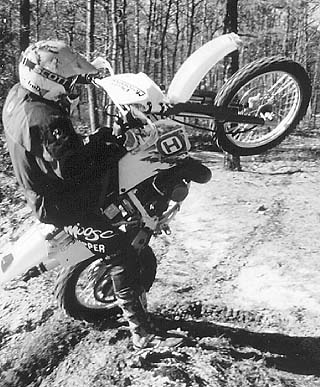
In the unique/weird/neat category, the WXE/WXC 250 is the only 250 on the market with a six speed tranny. For that matter, even the '96 360 gets the six speed--we like this. For motor updates, a reduced-weight flywheel and Mikuni TM38 carb are the major changes, while ergonomically, the bike still comes with the best kickstand tuck-in scheme in the business and has the thinnest seat of any bike on the planet (short of a no-seat trials bike). Peek-a-boo fluorescent yellow-green/white/blue plastic finds this year's fenders fluorescent yellow-green with the rest of the bike wrapped in white. Fork guards are blue. Contemporary splash graphics decals round out the package and are plenty thick and mostly tasteful, without being boring.
Powerplant All of our testing was accomplished in late January to mid February. Midwinter in the mid-Atlantic yielded 20-50 degree temperatures, frozen and melting snow; plenty of standing water with accompanying mud and slime. During the course of our engine testing we had the fortune to pick the brain of Husqvarna factory race bike builder/tuner Don Knight of Knight's Cycles, and to secure a Dyno Port pipe and silencer, to spice things up. As sort of a control, our initial setup included all stock motor parts and jetting, as the Husky comes with an air box demi-lid, double wall pipe and serviceable aluminum silencer with add-on spark arrestor. The Mikuni TM38 carby showed up at the Trail Rider garages with stock brass and settings, noted as air screw 1.5 turns out; number 6AEJ3-64 needle with the needle clip in the #2 (second from top) position, a 40 pilot, and a stock 3.5 slide. Our bike came with a 430 main jet, while the owner's manual claims that a 450 main is stock. Right off the bat, running the bike in this state of tune with premium pump gas found things kind of lean on top, yielding a slight detonation when pushed. This could possibly be corrected with a richer main jet or perhaps running race gas. Otherwise, the motor ran really clean in this configuration, with a nice tan plug insulator and no funky starting habits, bogging, or spark plug fouling.Every rider that took a turn on the Husky came away impressed by its quick reacting and sure handling manners.
Motor performance in this trim could best be described as sedate. In the stock configuration, there is absolutely no hit anywhere in the power band, as the engine is totally choked by the stock pipe. The bike had trouble pulling top (sixth) gear in mostly level straights! I know this is going to sound bad, but with the stock pipe, the power is comparable to an untuned RMX or perhaps even a KDX. You might think that all this choking and smoothness makes the bike a chore to ride--not true! Its actually a blast once you adjust, and we're told that most New Englanders (rock riders) prefer it this way, for the lack of explosion on top. Bottom line, the stock 250 motor must be ridden like a 125 to make it go, but with the right attitude, things get moving pretty swiftly. However, where's there traction and open country, some motor fiddling (a la RMX) will be required. No doubt all top riders will want more ponies, so we went a-searchin'. First we tried messing with the jetting in the stock configuration, figuring that perhaps the perceived slight leanness was slowing things down. This proved fruitless, as output got sloppy and blubbery with our richening attempts, and performance suffered. Conclusion: the jetting specs noted above were about optimum for our temperature and altitude. No free lunch here.
Next step was to try an aftermarket exhaust system. Dyno Port is the closest pipe builder to the Trail Rider offices, so Clip dropped a line to Rich Daily at Dyno Port and not soon thereafter we had the needed hardware. Our plan was to try the aftermarket pipe with the stock silencer/spark arrestor, and then the Dyno Port Cheater silencer. The most revealing impression when removing the stock pipe is that it is so heavy that it feels as if it has a solid core! We put it on the scale and it weighed in at a portly 10.5 pounds, while the stock silencer tipped the scales at four pounds even. For comparison, the Dyno Port pieces are 5.5 pounds for the pipe and two pounds for the "Cheater" silencer (pretty easy way to shed seven pounds from an already light bike, huh?). In conjunction with the pipe change, we increased main brass from 430 to 440. Performance improvements in this configuration were huge. Now the motor pulled slightly better through the bottom end and into the transition to midrange, but most noticeably, the Dyno Port pipe really improves boost in the top half of the power band. While the bottom end still chugs, and builds power at a controllable linear pace, now the top end answers the call when things open up.
We first ran the Dyno Port pipe with the stock silencer/spark arrestor with good results; it really woke the engine up, with very little change in sound output. Later, we slapped on the Dyno Port cheater silencer and were surprised to find little increase in noise output. While the stock silencer easily weighs a couple of pounds more than the Dyno Port, there was only a subtle change in performance. On the positive side, the motor lost none of its low end grunt with the aftermarket silencer, while providing perhaps a small degree of additional top end burst.
In all, the stock pipe is a heavy double wall unit, built for sound abatement first and performance second, and just plain chokes motor performance. The stock silencer is fairly light, offers good performance and is easy to service. Replacing the stock exhaust system with the Dyno Port set up has to save better than ten pounds! This turns what is already one of the lightest fully equipped enduro 250s into a virtual cheater bike, weighing in at less than 220 pounds!
A couple of motor odds and ends. Regarding starting ease, a smallish kickstarter with short stroke gets things spinning pretty easily with the tranny in neutral and really tucks in well. The kickstarter catches on the foot peg at the bottom of its stroke until it is broken in (read: a groove worn from striking the footpeg). Once this happens, everything is fine. Motor compression/sane kickstarter gear ratio keeps kicking effort within reason. Problems occur when you stall the bike out on the trail, as the clutch has a tendency to drag, making in-gear starts difficult (but not impossible). The trick is to crack the throttle open, and then give the bike a healthy boot. Even with this technique, it often took several kicks to get things started in gear. More on this later. Another potential trouble spot is the mounting of the new Mikuni carb. Problem is that the corner of the carb bowl rests on top of engine cases. This spells potential trouble over the long term. It is possible and highly recommended that the carb be repositioned within the carb/airbox boots to fix this.

More by Trail Rider Magazine














Comments
Join the conversation