
First Ride: 2000 Suzuki DR-Z400E - Motorcycle.com

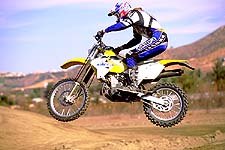
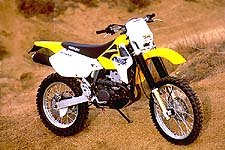
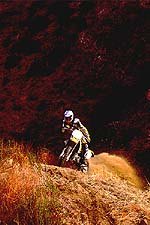
LOS ANGELES, January 25, 2000 -- Life's choices are hard. Disneyland or Disneyworld? Steak or lobster? Mercedes or Lexus? How about choosing whether to describe a ride with off-road legend Malcolm Smith or what it's like to be among the first to try Suzuki's brand-new DR-Z400E.It's almost impossible to chose, so we'll try to do both, with an emphasis on the newest thumper available from a company that hasn't done much in the way of off-road four-stroke development in 10 years. The DR-Z, you see, is completely different than the DR350 that Suzuki introduced to the world with so much fanfare for the 1990 model year.
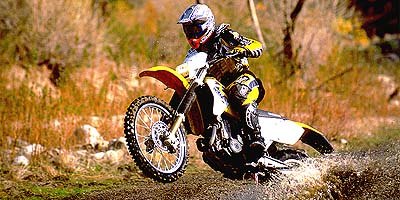
Ten years ago, of course, the DR350 was news. It was the first new Suzuki thumper designed strictly for dirt duty since 1980, at least. In addition, Suzuki also listened to U.S. customers begging for barely street-legal dual-purpose bikes and also introduced the DR350's dual-sport brother, the DR350S. While not exactly what hard-core dirt riders clamored for, it was nonetheless a decent bike for the majority of buyers and could be fairly easily modified for better off-highway performance.
At first, the dirt-riding public snapped up the DR350 with visions of winning races in mind. However, the DR simply wasn't designed for extreme duty like that, though it did fairly well at local competitions. The DR was really a trail bike and, as the years went by, people gradually accepted that fact.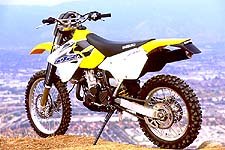
As competent a trail bike as the DR350 was, it began to get overlooked as other thumpers came onto the scene. Kawasaki introduced its excellent little KLX250R a few years later; then it grew to 300cc and was definitely in the same league. Honda's XR400R grabbed a share of the market when it was introduced in 1996.
The real wake-up call for Suzuki -- and every other manufacturer in the world -- came when Yamaha's YZ400F sprang onto the scene for 1998. Here at last was a race-worthy thumper that could hold its own against two-strokes and not cost twice as much as a Japanese 250cc MXer. Though not particularly light, it had a lot going for it. It was also fun to ride and Yamaha sold every one it could rush off the assembly line.
So, faced with Yamaha's success and the specter of increasingly stringent environmental regulations, every other company threw corporate R&D energies toward developing their own up-to-date four-strokes. Some, like the yet-to-sell Cannondale MX400, took dead aim at the YZ-F. Others, like Honda's recently introduced XR650R, targeted a different audience: In this case, customers who longed for something like the trusty XR600R but more contemporary.
For more than a year, rumors about what various companies were concocting provided plenty of fodder for those anxious to see the fruits of that labor. When it came to Suzuki, the rumors suggested a liquid-cooled 400 housed in an RM250 frame. And it turns out the rumors weren't too far off.
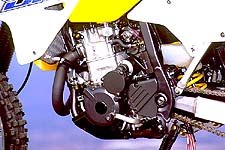
The new DR-Z400 is indeed a liquid-cooled 400 with a pair of cams in the four-valve head and a very oversquare bore-and-stroke configuration of 90.0 x 62.6mm for 398cc of actual displacement. Knowing it needed to make good power, even if it were only to be a serious trail bike, Suzuki relied on its sportbike technology, transferring much of it to the DR-Z. The Twin Swirl Combustion Chamber (TSCC) design is straight out of a four-cylinder GSX-R, as is the shim-under-bucket valve lash adjustment and narrow valve angle. Suzuki's proprietary SCEM (Suzuki Composite Electrochemical Material) plates the cylinder's bore with a nickel-silicon-phosphorus-carbide combination that is much lighter and better at transferring heat than a conventional cast-iron liner. In addition, the motor also uses a 2.0-quart dry-sump oiling system (as did the old DR350), which also helps keep the cases compact.
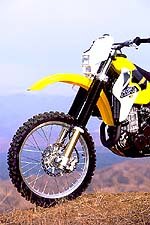
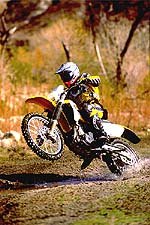
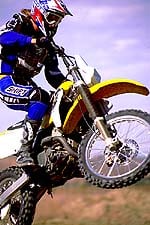
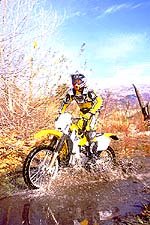
Keihin's FCR-series carburetors have earned quite a reputation among four-stroke enthusiasts, and a 39mm version comes on the DR-Z. Not only does it have an accelerator pump (which squirts a bit of raw fuel into the carb at low rpm to avoid the dreaded four-stroke stumble), it utilizes a Throttle Position Sensor similar to the YZ-F. Tied into the digital ignition system, it helps determine the optimum spark timing for a given rpm, depending on how far the slide is opened. The kickstart-only DR-Z400's Keihin also sports a hot-start button similar to that of the YZ-F that you pull to make starting a warm engine easier, especially if you stalled it.
There are a few other differences between the kickstart DR-Z400 and the dedicated electric-start version that we rode, the DR-Z400E. In order to accommodate the starter paraphernalia, the E model's crank is slightly longer on the left side, necessitating a minimally larger ignition cover. Interestingly, the 12-volt, 6.5-amp maintenance-free battery is a fairly compact, light, gel-cell unit, sort of like the kind you find in some dual-sport conversion kits.
The three-phase charging system puts out plenty of juice, with 150 watts of maximum power on the 400 and 200 watts max from the 400E. Sounds like you could run some killer lights on the new DR-Zs. And since the E model comes with only a button for starting, don't leave the key on or you'll quickly run that gel-cell battery down and find out just how difficult it is to start a 400cc thumper that has no kickstarter or manual compression release (both come on the regular 400). However, should you want the best of both worlds, Suzuki will offer a $199 kit which will let you fit a kickstarter and the manual decompresser to a 400E. On the other hand, Suzuki will not offer a kit that gives the kickstart-only model, the DR-Z400, an electric-start option.As for having an RM-spec chassis, well, it's not true. Both the DR-Z and RM use chrome-moly tubing with aluminum subframes and run the swingarm pivot through the rear of the cases, but the four-stroke's frame is specific to the DR-Z. Suzuki's design goal was to keep the bike as compact and narrow as possible. Indeed, the DR-Z feels quite slim. It sports 27.3 degrees of rake with 112mm (4.42 inches) of trail and 1475mm (58.1 inches) between the axles; not particularly extreme but directed at nimble steering with more than a semblance of stability.
The suspension is also different than a RM's. In front is a 49mm Showa conventional cartridge fork with 288mm (11.3 inches) of travel. RMs come equipped with inverted forks. In back is an aluminum-bodied, piggyback reservoir Showa shock that lets the wheel swing through a claimed 295mm (11.6 inches) of travel.
Both suspension units feature clicker-adjustable compression and rebound damping, 18 clicks of both compression and rebound in front and 26 clicks of compression and 21 clicks of rebound in back.
Naturally, the shock's 5.3 kg/mm spring has the standard threaded collars for preload adjustment. There are no such external adjusters for the 0.44 kg/mm fork springs. Both brakes utilize RM calipers, but the carriers and rotors are different.
"We applaud the quick-access, no-tools-required left side airbox cover and zerk fittings for the rear-suspension linkage."
Being an off-road bike, the Suzuki comes with an O-ring chain and 14/47 gearing. We applaud the quick-access, no-tools-required left side airbox cover and zerk fittings for the rear-suspension linkage.
Curiously, though, while a headlight, taillight and tripmeter are standard equipment, hand guards are not.
More by Mark Kariya







Comments
Join the conversation