
Trail Test: KTM 250EXC - Motorcycle.com
It's old news that the KTM 250 EXC is the best box-stock enduro racer out there. The quarter liter offering for Austria is probably KTM's most popular off-road mount, among a substantial dirt line of some dozen two stroke and half that number again four stroke models. It comes fully equipped, competitively priced, and has (arguably) the best constitution of its class. Been that way for near a decade, and 1997 is no exception.
Not ones to rest on their corporate laurels, KTM has been a continuous technological force, leading the industry with innovations like power valves, USD forks, water cooling and other technological leaps of the 80s, and more recently ('95 model year) the first dirt bike manufacturer to return to conventional slider forks.
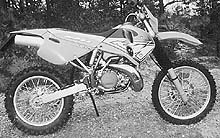
In response to the one lingering fly-in-the-ointment of recent years (ignition dependability), KTM has bid sayonara to the perennial SEM ignition for '97, replaced with a state-of-the-art Japanese Kokusan spark unit. Add to that the new mega-fork from Marzocchi, and it's easy to leap to the conclusion that KTM has another winner on its hands. A foregone conclusion, perhaps, but one that was easily proven during our extended testing. Here's what we've learned.
Getting Started
Our '97 KTM 250 EXC has been safely snuggled in the TR garages since December, and we've been trying to get a story out on it for two months running. Pre-empted by recent Kawasaki and ATK projects, in the interim we’ve continued to ride and wrench on the deuce and a half, and in the process left no bolt unturned. As usual, the bike showed up at the TR offices in a sturdily constructed, reinforced cardboard carton and as is often the case our first impressions of the steed were formed during the assembly process. This entailed mounting the fork and front wheel, installing the shock and various levers and controls, and making needed adjustments. First impressions of the fork are profound.
"The brutish new 50mm Marzocchi sliders are beefy and noticeably weighty."Prior to mounting, we did a casual check of the fork oil level and found it to be overfilled on both sides. A good dealer would pick this up, however negligence here could easily lead to the seal leakage problems reported by many users of the new Zokes. With sano fork boots installed (and proper fork oil level), we experienced nary a problem with seal leakage to date.
A new front brake hose makes mounting enduro hand guards more difficult, especially when the bars are cut some. This is because the new hose screws straight into the master cylinder (as opposed to earlier hoses with a 90º bend at the master cylinder), monopolizing space otherwise needed for hand guard mounts or tie down hooks. Our modestly cut handlebars (about 30") gave us a handlebar space headache. A switch to an older model front brake hose could solve things, but who wants to shell out bucks to replace a functional brake hose? We made do, and otherwise, everything went together fine. With that, we were ready to kick up some roost.
Motor
Inevitably, when a new bike hits the trail, there's one defining characteristic that we end up spending most our time fiddling with. Honda CRs, it's the fork. Thumpers get put on a diet. With ATKs, RMXs, and surprisingly, this years 250 EXC, it's uncorking the motor; each however in a very different manner. Right off the bat, we found the '97 KTM 250 EXC to have an uncharacteristically flat power delivery in stock trim. No doubt, the term "electric" is way overused, often being a thinly disguised way of saying "slow," although the term does admittedly come to mind.
"A lot of riders like a little more pop for roosting out of deeply bermed corners or lofting the front end over typical woods obstacles, and fortunately, it's really easy to find that with this KTM."
This bike's not slow, it's just that it doesn't have a lot of snap when you rap the throttle. Of course, what this means is that you're not spinning the back wheel wildly and spitting gravel in all directions, but instead maintaining good traction and propelling forward. Works great for some riders and some conditions. Still, a lot of riders (this author for one) like a little more pop for roosting out of deeply bermed corners or lofting the front end over typical woods obstacles, and fortunately, it's really easy to find that with this KTM. Before we launched into that quest, however, we cleaned up the carburetion some. For the record, the Keihin PWK 38 carburetor comes from the factory with a 48 pilot, 175 main, N85C needle with clip in #3 position (from the top).
Jetting was a little sloppy like this, especially down bottom, so we gave Mike Lafferty a call and he passed on his race bike jetting specs, a leaner 45 pilot and the needle raised to the #4 position (with the stock 175 main). We've had good luck with this jetting and it should be fine for just about everyone. It's been noticed though, that the bike does seem a bit sensitive to changes to temperature and fuel quality. As might be expected, the RFG pump fuel we get here in northeast corridor confounds jetting and sometimes leads to pinging at high speed while under load. A switch to race gas, 115 octane CAM2, made a tangible difference.
Another note, some bikes have been reputed to come with crud clogging the pilot, confounding low speed jetting. If you can't seem to get the low speed jetting right, drop the float bowl and give a look for obstructions. Throughout the duration of our TR testing, a single plug was fouled, and that was with the stock jetting. Since then, it's been clear sailing. With jetting straightened out, it was time to look for some bark, and a freer flowing silencer is one trick to opening up this pony.
A Dyno Port cheater silencer and a free flowing KTM MX silencer were tested and both provided tangible gains right where needed. More grunt off the bottom, more snap in the midrange. Both non-OEM silencer options increased the noise level slightly, however not as much as you might expect. Bear in mind that the stock silencer/spark arrestor is beaucoup quiet and is a tough act to follow. The noise differential is most noticeable at idle and just above. At normal riding speeds, the difference is negligible. Pipe changes were also contemplated, and in the past we've had good luck with Dyno Port torque pipes and FMF offerings. However, the nickel plated stock KTM unit makes good power and looks great. Factory KTM riders like Mike Lafferty and Scott Plessinger use the stock pipes and that's enough of an endorsement for us. Perhaps after we bash up the stocker we'll do some actual aftermarket testing and report on it accordingly.
Unfortunately, after all the re-jetting and aforementioned exhaust fiddling, we were starting to get worried. Where was the ample KTM enduro power, common on earlier models? Sure, the '97 motor is smooth, no doubt great for really slick and snotty conditions, but it just didn't have the kick needed for high traction work. A stab of the clutch when exiting a tacky bermed corner left test riders sorely disappointed. Clip suggested the ignition, so we got on the horn with KTM factory mechanic Tom Moen. It turns out the new ignition makes this the most radically different KTM motor introduced since the switch to left side drive (in 1989). The new KTM-spec Kokusan unit is used on all of the ‘97s (excepting 125s), both off-road and motocross models.
Off-road and SX ignitions differ in three ways: a different advance curve (milder on the EXC); lack of a lighting coil on the SX; and the addition of a bolted-on flywheel weight (for EXCs) on the otherwise common flywheel. Also noteworthy, there are only two different ignitions (SX vs. EXC) as all models (read: 250cc, 300cc and 360cc motors) share their respective ignitions. This is key, as Moen revealed that the designed flywheel effect for the EXC models (and perhaps the SX models as well) were for the worst case (read: 360cc motor application). As such, it's generally accepted that the weighted flywheel is kind of heavy for the 250cc power plant.
Sniffing a trail, we dug deeper. A '96 250 EXC flywheel was compared to the '97 flywheel assembly using the trusty TR bench scale. The results were startling. The '96 EXC flywheel weighed in at 655 grams, about 23 ounces. The '97 flywheel assembly (flywheel and bolted on weight) a whopping 912 grams (32.1 ounces)! Once separated (no easy feat) the bare ‘97 flywheel weighs 552 grams (19.4 oz.), while the flywheel weight itself tips the scales at 361 grams (12.7 oz.). What did all this tell us? The unweighted '97 EXC (and SX model) flywheel is less than 4 ounces lighter than the earlier SEM-equipped KTMs, while the stock EXC weighted flywheel assembly weighs almost 10 ounces more (editor's note: it's granted that weight is only one factor (a big one though) in determining flywheel effect, the other being how the weight is carried, which is affected by flywheel shape. The SEM flywheel is a greater diameter than the Kokusan flywheel, and likely develops additional flywheel effect as a result. However, this is fodder for engineering class, not a bike test and the truth is plainly evident with our test riding).
"Bottom line, the removal of the bolted-on flywheel weight really wakes up the ‘97 250, and is by far the single most important modification to turning this bike into a woods racer."

More by Trail Rider Magazine






Comments
Join the conversation