
2002 Honda VTX1800 - Motorcycle.com

Santa Barbara, California, February 28, 2000 -- Back in the seventies, motorcycles were evolving at an unprecedented rate. Motors got faster and suspension technology was making leaps ahead every year. Street bikes got bigger motors that overpowered the chassis they called home and brakes were horribly inefficient. Even on motocross bikes, twin shocks were replaced by mono-shocks that soon started working through linkages to get different ratios and increase wheel travel.
Soon, suspension travel exceeded 12 and even 13 inches, until people started to realize that maybe there is too much of a good thing, after all.Could this be deja' vu all over again with Honda's latest big-bore cruiser, the VTX 1800? In a word: No! Bigger, in this case at least, is better.
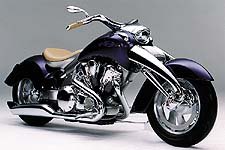
In an attempt to capitalize on the fastest-growing segment of our sport, cruisers have become a primary focus for many manufacturers, both Japanese and, of course, American. And while some choose styling over substance (read: performance) Honda has done their best to give us what they feel is a bike complete with "forward-looking" style and a motor that's unlike anything ever fitted to a cruiser before. Even the exhaust valves are larger than on a P-51 mustang!
We recently trekked to the coastal town of Santa Barbara for the press introduction of Honda's latest and greatest. In between spouts of rain, we were able to spend some saddle time on what Honda feels will be the bike that has the chests of Red Riders everywhere swelling with pride, and the bike that steals quite a few sales away from those "other" cruisers that, some say, are still stuck in the past.
Tech Briefing
Traditionally, Honda's cruiser line-up has been varied, yet comfortable and reassuring -- nothing fancy and certainly not anything risky. So what happens when Honda engineers are given a clean sheet of paper to scribble and doodle on? You get the VTX, that's what. Equipped with a rubber-mounted, 1,795 cubic centimeter, 52-degree, fuel-injected V-twin engine, the VTX is unlike any other cruiser in the Honda line-up.
"The engine features the largest connecting rods and cylinders (a whopping 4-inch diameter, in fact, just like a 400 Chevy!) ever made in a Honda facility."
The concept of the VTX started as early as 1995, although the actual design process began in 1996. Honda designers were given a clean sheet of paper to design the nastiest and gnarliest machine around. Of course, a product of that nature doesn't just pop into a person's mind. Usually, inspiration is required and in this case, it came in the form of a 1995 concept bike, the Zodia, that made its rounds throughout the world as a well-received motorcycle show spectacle. Long and low with inverted forks, dual-chromed shocks and sleek chrome-hooded headlight, the VTX designers make no bones about what bike they drew inspiration from.
The engine features the largest connecting rods and cylinders (a whopping 4-inch diameter, in fact, just like a 400 Chevy!) ever made in a Honda facility, and this includes both cars and bikes. It goes without saying that a twin-cylinder machine with such large displacement would produce a prodigious amount of vibrations. To quell the wild animal within, Hondaneers outfitted the VTX with a 41.4 pound, offset dual-pin crankshaft. A titanic first impression, for sure, but it's still got a narrow girth: By using two bolt-on balance weights, they saved 8.8 pounds and reduced crankcase width by nearly two inches versus producing a one-piece item.
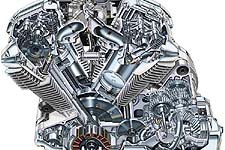
Moving to the cylinder heads, you'll notice the traditional Honda dual-plug, three-valve cylinder head design (two intake, one exhaust). The difference between this and other Hondas, though, is the immense girth of the various parts. For example, two 36mm intake valves feed the 101mm bore (that's 3.97 inches) and 112 mm stroke (4.41 inches) mill. Think thats big? How does a 45mm exhaust valve sound? Just for reference, the diameter of the fork legs on the VTX are also 45mm. But even with such gargantuan valves, Honda still incorporated simple screw-and-locknut valve adjusters to keep maintenance a do-it-yourself affair.
Air makes its way into the cavernous cylinders by way of dual 42mm throttle bodies. Fuel, pressurized to 50 psi, is injected via dual injectors featuring 12 orifices for more efficient atomization -- a first on a production vehicle. All of this is controlled by 3-D fuel-injection and ignition maps for each cylinder. Due to Honda's diligence and the use of a closed-loop emission control system, the California version of the VTX meets all CARB Tier 2 (2008) standards, losing only one horsepower in the process. Also, the 49-state version exceeds the CARB Tier 1 (2004) level.
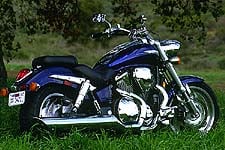
After ignition, exhaust gasses are swept out by a two-into-one exhaust that has to be the most obscene phallic symbol ever fitted to a production motorcycle. In other words, we like it. During the prototype phase, the engine would create such significant "power-pulses" that the exhaust shook a tremendous amount. This vibration was remedied, of course, as were the shakes that crept into the head-lamp and gas tank in pre-production models.
While the exhaust gasses may have a free path to escape, power is harnessed by an eight-plate clutch and five-speed gearbox. A shaft takes power to the rear wheel since the motor simply produces too much torque for any sort of belt-drive system currently available.
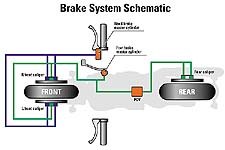
In order to slow all 705 pounds (claimed dry weight), the VTX features a unique version of their Linked Braking System. Instead of having all the brakes linked together in typical fashion, the VTX has independent front brake control, with the rear brake activating both front and rear calipers. However, the rear brake will only actuate the center of three pistons on the front caliper in conjunction with both rear brake pistons.
Activating the front brake will actuate the outer two pistons of each caliper. Honda did this since, they claim, cruiser riders tend to use their rear brake more frequently than the front binders. By using a variation of their LBS system, they are able to provide solid, balanced stopping power for those who only brake-dance with their feet, without intruding on "normal" brakers too much.
Potatoes, Potatoes
The morning started out with the sort of coastal beauty that makes you want to live in a beach town. The sun was peaking through broken clouds after a rain storm had passed, leaving the day's ride a frigid but beautiful affair. The motors on the assembled VTXs were brought to life and you'd swear there was a bit of thunder rolling in the distance once again. At idle, you can count the RPMs and feel the explosion of each stroke even as you approach the bike.
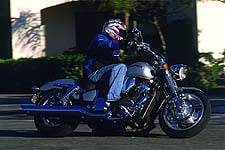
Pulling away, the first thing we noticed was why Doug Toland spent so much time on the VTX's "power-pulses" the previous night. Each and every time a piston rises and falls, you feel it. Not in your hands, but in your heart. It's the sort of muted violence that can make you smile or cringe, depending on your perspective on life. The best analogy we can come up with? Hold a mattress vertically and have Johnson throw bricks at you. That's what the VTX feels like: You feel the sharp crack, the severity of every action, and thank your favorite deity that there's something between that source and you.
Exiting the hotel parking lot, heading out onto the street, a quick braaap of the throttle revealed two things: lots of power and, not as pleasingly, we also detected a fair amount of driveline lash.
"Cracking open the throttle at even 10 miles-per-hour produces serious thrust, the likes of which have only been found on seriously modified cruisers until this point."
Cracking open the throttle at even 10 miles-per-hour produces serious thrust, the likes of which have only been found on seriously modified cruisers until this point. However, somewhere between the crankshaft and the rear wheel reside no less than four dampeners that keep power-pulses to acceptable levels. They do a good job, no doubt, as the solid-mounted handlebars transmit very little of the motor's vibes to the rider.
Still, the trade-off is that, with all of that "cush" in the driveline, there's some slack to be taken up every time you twist the throttle. At low revs, for instance, opening the throttle from fully-closed causes the engine's revs to start picking up ever so slightly before the rear wheel starts putting some of that force to the rear rubber. At that point, there is a bit of a jerk as the driveline catches up and starts producing serious forward thrust. Our advice: Be smooth, don't wack the throttle, and you'll be fine.
More by MO Staff








Comments
Join the conversation