

Ghezzi & Brian Guzzi - Motorcycle.com
Northern Lake District, Italy, 18 April 2002
Blame the endless curvy roads that slice through Italy's Northern Lake District, blame the long and cold Alpine winters.
For whatever reason, the locals seem to be afflicted with a strange pathology: creating power- assisted cycles in diverse fashions and sizes: MV Agusta, Aermacchi, Cagiva and Moto-Guzzi are just a few examples of this compulsive tendency. A contagious passion for two-wheelers seems to haunt this hilly area. Hard to think, then, of a better breeding ground for yet another soulful Italian creation. With its Moto Guzzi twin, produced just a few miles down the road in Mandello dell Lario, and its hand-built frame, the Ghezzi & Brian 1100 Sport Twin embodies the region's love for anything two wheeled.
Giuseppe Ghezzi is just another head case, a young bloke that loved touring the area on his old Moto-Guzzi LeMans. As often happens, sporty road riding jaunts eventually led to the classic, "I wonder how I'd do on a race track?" and it all went downhill from there. Luckily, Italy's Super Twin championship caters to two-valved twins like Giuseppe's Guzzi, but in a field dominated by tuned-to-the-fuel-taps 900SS Ducatis and BMW's, the old Lemon had no chance. With the help of his good friend, Bruno Saturno, aka Brian, the owner of a dental equipment factory, Giuseppe started to build a proper racing machine around the LeMans engine in `93. By `96 Giuseppe's disease was in full swing and his home-made concoction conquered the Italian Sport Twin championship, winning over hordes of 900SS Ducatis and their race-bred frames.
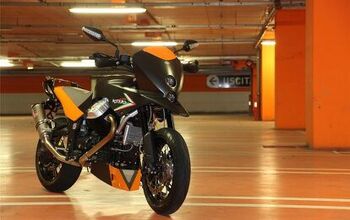
That success brought demand for the G&B's special frame, and in `99 Ghezzi & Brian showed a road-going version at the Milan Show. Moto Guzzi agreed to sell engines to their cute neighbors, and the odd couple was suddenly deep in the motorcycle industry bizzniz. The bike I saw at their little stand was quite a sight: An anorexic fuel tank/seat unit perched atop two bold Guzzi cylinders, an almost non-existent frame, and not much else. By comparison, the official 1100 Sport at the Guzzi stand looked fat and ungainly.
With its brutal minimalism, the Ghezzi & Brian harks back to the days when sport bikes were bare-bones machines without twin fat spars or plastic panels to obstruct your view of the machine's most intimate parts. And judging from the proudly displayed championship trophy, the thing also seemed to work. Exactly two years after the show, I rang the bell at the door of the small industrial estate in Perego, just south of Lecco.
Although a few dozen Sport Twins have been sold already, the "factory" remains a 1000-square-feet space shared with the dental equipment factory (interesting that Dr. John Wittner was a dentist, too). The secretary leads me to Giuseppe, who's busy building the engine for Ghezzi's US importer entry in the Daytona Twins race. The pressure is on, two amazing titanium con-rods peek out of the engine's crankcase, waiting for pistons, but nevertheless Giuseppe finds time for a pestering journo.
The Ghezzi & Brian power unit is the latest incarnation of Guzzi's 1064cc, air-cooled twin as fitted to Guzzi's own V11 Sport. It's basically the same engine that powered the 1971 750 Sport, though it has been smartly enlarged and updated over the years and now sports a full electronic engine management system--fuel injection and ignition. The engine used by Ghezzi is mated to the old 5-speed gearbox instead of the V11's new six-cog box.
The heart of the Sport twin is its tiny frame: A healthy-sized rectangular section tube is welded at the front end to the steering head, runs diagonally between the cylinders, and splits into a huge box crossmember just above the rear of the gearbox. Some will liken it to the frame developed in the US by Dr.John Wittner and later adopted by Guzzi, and they'd be damn right in doing so, but there is a big distinction between the two. Giuseppe's frame uses the main beam and the huge rear crossmember as an air box. The engine's throttle bodies are connected to the frame by rubber bellows, and an opening in the frame's main tube just below the steering head lets the air in. Big cylinders need huge air boxes to dampen their suction pulses, and the frame's huge volume provides just that. Even if you'd be going racing with open bell mouths, Ghezzi's frame still makes sense. A common but not-so-well-known problem of air-cooled racers is that they suck warm, turbulent air that's just passed through the engine's cooling fins, thus hampering performance. By sucking air from the front of the machine, the Sport Twin gets cool and fresh air even when running with the air filter installed at the frame's air intake. Cool and smart.
Giuseppe added other fine components to his frame. A floating rear bevel case cancels out most of the dreaded drive shaft's torque reaction, a progressively linked monoshock system with a Bitubo damper controls the rear end, and up front a 41mm inverted Paioli fork supports novel, inside-out twin discs . The fiberglass fuel tank/seat unit is just a cover for the real aluminum tank underneath. Limited free real estate and mass centralization concerns brought the battery to the front of the bike, just by the steering head. A small fairing covers the battery and seems to sit too low for any real protection, though it does contribute to the bike's low and lean look. The whole plot looks extremely sporty and aggressive, even worrying. Is this going to be a classic Sporty Italian torture rack in the best tradition of the good old days too?

More by Yossef Schvetz












Comments
Join the conversation