First Ride: 2002 Ducati Monster 620 i.e.

story by Motorcycle Online Staff, Photograph by Brian J. Nelson, Created Mar. 16, 2002
BACK TO THE ARTICLE PRINT
San Diego, California, February 11, 2002
We like to think of California, the southern portion in particular, as the epicenter of the two-wheeled world. The United States market is a huge target for manufacturers, and sales in California make up a significant portion of sales here.

It comes as no surprise, then, that Ducati's Monster 600 has gone relatively unnoticed here. Being the little sibling to larger bikes like the Monster 750 or even the S4 with its 996-derived motor, is not an easy job. So despite the fact that it's the best-selling Ducati in the world, with over 10,000 units having left dealer's floors already, it's hardly been seen on anybody's must-have list.

In spite of the fact that the smallest of the Monster line has been the best seller, Ducati has seen fit to introduce to the world a brand new small-displacement Monster -- this one with even more power, better handling, stronger brakes and fuel-injection. Ducati hopes the American market takes notice of its new baby, too. And by sticking to a smaller version of the same formula that gave us the S4, they think we won't mind robbing the cradle this time.
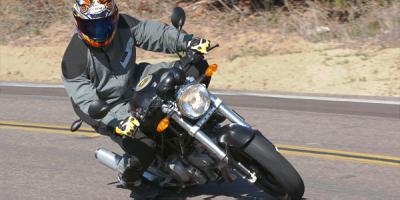
Changing the Monster

Starting with the obvious, the 620's motor now displaces nearly the amount of cubic centimeters its name would suggest, falling just two shy at 618 cc. The motor has grown from 583 cc to its current displacement thanks to a three-millimeter increase in each cylinder's stroke (now 61.5 mm) while the bore has remained the same at 80 mm. In addition to the increase in displacement, the motor now sports larger valves that work through the familiar Desmo valve train.
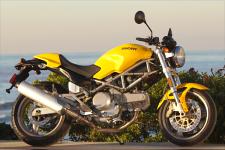
At a glance, you'd be hard-pressed to spot the difference between the Monster 620 i.e. and one of its larger displacement brothers. The new motor sits between the Trellis frame's rails in classic Ducati style.

To match the larger motor's needs and up the number of horses that live at the top end of the rev range, the cams now feature more aggressive lift and duration. This all adds up to a claimed 60 horses at 9,500 rpm and 53.3 foot-pounds of torque at 6,750 rpm. This is a solid improvement over the old motor's figures of 51 horsepower and 50 foot-pounds. And, in addition to the increase in outright power figures, the new motor now revs 1,500 rpm higher than its predecessor, with a rev limit set at 9,500 rpm.

Getting air into the motor is the job of a new, larger airbox that feeds into 45 mm throttle bodies where the incoming air mixes with fuel, thanks to a Magneti Marelli fuel-injection system. Once through the motor, spent gases exit through a new exhaust system that features a catalytic converter just upstream of the familiar dual mufflers. The new system is supposed to provide cleaner emissions and around-town drivability as well as enough flow so as not to kill any hard work that's been done inside the motor.

Wrapped around the new motor is the familiar Trellis-style frame Ducati has used for what seems like forever. The S4-derived frame is very similar to the unit it replaces, except for a three millimeter increase in the diameter of the tubing. At the front of the frame is a new cast steering head that sets the rake out at 24 degrees. The steering spindle's diameter has been increased from 25 to 40 mm and the torsional rigidity of the whole chassis is said to be up 30 percent.
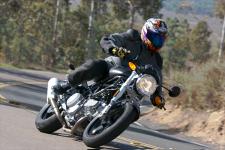
Coming out of corners, the 618 cc motor produces enough thrust to entertain experienced pilots while its docile nature allows lesser riders to feel confident.

Keeping tabs on the asphalt below you is a new set of 43 mm inverted forks that allow 130 mm of wheel travel and feature new damping characteristics to better match the 620's sporting character. Out back resides a similarly inclined Sachs shock absorber that allows 148 millimeters of travel at the wheel. The fork features no external adjusters, though the rear shock provides provisions for tweaking pre-load and rebound damping.

Riding the mini-MonsterThe problem with taking a theory that worked at its intended full-strength application and applying it to a smaller situation is that, frequently, you often lose more than you intended. Thankfully for Ducati, and us, that's simply not the case here.

Leaving the seaside town of La Jolla, headed up into the mountains of San Diego county, it was obvious that we were still riding something that's every bit a Ducati Monster, Never mind the "620 i.e." lettering adorning the bike, it didn't feel at all like we expected.

Pulling in the clutch, precisely clunking into the first of five well-spaced cogs, we were greeted with a pull that was no lighter than what we can recall of any of the larger Monsters we've recently sampled. Thankfully, engagement of the clutch is the only part about the bike that may be considered difficult by some. Once under way, however, we found ourselves pleased with the adequate power on tap and the clean way it pulled across the rev range.
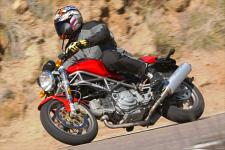
On the brakes, we were surprised to find the dual discs mounted on the 620 Standard's binder to be only slightly stronger than the single disc mounted to the 620 Dark.

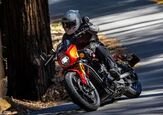
With its wide bars and non-threatening power, the herd of 30 Monsters wound out of town and onto some interesting bits of twisty two-lane. Under way, each of us was needlessly chucking the little bikes about beneath us. There was no reason for the aggressive side-to-side antics, other than the simple fact that the bike felt planted and light beneath us -- so why not?

Climbing up through the mountains, our first stint was aboard the single-braked Monster dark. Even with a rather large (some would say oafish) 6'2" tall tester on board, the little bike handled the chores set before it quite well. Hauling all 195 pounds of rider up a hill, immediately out of a tricky low-rpm 180-degree turn, the motor never missed a beat. The pull out of such corners was enough to get us going, though the bike's front end never got light enough to even threaten an unwanted departure from terra firma.

Through the mid-range the 618 cc motor pulls quite well, if not better than we expected. Though we could easily and often rev the bike up to its rev-limiter if we chose to, we found the most efficient approach was to keep it singing between 4,000 and 8,000 rpm. That kept us out of the motor's basement where it's vibes were often chunky and mildly intrusive, and out of the motor's extreme upper revs.

Page 2Up top, towards the red portion of the gray-faced tachometer, the motor makes little more power than it does a few hundred rpm south. Keeping things a little less frenetic inside the motor keeps the vibes and noise down, too. About the only time we'd really run the bike up that high was through a series of corners taken at what would be gladly referred to as a spirited pace. Holding onto that gear avoided the need to make a quick upshift, followed by an even quicker downshift before the next bend.

At this accelerated pace, however, we began to uncover one of the little Monster's shortcomings. The first thing we wished for was a slightly stiffer rear end. In quick transitions or over a series of pavement undulations, the back would move about beneath us more than we usually care for. Thankfully, help is only a few turns of a threaded pre-load collar away. The non-adjustable front end, meanwhile, felt remarkably well dialed in for just about everybody who had the pleasure to ride the new Monster.

The gray background provides a neutral setting for the instrument cluster. Mileage, road speed, engine speed and the usual array of warning lights are nicely layed out before you. Before you what? Before you ride, of course...

Once accustomed to the way the 620 i.e. felt beneath us, we were confident enough to repeatedly chuck it onto the sides of its tires. The only problem with such easily attainable lean angles like this is the placement of the mufflers.

You see, there is no warning before they touch down. You throw the bike on its side, from one bend to the next, and the first thing to touch down is the leading edge of the pre-beveled muffler. On occasion, the hard-mounted muffler would lighten up the rear tire enough to get it moving out a bit. Nothing frightening, of course, and totally predictable. This shouldn't be considered a flaw, really, as much as it's attributable to the little bike's solid handling traits that inspire confidence in nearly all levels of riders.

Back through a few more bends for some photo passes, we swapped off our Monster Dark for one of the red-colored Standard versions that feature dual front discs, rubber-coated footpegs and an aluminum swingarm in place of the Dark's steel unit. Immediately, we were unimpressed by the Standard model's dual disc set-up. We had, frankly, expected more stopping power.

In addition to dual front disc brakes, the Monster 620 Standard comes with rubber-covered footpegs and an aluminum swingarm. The mufflers on both bikes, however, come pre-beveled from the Bologna factory -- which is a good thing.

The Monster Dark's binders felt nearly as strong and unflappable as the Standard model's, right up to the last few percent of lever pressure. It was only here that the dual discs seemed to offer any advantage over the single set-up. Back on the Dark version, we also noticed that the single discs lack of reciprocating mass made it a tad easier to chuck about through the same series of bends.

At the end of the day, we had a stretch of roughly 40 miles of freeway to drone home on. Though we weren't looking forward to it, we were quite impressed how good the 620 is as an all-around bike. It's no sport-tourer, of course, but its behavior was perfectly acceptable on the super-slab, its motor ticking away beneath us at a leisurely pace even at super-legal speeds.

A Mighty (little) Monster?

After a day spent flogging (and we really do mean flogging Ducati's newest Monster, we can say, without a doubt, it's a much better bike than we'd expected. It's power is plentiful, though not over-powering, with enough boost on tap to entertain even the usually power-hungry adrenaline junkies in the group. And, as you'd expect, the 620's handling and its looks are, without question, classic Ducati.

In the twisty bits, the leverage afforded by the wide bars and the feedback well-planted suspension made tossing the bike back-and-forth a breeze. The tighter the road, the more we loved the new baby Monster.

So would we own one? In a heartbeat. And with the Monster Dark coming in with a suggested retail price some $500 US dollars south of the Standard model, we'd be hard-pressed to justify the cost of the high-dollar model which, at $6,995 US dollars, isn't really all that high at all -- especially for a Ducati.

Specifications
Engine: L (90°) twin, 2 valve/cylinder Desmodromic; air cooled Displacement: 618 cc BorexStroke: 80x61.5 mm Compression Ratio: 10.7:1 Power: 60 HP @ 9500 rpm Torque: 53.3 lbs/ft @ 6750 rpm Fuel injection: Marelli electronic fi, 45 mm throttle body Exhaust: 2 aluminum mufflers with catalytic converter Emissions: Euro 2 Gearbox: 5 speed Ratios: 1st 40/16, 2nd 36/21, 3rd 32/24, 4th 29/27, 5th 28/29 Primary drive: Straight cut gears; Ratio 1.85 Final drive: Chain; Front sprocket 15; Rear sprocket 46 Clutch: Wet multiplate with hydraulic control Frame: Tubular steel trellis Wheelbase: 1440 mm - 56.7 in Rake: 24° Front suspension: 43 mm upside-down fork Front wheel travel: 130 mm/5.1 in Front brake: 2 x 320 mm discs, 4-piston caliper Front wheel: 3-spoke light alloy 3.50x17 Front tire: 120/60 ZR 17 Rear suspension: Progressive linkage with Sachs adjustable monoshock; aluminium swing-arm (on the Standard) Rear wheel travel: 148 mm/5.8 in Rear brake: 245 mm disc, 2-piston caliper Rear wheel: 3-spoke light alloy 4.50x17 Rear tire: 160/60 ZR 17 Fuel tank capacity: 15 l (including 3.5 l reserve) Weight: 177 kg/389 lbs Seat height: 795 mm/31.3 in Instruments: Electronic dashboard: Speedometer, rev counter, warning light for neutral, low oil pressure, indicators for high beam, turn signals, immobilizer, LCD clock, LCD oil temperature Warranty: 2 years unlimited mileage Colors: Red, yellow, blue, silver, black, metallic blue, metallic grey (In the US, red, yellow, black for standard, and matte black for Dark)
copyright (c) 2013 Verticalscope Inc. Story from http://www.motorcycle.com/manufacturer/ducati/first-ride-2002-ducati-monster-620-ie-14407.html