We write about Ducatis -- and you read about them -- because they represent an ideal of what the sporting Italian motorcycle should be. Of the dozens of manufacturers that sell motorcycles here, only a small number really seem to get what inspires riders when it comes to a look, sound and feel. When you see a Ducati in the flesh, it has a distinctive visual presence that makes you want to touch and ride the bike, born of many elements; the marque's history, that beautiful air-cooled V-twin, the painted steel trellis frame. How can you not want to read about it?
And how can you not want to read about one of the most beautiful motorcycles Ducati has made in recent times?
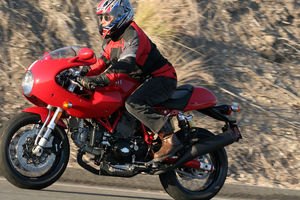
Especially intriguing among Ducati's creations are the concept bikes that appeared at the Tokyo Motor Show in 2003. Called the "Sport Classics", they were three bikes with 1970s styling and the good-as-gold DS1000 two-valve air-cooled motor. One was the gorgeous 1000LE Paul Smart replica, another was the simplistic Sport 1000, and the final version was the GT1000 roadster. The first two models had tasty-looking staggered dual exhausts that looked great but precluded carrying a passenger.
For 2006, Ducati buyers world-wide were allowed to buy these three bikes. The production versions were remarkably similar to the show bikes, and they sold very well indeed: according to European Correspondent Yossef Schvetz's test of the GT1000 last year, something like 30 percent of Ducati's sales worldwide are of the Sport Classics line. For 2007 the bikes return with just a few changes.
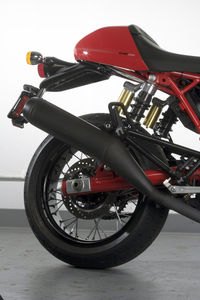
The biggest change is that all three of these bikes are now equipped to carry a passenger. So Ducati ditched the shotgun exhaust and single shock, giving both Sport 1000 models the symmetrical swingarm and dual shocks of the GT1000. Surprisingly, it hasn't detracted too much from their classy good looks, and now you can bring a passenger along for the ride.
For those of you who don't obsessively read every word written about Ducatis, here's some quick low-down on the Sport 1000S. The heart of this bike is that DS1000 motor, which first appeared in 2003, a descendent of the first Pantah belt-driven cam motors that replaced Ducati's first generation bevel-drive cam motors. It works its magic by dint of almost every part from the old 900 motor getting a redesign, as well as being bigger and receiving an extra sparkplug. For 2007, other models in the Ducati line get an 1100cc version of this engine, but for some reason the Monster and Sport Classics only get the 1000. Maybe there's a whole warehouse full of the 1000cc pistons. Who knows? What we do know is this motor makes 81.07hp on our Dynojetto di Motociclo.com, with 61.67 foot-pounds of torque, and can rev to almost 9,000 rpm.
It does this with the aid of Marelli electronic fuel injection and 45mm throttle bodies, and gets the power to the back tire via a six-speed gearbox and wet -- wet, I tells ya! -- clutch with hydraulic actuation. No more people asking if there's something wrong with your clutch at idle when they hear that dry-clutch clatter. Valve actuation is that loveably-complicated but oh-so-precise Desmodromic system that eschews springs to open and shut the two valves per cylinder. This year Ducati revised their service manuals and only call for valve clearance adjustments every 7,500 miles, which means starting in 2009, Ducati mechanics' trucks, boats and stripper gratuities will be approximately 20 percent smaller.
| Living with a Duck |
|
Ducati has been trying to get service costs under control for many of their models for some time now, and 2007 marks a major milestone in their cost-cutting campaign. The service schedule is now greatly simplified; the owner need only visit his shop for ritual demoney-fying every 7,500 miles after the initial 600-mile service. Gasp! This means that your Grandpa's advice to change engine oil every 2,000 miles is being ignored. Instead, Ducati recommends using full-synthetic Shell Advance Ultra 4, and it makes sense; synthetic oil's main advantage over rock oil is that it resists breakdown for a much longer time, so why not double the oil-change intervals? And fuel injection can adjust itself enough so that it doesn't require attention as frequently, so why not just check your chain and tire pressures yourself and ride, ride, ride?
But if you want to just have The Man do your service for you, relax. According to Ducati's suggested service pricing, all the services to (but not including the 30k service) the 30,000-mile mark should run a mere $1,833, not including sales tax on parts, figuring a $75 per hour labor rate. This includes three valve adjustments and a cam belt replacement, but not tires, brake pads, or chains. Not bad; most bikes (even Japanese ones) usually cost over $2,000 in that same period to maintain at a dealer. |

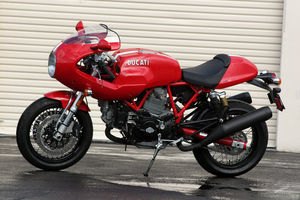
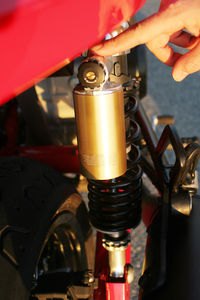
Page 2Even though the sporting '70s Ducs this model is modeled after made do with a double-cradle frame, this bike proudly displays the signature chrome-moly tube trellis frame that has won more trophies than Tiger Woods. It's an assemblage of isosceles triangles that can only be described as some kind of geometric pornography. The swingarm is constructed of big steel tubes and is bolted to a pair of fully-adjustable Sachs shock absorbers with sexy piggyback reservoirs. In front nests a 43mm Marzocchi inverted fork, which although it lacks any capacity for external adjustment, is still about 20 times better than anything available in the 1970s. Wheelbase is a tidy 56.1 inches (the same as last year's, despite the new swingarm) and the bike weighs in at 398 pounds dry (claimed).
The running gear is a similar mix of archaic and modern. The black-finished aluminum rims are mated to the hub with spokes, which means the Pirelli Phantom radials (which were developed specially for this line of bikes, complete with retro-look grooves) get tubes, but are in modern 120/70-17 front and 180/55-17 rear sizes. Front brakes use 320mm semi-floating dual discs with two-piston sliding-pin floating calipers. In back is a one-piston caliper on a 245mm semi-floating disc. If you're disappointed they aren't the four-piston, radial-mount calipers the Hypermotard and 1098 get, at least the brake lines are braided steel.
The motor and chassis looks good all by themselves, but Ducati's stylists decided to make them look even better by adding bodywork. The plastic gas tank holds 3.9 gallons of premium unleaded and is painted with a white racing stripe down the middle to match the plastic seat hump which removes to reveal a passenger seat. There's a nice, round fairing with an even rounder chrome-ringed headlight and chrome clocks. Polished aluminum and rich, painted metal is everywhere in the cockpit, from the fairing stays to the instrument bezels.
And that's why you might spend more time staring at this bike than riding it. I've always had the idea that somebody should make full-sized, non-running replicas of Ducatis out of plastic or fiberglass in China and sell them for $99 at Pep Boys so people can put them in their living rooms*. Styling-wise, this bike is a beauty, with build quality to match. But this is a ride report, so I hop on and give the starter a stab.
The motor comes to life easily, and instantly exhibits the easy throttle response and smooth power curve that make this motor a favorite of every person who experiences it. Controls have a very normal feel -- not too stiff or soft -- and the switches and levers work exactly how they should. The seat is comfortable, and the distance to the pegs from the 32.5 inch seat is nice and roomy, although very short people might want to check out a Monster. In any case, any complaints about leg room or seat height are forgotten as soon as you reach for the bars and realize they are about four inches below where you expect them.
Part of the authentic European 1970s sportbike experience is sadistic clip-on placement, and I was confused at first; I had heard the naked Sport 1000 model received higher bars for 2007, so I was hoping the same improvement was made on the 1000S. No luck! I looked under the triple clamp to discover a spacer wedged in between the bar clamp and triple clamp to keep it from being slid up that luxurious extra inch, probably to keep the switch gear from contacting the fairing. Why not carve an inch from the fairing? If Ducati doesn't, new 1000S owners will after a week. I'm buying Dremel stock.
...any complaints about leg room or seat height are forgotten as soon as you reach for the bars and realize they are about four inches below where you expect them.
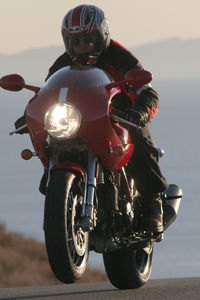
But that's enough complaining for now. The gearbox and clutch work very well, and low-rpm throttle response is just right. The bike packs enough power and torque to easily pick up the front wheel with just the throttle, so slicing through city traffic is no trouble at all. The steering is much lighter than what a vintage bike would offer, thanks to that short wheelbase, modern rolling stock and a 24 degree rake.
On the freeway, the bike becomes more comfortable. At high speeds the windblast at mid-chest props up your body and takes some weight off your wrists and lower back. It has all the stability you'd expect from a bike like this, and is nimble to boot, with all the power you need to pass anyone you want and ensure a nice space cushion around your $12,000 investment. Once in sixth gear, the vibration is a distant, pleasant thumping and you should see great fuel economy, thanks to very tall gearing. A quick downshift -- or better yet, two -- is necessary to access serious power in a hurry, though.
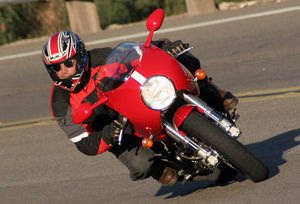
It should be no surprise that city and freeway travel is not much better than bearable. So a nice twisty road is a reward for the 1000S rider. It has to be just the right kind of twisty road, though: on very tight roads the low bars don't make things easy, but on a smooth, flowing third or fourth gear road the bike is really in its element, turning easily and holding its line in a turn perfectly. The brakes work well, much better than other two-pot systems do, thanks to those salad-bowl-diameter discs and braided lines. At a sporty pace, the bike does just what it's designed to do, flowing with the rider through the turns as fast as he dares to go, with ample ground clearance and a solid chassis. I don't think this bike would be out of place at a track day.
Pull off the road and relax under a drooping tree and listen to the cooling metal parts tick in time with the crickets. Resting on the sidestand, the Sport 1000S is beautiful to look at as it basks in the afternoon light and you recall how satisfying it was to ride. Sure, with an extra inch or so of rise on the bars it would be as comfortable as a VFR, but that would be missing the point. The 1000S is intended to replicate the classic sportbike experience, and it does it humanely, with a reliable, economical motor. But I need more comfort, and although that fairing is a gorgeous work of art, I'd go for the simpler -- and $500 cheaper -- Sport 1000. The basic Sport Classic design, with a great chassis, good suspension (with ample tuning potential) and delicious motor might add up to be the perfect motorcycle for me.
| Nits and Notes | ||
![]() |
| |