

2006 Star Stratoliner Press Introduction

By Gabe Ets-Hokin, Feature Editor , Feb. 20, 2006, Photography by Tom Riles

 
 
PAGE 2
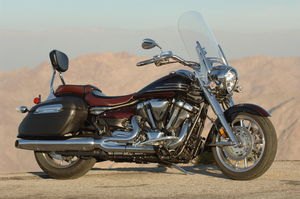
Star Motorcycle's Bob Starr (yes, that's really his name, and no, they didn't name the brand after him) started our technical briefing with the frame. The frame uses the same materials and casting techniques as Yamaha's high-performance sportbikes and consists of just eight parts welded together, a far cry from the Road Star's 64-piece jigsaw puzzle of a chassis. The bits are formed utilizing Yamaha's "controlled-fill" casting, so massive pieces like the swingarm mounts can be made with less metal, saving weight and creating a more solid structure. The entire frame weighs just 37 pounds and is very rigid, but the engineers still chose to solid-mount the engine for optimal handling. Chassis measurements like wheelbase, rake and trail are traditional cruiser, designed to provide that comfortable, stable big-cruiser feel, but the engineers also managed to get 49.6% of the weight over the front wheel-- practically sportbike territory --to further balance and improve handling.

The aluminum frame is solid enough to not use rubber-mounting for the engine.The engine is tuned to provide a "heartbeat" type engine pulse. The Star's riders are protected from induced arrhythmia by dual counter balancers, one on either side of the engine, to allow just a muted thumping from the gigantic, 100mm pistons going through their 118mm stroke. The 43mm fuel injectors are drilled with 12 holes each instead of three or four for a wider spray and better atomization.

Yamaha's sportbike engineers got into the engine department, too, sneaking in 9.5:1 compression, dual-spark cylinder heads and even an EXUP valve in the exhaust system for optimal engine response in the low-end and middle of the powerband.

All of this adds up to a motor that Star claims makes 91hp and 117ft-lbs of torque at the back wheel. We managed to coax 86hp and 110ft-lbs of torque out of our Roadliner test unit in November on the MO Dynojet Dynamometer. Mike Ulrich (no relation to John Ulrich), one of Star's development engineers, seemed to focus on the high-performance features of the motor and told me after the presentation that even though he is a former racer and loves sportbikes, he prefers riding high-performance cruisers to work. When you let the sportbike guys into the cruiser department, good things happen.

Stratoliner S: $16,580. 110 ft-lbs of torque? Priceless.When it comes to performance, brakes and suspension have not been neglected either. Fancy chrome covers hide the distinctive round bore-covers that mark the front calipers as Yamaha's excellent monoblock four-piston units. These monoblock calipers (unfortunately not radially mounted like the 2006 Road Star Warrior's) grab 298mm discs. In back, there is a single-piston caliper and a 320mm disc. A 43mm, non-adjustable, damping-rod fork suspends the 18" front wheel. Rear suspension is handled by a hidden monoshock, a lightweight aluminum swingarm and a cast 12-spoke aluminum wheel. Tubeless radial tires -- a 130/70-18 front and a 190/60-17 rear -- take advantage of the decent brake and suspension package.

My riding time on the Stratoliner was extensive for an intro-a full day of riding over all kinds of roads in Southern California's High Desert and Inland Empire. The first leg was on the Pines to Palms highway, which winds its way from Palm Springs to Temecula. It started with a nice, twisty ascent to our first photo spot. Here, the `Liner's stable chassis and torquey motor soon help me work my way to the front of the pack, trying to show up some cheap jackass who passed us on a straightaway in a red Corvette. I almost caught him, but the chicken turned around at a view area and headed back down the mountain.

[T]he `Liner's stable chassis and torquey motor soon help me work my way to the front of the pack, trying to show up some cheap jackass who passed us on a straightaway in a red Corvette.

The Strat is very stable in turns, with none of the wiggles and wallows I associate with cruisers. It does what's asked of it, with a light feel that belies its 750 pound claimed wet weight-until the floorboards skim the pavement and the pot metal floorboard sliders start scraping and sparking right under your feet. More lean angle, and the frame touches down, with the back tire letting go soon after that. I realized that no matter how sporty the engineers and marketing people say they are, cruisers are for cruising, not cornering. When getting into corners too hot, I learned to quickly brake, lean and pray

Brad and Gabe's Cruiser Riding Tips

The Memphis Belle on her 26th mission. Cruiser guys must weary of explaining to folks, "It's not a sportbike, it's a cruiser!" A cruiser is not meant to get from here to there as fast as possible; it's meant to get from here to there in the most enjoyable way possible for the rider, a passenger and maybe a saddlebag filled with Navajo blankets and Hummel figurines. Therefore, they have certain styling elements that get in the way of outright performance.

These elements include a long wheelbase, lots of rake and limited ground clearance mandated by forward foot controls and a low seat. This can get in the way of a zesty sportbike guy having a good time on a press intro, but fortunately Yamaha's Brad "B-Rad" Bannister gave us some pointers.

Brad is an experienced off-roader and trackday knee-dragger. You'd think he hates cruisers, but he actually enjoys riding them fast.

Sumitomo monoblock calipers work incredibly well. Chrome fender brace provided optimum chrome bracing performance, with little fender flex evident to the rider."You have to lean your body way off the bike, in the direction of the turn. It looks weird but you can carry more speed with less scraping."

I gave it a try, remembering that according to riding gurus Keith Code and Lee Parks, hanging off a sportbike drops the center of gravity, allowing the bike to carry more speed while using less precious lean angle. Brad's method does look weird, but seems to work well. I also tried it another way, and instead of hanging off and putting too much input into the bars, I shoved down on the inside floorboard with my foot, pushing as hard as I could. It felt like steering a flak-damaged B-17, but it seemed to work, especially on fast downhill sections.

Give either my or Brad's method a try the next time you are riding a big bike with floorboards.

View all Photos PHOTOS & VIDEOS

06 Stratoliner 8920
06 Stratoliner 8920
06 Stratoliner 8795
06 Stratoliner 8795
06 Stratoliner 9159
06 Stratoliner 9159
06 Stratoliner 7565
06 Stratoliner 7565