MSF Advanced Rider Course
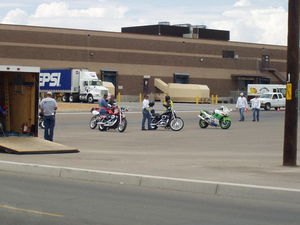
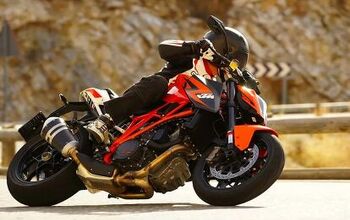
Our next trial consisted of trying to stop while turning. Here I think the MSF is making the biggest mistake of all with the course. We ran through the turns at 15-20 mph a few times to get familiar with the layout, then had to come in to the turn, initiate lean in, then stand the bike up and stop. They did not want us to brake while leaned in the least, and encouraged us to run outside the lines that marked the borders. Why you would want to teach someone to stand the bike up and run it off the road to try and stop is beyond my understanding.
Perhaps they are thinking there will be a large tree, guard rail, or SUV that you will stop against proving that the
ir way is the fastest way to stop. They also mentioned to Racer Dude and me to quit using one or two fingers to stop; "that was a four finger exercise". At that point I was thinking of doing something else with a certain finger. They added that we should not cover the brake with our fingers either, because if we panic we might grab the brake and lock the front wheel. Racer Dude and I looked at each other knowing that this was BS, but we acquiesced. I just kept doing what I was doing and I assume he did too. At least they didn't mention it again, and truthfully they were pretty cool about the whole thing. I do wish they would try to teach students to not leave the clean surface of the road and how to brake while leaned; once you leave the road you are at the mercy of the laws of physics.
The next event was basically how to apply the throttle through a changing radius turn. We had a short run up to 25mph or so including the dreaded shift to second, slowed for the turn and down shift, looked for the line we wanted, reach the apex, turn in, and applied smooth throttle to exit the turn. They had an excellent set up for this with a turn that started gradually and tightened so the "look where you want to go" thing was really reinforced. There was even some discussion about the proper line through the corner. I breathed a sigh of relief; finally something more up my alley. I occasionally ride with guys in the canyons and I'm always surprised when it appears as though they are looking about two feet in front of them and not using a line that sets them up for the next corner. Almost without fail when I lead they will ask how often I ride the road we are on, thinking I must have some special knowledge of where it's going to go next because I always seem to know and rarely use the brake.
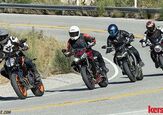
Well, let's just say that testosterone was not left at home and this quickly turned into a 30mph GP race with Racer Dude pulling away like Rossi and me trying to keep up.
Often I have been on the road before, but that has nothing to do with it; I am just looking further ahead than they are and using a line that gives me a good set up for the next corner, and maximizes corner speed (versus crawling through the corner and blasting WFO to the next one, then dropping the anchors trying to stop without crossing the yellow line of death, or worse). I try not to ride with people that cross the line, both figuratively and literally. There is nothing to prove on the street. At any rate, the exercise was very useful and they made a point of illustrating that the safest line through the corner is also often the fastest. Racer Dude was using some serious lean angle and could have easily put a knee down at 25mph. We took a break again and I asked him about the shifting thing. He said he never left first all day, and didn't intend to start because the bike was geared taller to help prevent wheelies on starts, estimating it was good for 100mph in first.
The final test was really fun; a giant figure eight with us broken into groups of three. Racer Dude, the guy with the brand new Hayabusa and I were the first up, with a stern warning not to exceed 25mph and to exercise caution at the crossing. This was supposed to put all of the elements together and give us the feeling of being on the road with other riders, with an intersection thrown in to the mix. Well, let's just say that testosterone was not left at home and this quickly turned into a 30mph GP race with Racer Dude pulling away like Rossi and me trying to keep up. His smoothness and experience was really apparent, and soon we had lapped 'Busa man, who was doing really well considering it was a relatively unfamiliar bike to him and his remaining 59 payments. We pulled in and there was some discussion of smoothness and how we were going quickly but completely in control and safe, looking ahead when crossing and slowing when needed. They also pointed out that the only time they saw brake lights on Racer Dude was at the crossing, which might have been too aggressive for the street in their opinion. I thought it rocked. Another issue they pointed out was that all of us were riding our own pace, not trying to keep up with the fast guy. (Sort of true I guess.) I really wanted to keep up with him to learn from him. Riding with a guy who is just a little faster is often a wonderful way to learn little things that make a big difference.
The last event of the day was the beer goggles and a discussion about riding and alcohol. I have seen several of my Army buddies with beer goggles do some amazing things, but these are the absolute ticket! This special pair of goggles give you the equivalent of .10 blood alcohol: talk about an instant buzz! You have to try to perform a few simple tasks such as walking a line, touching finger to nose and other roadside bits I am sure you MOrons are familiar with from prior experience. The amazing thing was some of the guys could walk and do several of the tasks pretty closely to normal. Lots of experience I guess. I offered to take the goggles to the Officer's Club to see if they could make all the toothless c
rackheads around here look good just like the beer goggles I am used to but I was denied. No one was allowed to ride with them on but I'm sure it would have resulted in injury. It is just amazing, when they review the statistics from motorcycle accidents, that quite often the rider was under the influence of alcohol. How anyone could attempt to ride while intoxicated is puzzling, unless they are hoping to die. The take home message was easily understood by all: "One is too many if you are riding."
Certainly, I already knew a lot of what was taught, but like anything else there is always more to learn and practice never makes you worse.
As we parted ways with our new MSF Experienced RiderCourse graduate cards I wondered if your precious tax dollars were well spent educating me. Certainly, I already knew a lot of what was taught, but like anything else there is always more to learn and practice never makes you worse. I know that the U.S. Army (actually, all of the Department of Defense, I think) is requiring this course with the intent of really trying to keep young soldiers from dying needlessly, and for that I am grateful. I would not hesitate to take it again on your dime so I could ride on post, but if I had to shell out my hard earned greenbacks I would pass. From a civilian perspective, if you have been riding less than a few years, or only ride a little bit per year, or are just not very sure of yourself on the road, it would be a very good investment. If you are an avid motorcyclist with lots of experience on and off road, don't waste your money. A track day would be more appropriate and you would learn way more.
In March, a soldier recently returned from a tour in Iraq, bought a "hyper bike" (whatever that is) and was killed three days later in a single vehicle accident involving excessive speed. I don't know if he had much prior motorcycling experience, but if one such tragedy could be prevented, then certainly your money is well spent.